Adding another operator may not address the growing PDF queue. Some requests need typing. Others need a customer-SKU translation, a pack-size decision, a price check, or confirmation that a revision replaces an earlier purchase order.
Sales Operations should first measure the work behind each accepted order, including requests that remain unresolved. A linked order list, handling/error/exception record, final dispositions, and named decision owners give the COO a capacity baseline, the ERP owner a view of mapping problems, and finance a basis for evaluating cost.
Count buyer orders separately from the documents they create
One purchase order may arrive as an email, attachment, forwarded copy, and revision. Counting each as new demand exaggerates volume; counting only the final ERP record hides reconciliation work.
Use a buyer-order identifier linking authorized source documents, revisions, and final disposition. Keep separate counts for messages, documents, lines, unique buyer orders, accepted ERP orders, and rejected or pending requests. Retain revision history instead of overwriting it.
Sample ordinary and peak periods, frequent and occasional buyers, and clean and difficult documents. Include requests that never reached acceptance. Successful ERP records alone cannot explain the backlog.
Record handling, errors, and open exceptions consistently
Use one record per buyer order, with linked activity entries where several people work on it. Agree on these definitions with the desk before collecting data:
Source and complexity: channel, permitted customer identifier, line count, document format, and revisions. These explain the mix behind an average.
Intake and entry effort: active minutes opening, identifying, registering, and transferring the request. Keep transcription separate if you want to evaluate extraction.
Validation effort: active time checking customer SKU, exact variant, unit of measure, pack, buyer price, and credit rules.
Rework: active correction and duplicate/revision reconciliation. Record the cause without counting the same work again as validation.
Errors found: incorrect lines after initial entry, corrected or unresolved, with type/severity and discovery stage—before posting, after posting, or after shipment/invoice. Track correction status separately.
Inspection coverage: total lines reviewed and orders affected, by channel and complexity. Error counts without the amount inspected cannot support a fair comparison.
Waiting: elapsed time awaiting a buyer, commercial owner, or ERP decision, with reason and owner.
Outcome and open exceptions: accepted, rejected, or pending; final reference where available; unresolved reason, next action, accountable owner, and age.
Count each incorrect line once in the headline total, retaining multiple error types separately if needed. Missing information is not an error unless someone entered a wrong value. Record downstream consequences and correction time without guessing their financial cost.
Use the definitions above as the fields of a baseline record, one row per buyer order, and check it against the fictional effort example below. Use minimized, authorized records; this does not require unrestricted mailbox access or an unapproved document-processing provider.
Separate handling effort from elapsed time
A request may need short bursts of work separated by a long wait for pack clarification. Log work intervals and the receipt-to-acceptance interval separately. Faster transcription may reduce handling while leaving the wait unchanged.
Compare active minutes by work class, not just order count. A large group of clean repeats may consume less effort than a smaller exception-heavy group. If several classes have similar totals, investigate them rather than forcing one dominant cause. A rare severe error may deserve priority over a larger time saving.
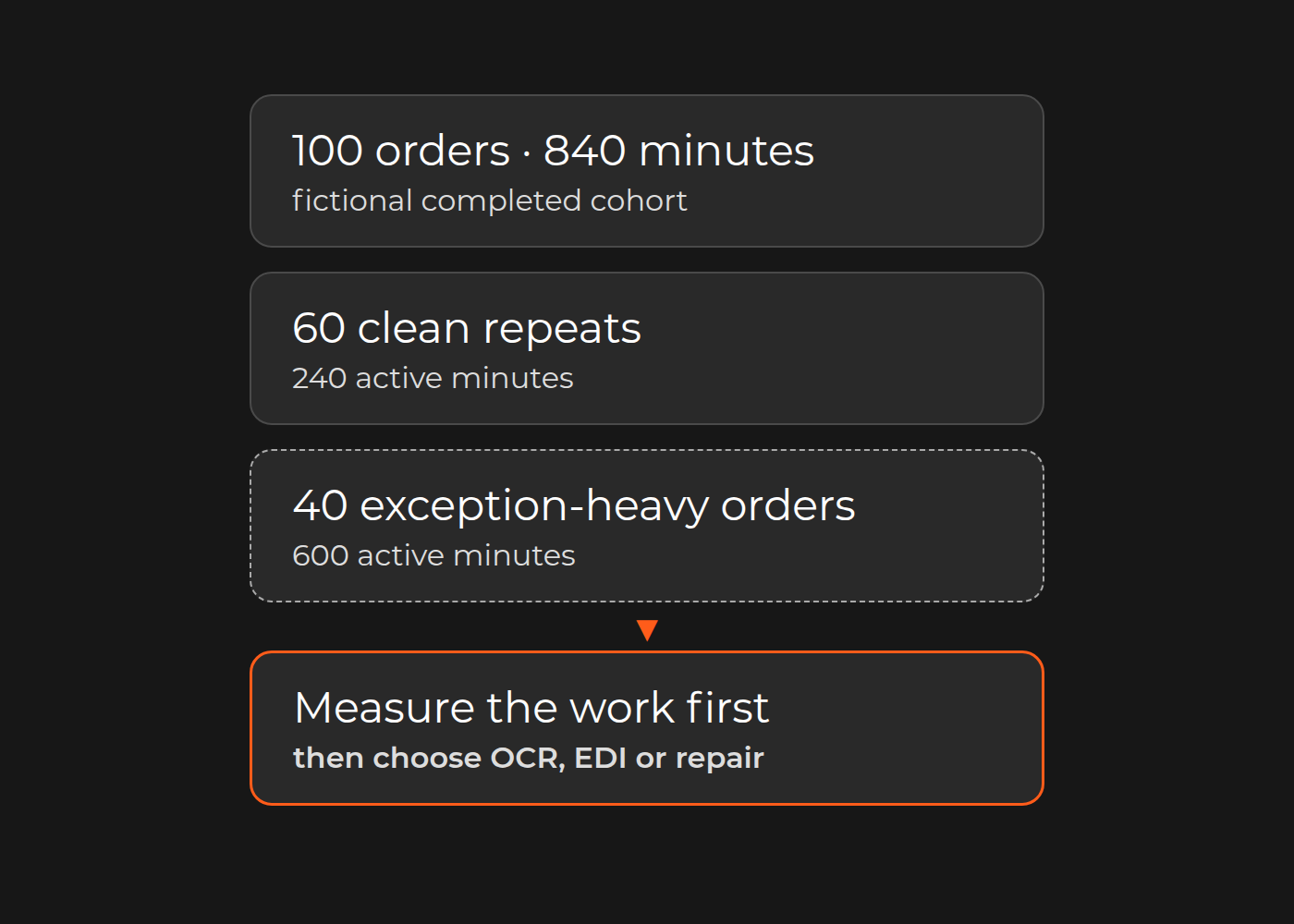
In this fictional completed cohort, all 100 buyer orders eventually reach acceptance:
Order class
Orders
Active minutes per order
Clean repeats
60
4
Alias/pack clarification
25
12
Revision or commercial exception
15
20
The active effort is 240 + 300 + 300 = 840 minutes, or 8.4 minutes per accepted order. Forty exception-heavy orders account for 600 minutes; the sixty clean repeats account for 240. These are illustrative inputs, not a benchmark or Dinarys result. A real baseline must also report pending and rejected work so it cannot disappear from the economics.
Suppose transcription accounts for 180 of those 840 minutes. Even eliminating all of it would leave 660 minutes of other handling, before adding the new route’s review and administration. That ceiling is a way to challenge a benefit assumption, not a forecast of achievable savings.
A readable line is not necessarily a valid order
Consider the fictional PDF line “boxes, item B17, blue.” Extraction may read every word correctly while leaving the order incomplete. Does B17 map to an approved internal SKU and exact variant? How many units are in a box? Which revision, buyer price, and credit decision apply?
Extraction proposes fields; approved master data, ERP rules, and authorized people establish their business meaning. An unresolved pack definition is an exception. Silently choosing the wrong pack is an error. Moving requests faster is not success if it creates the wrong orders.
This is also where integration experience becomes relevant. Dinarys’ SanMar case describes connecting B2B/B2C commerce to an existing ERP and building a custom API connector to translate its legacy data format for Magento. The concrete component is system-to-system data conversion and exchange—not completed AI PDF-order extraction or a ready-made connector for your ERP.
If the documents are readable but authoritative mappings or system exchange are the bottleneck, ERP integration services are a nearer service route than an OCR-only project.
Let the measured work suggest the intervention
Treat these as hypotheses to test, not automatic selection rules:
Clean repeat entry dominates: inspect existing ERP intake, structured templates, EDI, or buyer-portal adoption first.
Customer aliases and packs dominate: repair mappings with an accountable master-data owner.
Document variability drives entry and correction: compare extraction options on the same permitted sample, including review time and incorrect lines.
Revisions, price discrepancies, or credit holds drive delay: improve version control, commercial ownership, and escalation.
Volume is low or exceptions are infrequent: a documented manual route may be sufficient.
Compare structured and unstructured intake only on comparable order mixes. A raw difference does not prove document format caused the errors. If buyers avoid an existing portal, examine that buyer journey separately from the desk’s processing effort.
Bring the baseline to the people who can act on it
Sales Operations owns handling definitions; the ERP owner validates mappings and rules; the COO sponsors the process decision; finance approves how effort and cost are evaluated. Review large work classes, severe errors, and aging exceptions together before choosing OCR, EDI, a portal, or process repair.
Before evaluating a partner, agree on acceptance tests for mappings, revisions, and duplicate handling.
Talk to Dinarys about the order-desk gap with the sanitized baseline, examples linking requests and revisions to final dispositions, SKU/pack rules, ERP/version, and named commercial and technical owners. If document extraction remains material, the next useful step is a read-only comparison on that evidence—not production writes or an assumed headcount saving.
You may share this article
Let professionals meet your challenge
Our certified specialists will find the most optimal solution for your business.