Content
E-Commerce
Nov 10, 2026
AI Quote Automation for B2B: From RFQ to an Approved Offer
Time to read: 6 minutes

Automatic quotes are worth having when the finished offer is correct enough for an authorized person to approve. A model that reads a PDF quickly but confuses pieces with packs, selects an unapproved alternative, or invents a discount has not solved RFQ-to-quote.
For technical distributors and manufacturers, compare a combination: existing CPQ or RFQ software for structured commercial work, rules for constraints, and assisted extraction where incoming documents resist standard forms. Custom integration fills a demonstrated gap rather than replacing a working pricing engine by default.
Test each route on control RFQs with expert-validated answers. First require correct, approvable drafts and visible exceptions; then compare corrections, review time, operating cost, and maintenance. One easy request or the fewest edits does not establish the best route.
Follow one control RFQ through five boundaries
Use a business-approved fixture before a vendor demonstration. This example is fictional and simplified, not a real quote, client result, or supplier price.
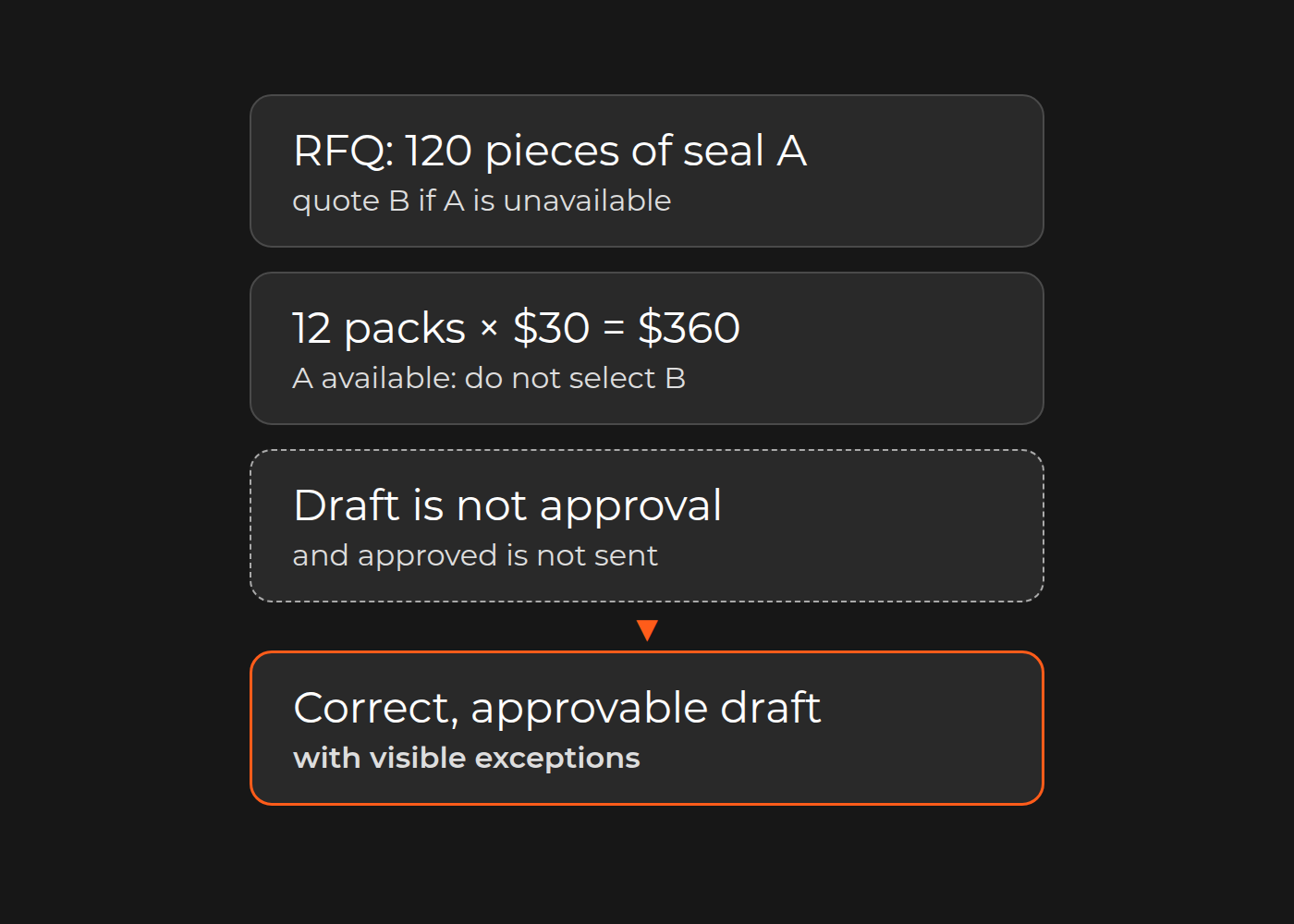
120 pieces of seal A; quote alternative B if A is unavailable.
Assume A is sold in sealed packs of 10 pieces, its authorized test price is $30 per pack, and A is available. Taxes, freight, currency conversion, and additional fees are excluded.
1. Extract the request. Show 120 and “pieces” with their source reference. Preserve part references, attachments, and drawing revisions. An unreadable field stays unknown rather than becoming a fluent guess.
2. Match the product. Resolve customer aliases to the validated catalog item. Because A is available, do not select B. Exact identity, engineering compatibility, and substitution permission are separate checks: commercial approval cannot make an alternative technically suitable.
3. Calculate using authoritative terms. Twelve packs × 10 pieces = 120 pieces; 12 packs × $30/pack = $360. Retrieve the approved pricing/CPQ source and enforce customer terms, MOQ, currency, validity, and margin constraints. The language model must not generate authoritative prices.
4. Review and approve the version. Save the source-linked draft in the agreed CRM/ERP quoting boundary. Show unresolved lines, calculation sources, and decision history to technical and commercial reviewers. Record the approved quote version and approver. A changed quantity, substitution, or expired price must return through the applicable review rule; a confidence score is not approval.
5. Authorize transmission separately. Approved is not sent. Sending follows the company’s process and permissions, with the destination and transmitted version recorded. A draft or approval badge must not itself trigger customer communication.
Change one field at a time
Mutations make the control set useful beyond correct multiplication:
- Remove the unit: flag ambiguity instead of assuming pieces.
- Request 125 pieces: sealed-pack rounding changes the supplied quantity; require the approved policy and review rather than silently rounding.
- Put 120 pieces in the table and 100 in the email: show both sources and the conflict.
- Remove availability: do not infer a delivery commitment.
- Replace A with an obsolete SKU: require a validated mapping or an exception.
Record expected behavior and actual output for every mutation, including whether the reviewer can resolve it. These are tests of decision behavior, not an executed acceptance report.
Which tool should own which part?
The options overlap. Evaluate them against the same customer, product family, price authority, approval policy, and exceptions.
Structured form or price template: the smallest route for known SKUs and straightforward repeat orders. It loses when customers will not use it or variable attachments carry essential requirements. Check adoption and exceptions before assuming intake is solved.
Existing CPQ/RFQ product: strongest where configuration, agreements, pricing, and approvals dominate. Check installed features, product rules, ERP interfaces, licensing, and implementation ownership. It does not solve unstructured intake merely by being called CPQ.
Rules and catalog cleanup: appropriate for aliases, units, packs, minimum quantities, and routing that can be governed explicitly. It loses when source information is missing or genuine engineering judgment cannot be reduced to validated rules. Define who maintains mappings and what happens when no rule applies.
AI-assisted extraction: appropriate when email, spreadsheet, and document formats vary materially. Require source-linked fields, explicit unknowns, and representative document tests. It loses if review/rework outweighs saved reading time or it cannot reliably expose critical ambiguity. Extraction is not pricing authority.
Scoped integration: appropriate when otherwise useful tools cannot connect inputs, decisions, review, and the CRM/ERP record. It loses if custom code recreates maintained product functions without a justified gap. Include permissions, monitoring, recovery, and maintenance in the comparison.
For a concrete native workflow, Adobe Commerce documents negotiable quotes, including seller drafts and review subject to B2B prerequisites. That is not evidence of drawing interpretation or compatibility checking, or confirmation that your installation includes it.
Compare complete workflows, not extraction scores
Build reference answers with sales engineering and pricing using permitted historical RFQs and final quotes. Historical quotes can contain errors; experts validate them before they become test answers. Keep a later-period holdout unavailable to prompt or configuration tuning. Use catalog, price, and term versions appropriate to the request date rather than benefiting from future knowledge.
Compare the current process, rules/CPQ, and assisted candidate on the same scope. Measure complete and unresolved lines, critical unit/SKU mistakes, human review, rework, and elapsed time to an approved draft. Report exclusions and unprocessed requests. An extraction accuracy percentage does not establish safe substitutions, acceptable margin, or sales uplift.
Start in a sandbox or shadow review with customer sending disabled. The commercial director owns the process; sales engineering owns technical correctness; pricing owns terms; IT/ERP accepts integration and access. A CEO/CFO or authorized P&L owner approves investment. Broader rollout follows a bounded pilot on one desk and product family.
Turn the evidence into a fit-gap decision
A usable decision record contains the requirement, evidence from each route, and the remaining owner/action. For example:
| Requirement | Evidence to inspect | If unresolved |
|---|---|---|
| 120 pieces → 12 packs | Source unit, mapping, calculation | Block line for review |
| Authorized price | Pricing version and unit basis | Route to pricing owner |
| Substitute allowed | Technical and commercial approvals | Do not substitute |
| Approved CRM/ERP offer | Quote version, approver, saved record | Keep draft; do not send |
Ask the current provider to run this set before commissioning custom work. Prefer a maintained product/rules route when it covers the process with acceptable operating cost.
The SanMar ERP case describes Dinarys’ legacy-format API connector for Magento B2B/B2C data exchange. The BigCommerce case, for an unnamed office supplies product wholesaler, describes field normalization, AI-assisted categorization, and custom request-to-quote functionality. These are relevant integration/catalog components, not a demonstrated complete AI RFQ/CPQ deployment or validated engineering substitution engine.
For a demonstrated connection gap, review Dinarys’ ERP integration services. To discuss the fit-gap with Dinarys, bring permitted control RFQs, expert-approved answers, alias/pack rules, pricing authority, approval map, and current-system constraints. Then use the RFQ integration partner-selection guide to test delivery competence and handover—not merely the quality of a generated quote preview.


Let professionals meet your challenge
Our certified specialists will find the most optimal solution for your business.