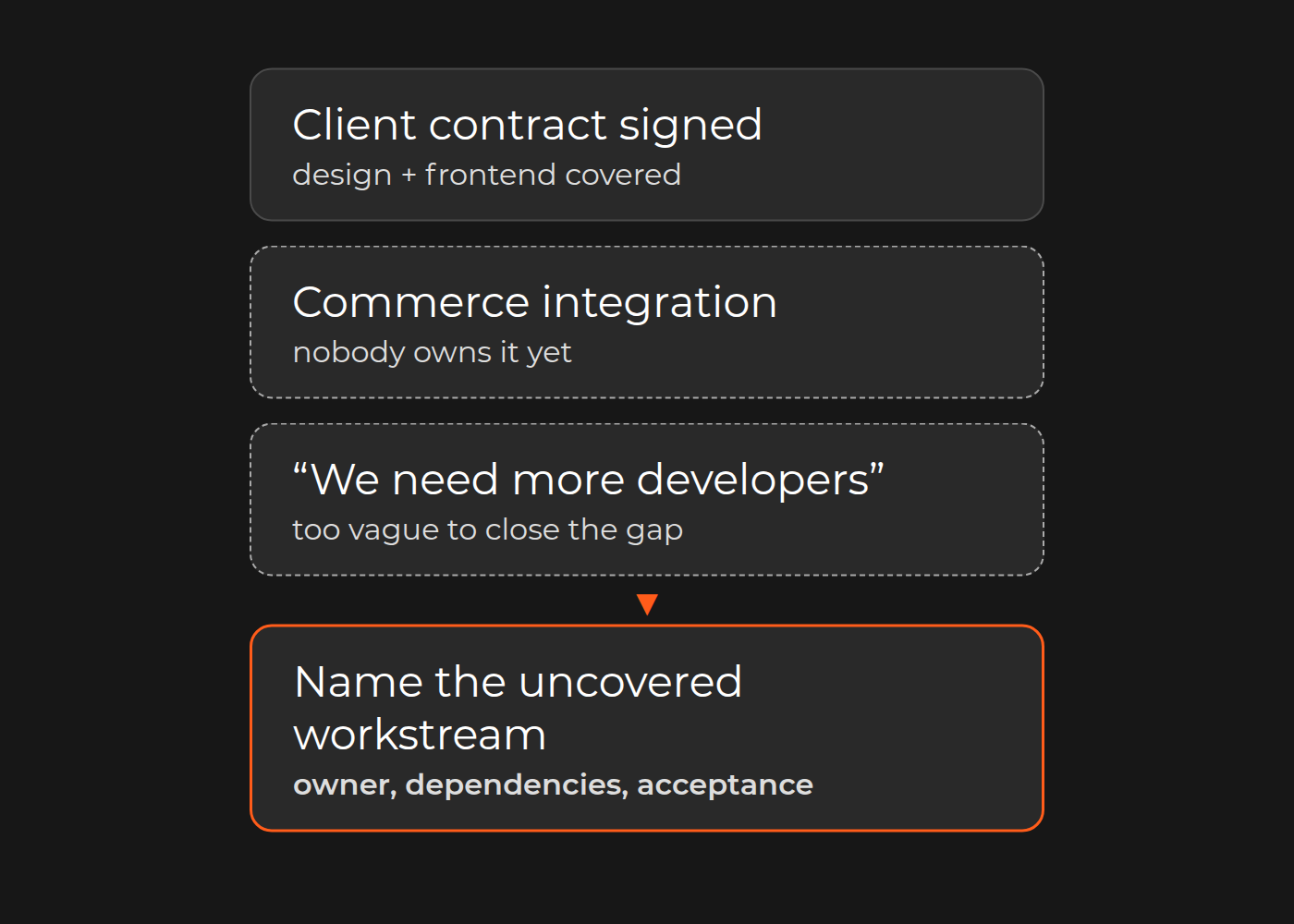
The client contract is signed. Your design and frontend team can deliver its part, but nobody owns the commerce integration on which acceptance depends. “We need more developers” is too vague to resolve that gap.
First name the uncovered work, its dependencies, and the authority needed to complete it. Then decide whether you need supervised execution, a technical workstream owner, or a change to the client commitment. A capacity gap, a capability gap, and a client-controlled dependency can exist in the same project; hiring for one does not close the others.
Find the constraint before asking for people
A dependency gap means someone outside the implementation team controls the next decision: API access, a data contract, permission to subcontract, or acceptance. Name that owner and escalate through the agency’s agreed client communication route. More engineers cannot authorize access for themselves.
A capacity gap means your team knows how to do the work but lacks room. An embedded engineer may help if the agency can supply technical direction, code review, and release coordination. Include the reviewer’s time in the plan. If the tech lead has no time to review another engineer, implementation hours alone will not remove the bottleneck.
A capability gap means the project needs decisions your team cannot make or verify—for example, designing an unfamiliar backend/API flow. Ask about a bounded workstream with technical leadership and QA ownership, not development hours alone. Identify the interfaces, exception paths, and evidence required for acceptance.
The delivery lead should map the gap, the tech lead should confirm what can actually be reviewed internally, and the agency owner should approve the commercial response. The account owner remains responsible for changes to the client commitment. None of these decisions should disappear into a request for CVs.
Recheck the client milestone against the real dependency chain
Work backward from the milestone through client acceptance, defect-fix allowance, engineering and tests, and access/environment lead time. Use actual estimates; this is a planning method, not a universal scheduling rule. Consider parallel work only where its inputs are genuinely independent.
In a fictional planning example, the team has 15 working days before the milestone. It estimates three days for acceptance, two for corrections, eight for implementation/testing, and four for access and onboarding. If those activities must run sequentially, they need 17 days. Adding a developer does not automatically recover the two-day gap; some work may be blocked by the same access or reviewer.
Discuss a client-approved scope change, a revised milestone, or a defensible parallel path. Do not turn an already-impossible plan into a supplier’s unqualified deadline promise.
Worked example: the uncovered PIM-to-storefront feed
Fictional agency example. The storefront has an owner, but the product feed and its error handling do not. The end client’s PIM provider controls the source interface. This creates a dependency gap and, if nobody can design and review the integration, a capability gap too.
Turn that discovery into a short backlog:
Work item
Owner needed
Evidence of completion
Source contract and sample
Authorized PIM owner
Identifiers, fields, permitted sample
Product/variant mapping
Integration lead
Agreed mapping and rejected cases
Updates and failures
Engineering workstream
Retry, invalid-row and stale-data tests
Integrated release
Agency + client reviewer
Product visible and usable in buying flow
Handover
Named support owner
Runbook, access and replay instructions
The source owner confirms interface behavior. The engineering owner covers mapping, implementation, exception tests, and handover. The agency reserves review time; the client’s authorized owner accepts the integrated result. A successful import alone does not establish that the buying flow is ready.
The request becomes: “We have an uncovered PIM-to-storefront workstream. We need a proposed owner for mapping, implementation, exception tests, and handover, working through our technical review. The source contract and dates are dependencies to confirm.” That is a useful brief, not a disguised headcount target.
Match the engagement to the missing responsibility
Check an existing specialist, a standard integration, resequencing, or a smaller client-approved scope before adding a supplier. If sourcing is still needed, compare a freelancer, an in-house hire, and a white-label partner on the same work. For the partner option, distinguish these two models:
Embedded role: the agency directs the backlog and owns technical decisions, review, and release. Dinarys’ IT outstaffing services are an active route for discussing this type of team extension.
Bounded delivery workstream: the partner is asked to propose technical ownership, implementation, testing, and handover for an agreed result. Its authority and dependencies must match that responsibility. Do not assume a staffing arrangement includes workstream ownership.
Dinarys’ public Kaizen Technology Solutions case describes supplying Salesforce integration developers and assigning an account manager as an escalation point. That is concrete evidence of integration staffing and relationship support—not proof of fit for every commerce stack or current availability.
For a closer commerce comparison, the published Magento outstaffing case describes engineers embedded in an unnamed consulting firm’s agile teams, aligned with its delivery cadence and reporting. The client is not named publicly on that page. These examples help you ask about the operating model; they do not replace assessment of your particular feed or deadline.
Keep the client relationship and handover explicit
Before sharing code or client data, confirm subcontracting permission, required disclosure, confidentiality, and authorized access. Agree who can contact the end client, who approves a scope change, who accepts technical work, and who handles incidents after launch. Define overlap hours, backlog management, code review, work reporting, and escalation.
The agency owner also needs a margin view: partner fees are only part of the commitment. Include internal review, coordination, access preparation, and handover effort. Do not compare options using rates alone.
A referral is different from subcontracted delivery. If you only want to introduce a client, obtain consent and agree on contact boundaries and commercial interests. An introduction does not create a delivery contract or transfer acceptance responsibility.
Send the uncovered workstream—not just a headcount request
For one workstream, assemble a sanitized request containing the required result; platform and version; interfaces; a short backlog; unresolved dependencies and their owners; agency reviewer and client acceptance owner; milestone and planning assumptions; and communication, access, and support boundaries.
If a dependency prevents a responsible commitment, identify the decision needed before requesting a start date. Otherwise, contact Dinarys about that scope, stating whether you need an embedded role or a delivery workstream. Share confidential materials only through an agreed authorized route. The next useful decision is whether the responsibility can be covered under those conditions—not how many CVs can be sent.
You may share this article
Let professionals meet your challenge
Our certified specialists will find the most optimal solution for your business.