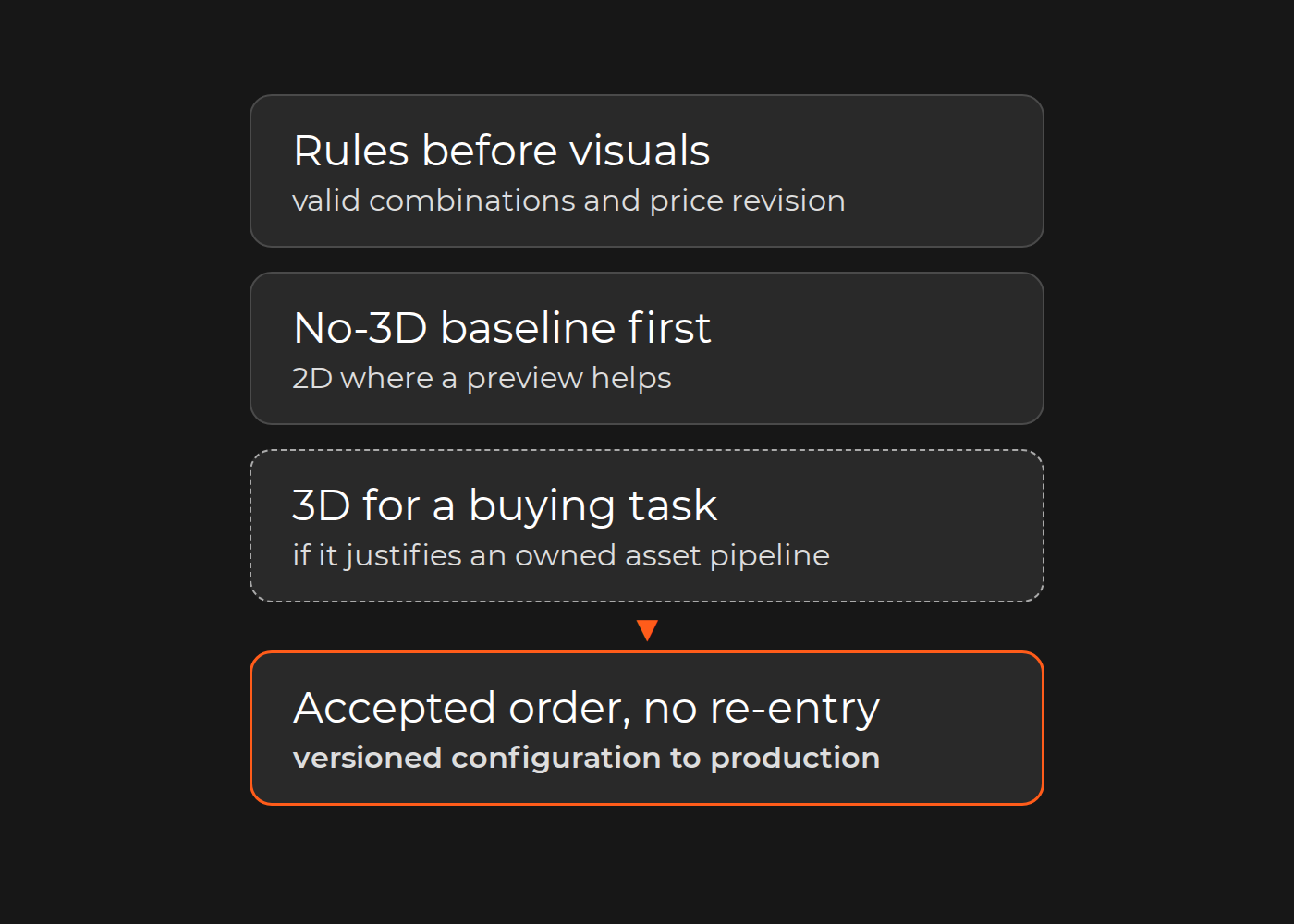
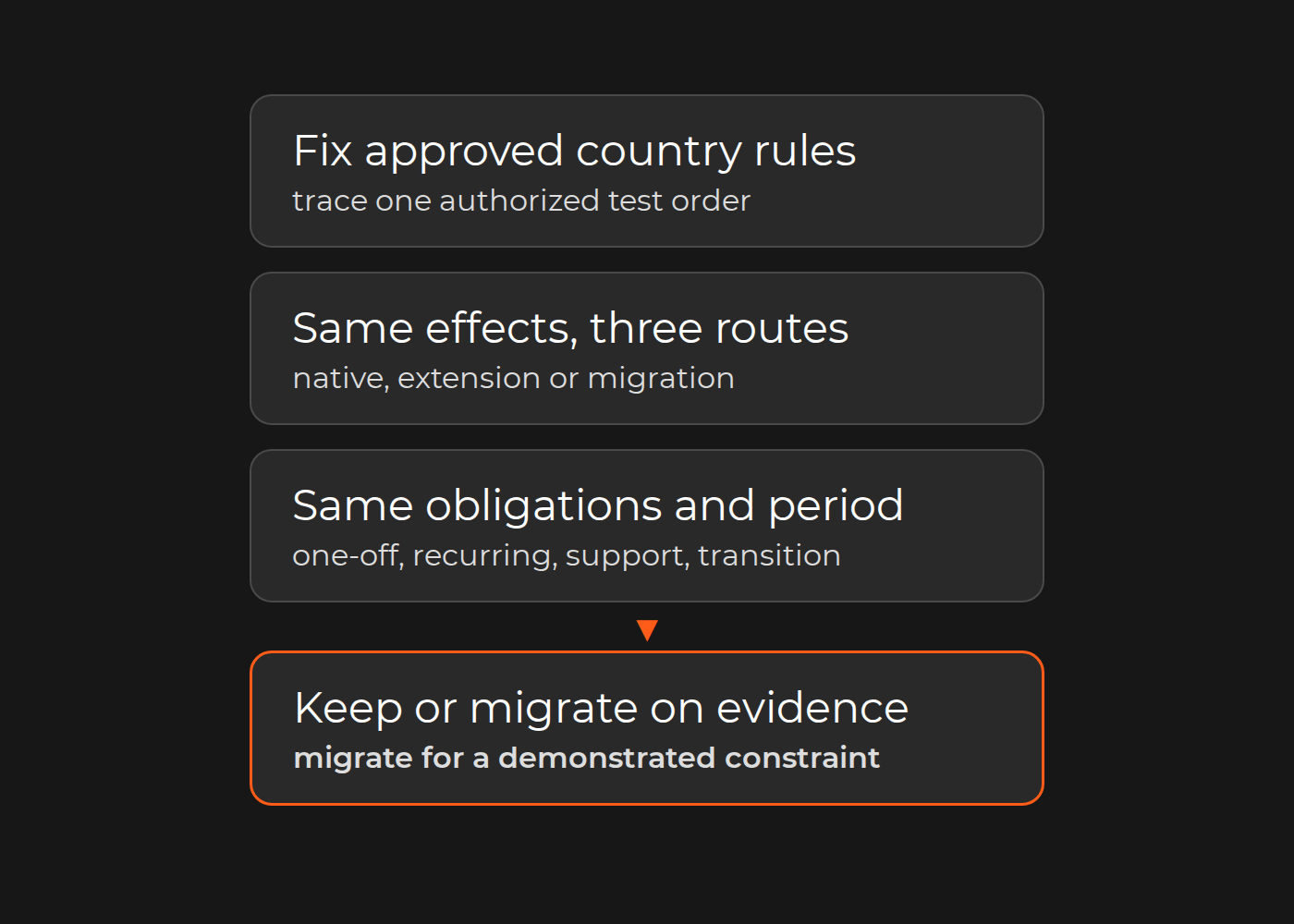
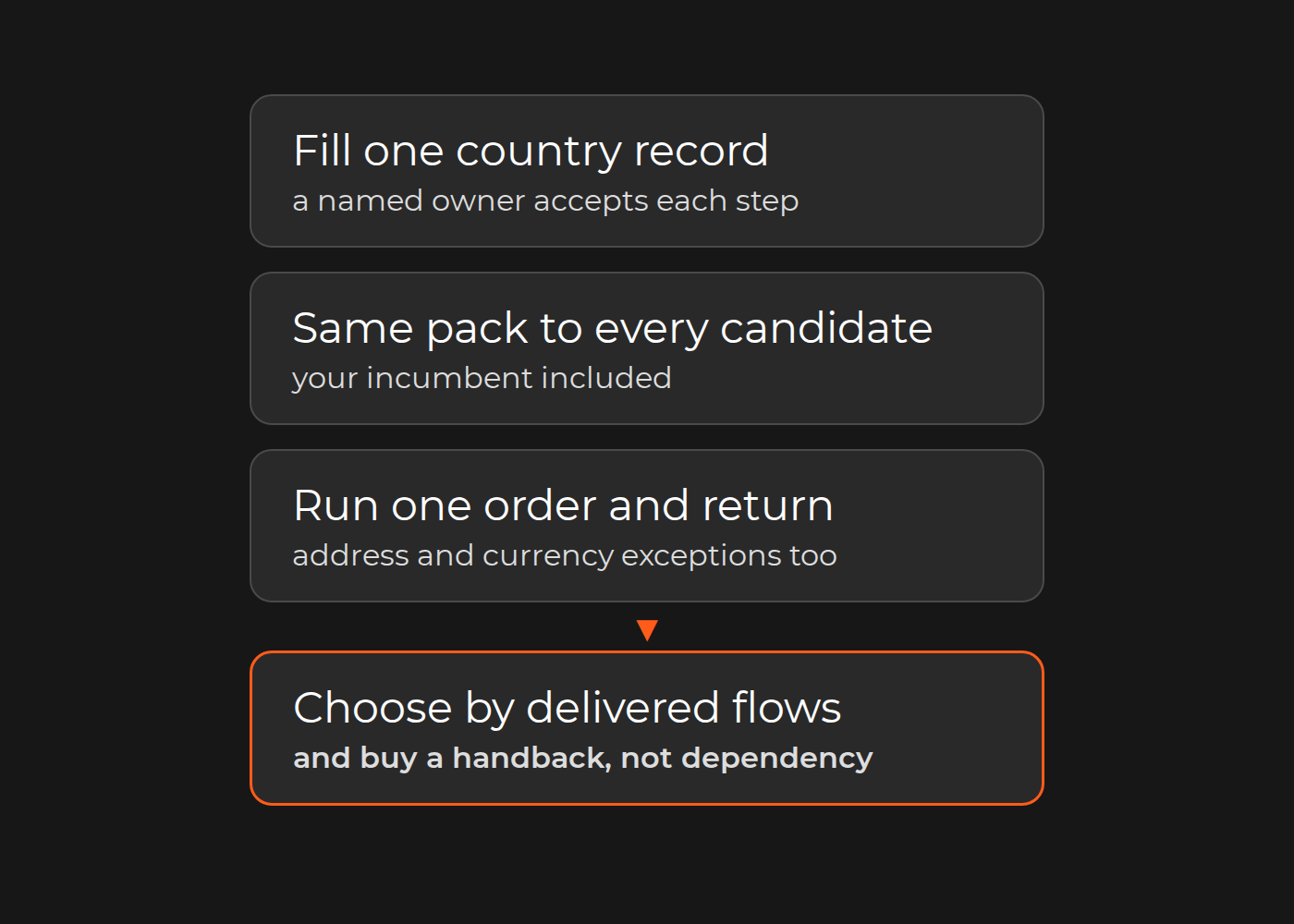
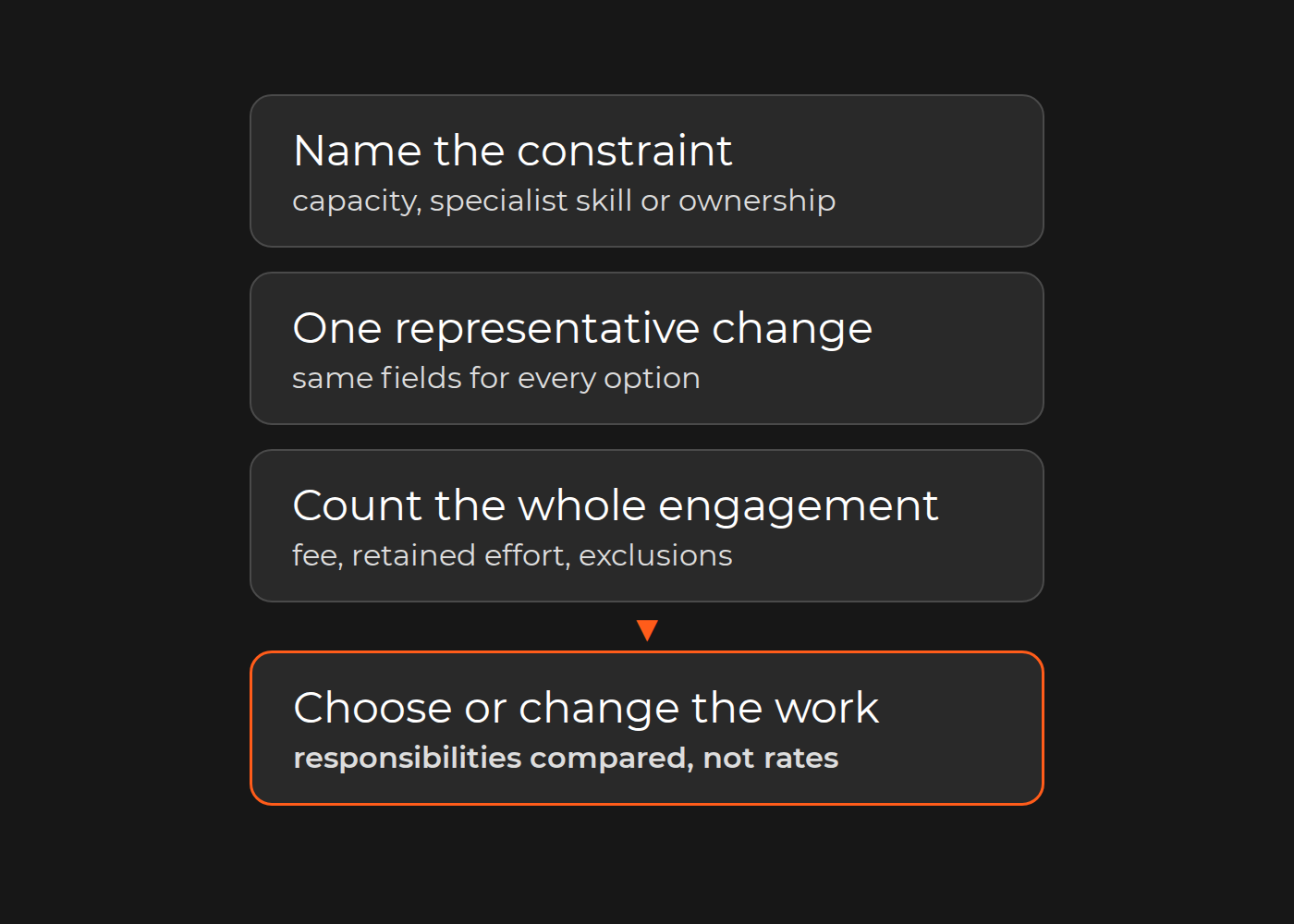
3D can help a customer understand a product. It cannot fix an invalid option combination, an unreproducible price or an order that production must type in again.
Can customers specify a valid product that sales and production can use without re-entering it? Yes, when the configurator enforces approved compatibility rules, fixes the price revision and passes a versioned configuration to the quote and to production. That is also what sets most of the cost and timeline: validated rules and the production handoff come before visual polish. Start with an options-to-production baseline—2D where a preview helps—and add 3D only if its buying value justifies a separately owned asset pipeline.
For a manufacturer's product or ecommerce director, the budget decision has two parts: what must the configurator do, and what must the buyer see? Price the rules-to-order workflow first. Then compare text, 2D and interactive 3D against the customer decision they improve.
This guide shows how to choose the visual format, break down development and ownership costs, and build a dependency-based timeline. It does not supply an agency price range disguised as an estimate. The practical starting point is one product family, its option rules and an accepted production-order format.
A no-3D baseline and what 3D adds: a filled scope worksheet
Take an illustrative product family with two approved sizes, three colors, one price rule and a versioned production PDF. The product and production owner supplies the valid combinations—here, the large size is not offered in white, so five of the six combinations are valid—and signs off the PDF template. Compare that baseline with the same family plus a 3D view:
Deliverable
No-3D baseline
Added for a 3D option
Owner
Options and rules
2 sizes × 3 colors; one forbidden pair, validated in the browser and at the order boundary
Same rules; each valid state must also map to a model state
Product and production owner supplies valid combinations
Price
One versioned price rule
No change unless 3D introduces new options
Commercial owner
Visual
Swatches, a dimensioned outline or a 2D preview
A model for each supported geometry, material textures, renderer integration, mobile checks
Named owner for future asset changes
Production output
Versioned PDF carrying the configuration ID
The same PDF; a render is not the production specification
Production owner signs off the PDF
Cart and order
Configuration ID and price revision carried to the order
Unchanged
IT
After launch
Rule and template updates
Asset updates for every new option, color or geometry
Named owners for each
The worksheet has no price or duration column on purpose. There is no public benchmark for this exact scope, and an estimate means something only once the rules, asset inventory, catalog volume and ERP boundary are known. Ask for an estimate per row, and mark rows that cannot be estimated yet as unavailable rather than zero. Sequence the work as rules approval → 2D/PDF acceptance → optional asset and renderer pilot → production handover, so a 3D pilot cannot hide an unresolved rule.
Compare the two options over the same ownership period. For an illustrative two-year horizon, count the work in units rather than money:
Cost driver (same two-year horizon)
No-3D baseline
With a 3D option
Valid configurations to test
5 of 6 combinations
The same 5, each also checked as a rendered state
Visual assets to prepare
3 color swatches, 2 dimensioned outlines
Models for 2 geometries, 3 material textures
Device checks
Standard browser checks
Plus rendering checks on representative phones
Output templates to sign off
1 production PDF
The same 1 PDF
Change work per new color
1 swatch, a rule check and a PDF check
Plus 1 texture and a render review
Owners after launch
Product, production and commercial
Plus an asset owner
The units describe the fictional family above; they are not effort or price estimates. Compare per-row estimates over the same ownership period, including asset and rule upkeep, using the scope-question table further down.
The record that proves the baseline works looks like this for one illustrative order and one rejected attempt:
Field
Accepted configuration
Rejected attempt
Option
Large, charcoal
Large, white
Compatibility rule
R-3, version 2: large is not offered in white
R-3, version 2
Quantity
4
4
Price revision
P-7
None issued
Configuration ID
CFG-1042, revision A
None created
Quote/BOM version
Quote Q-1042 v1; production PDF v1
None
Production handoff
PDF v1 with CFG-1042 revision A on the signed-off template
Nothing sent
Rejected rule
None
R-3, version 2; reason shown to the customer
Turn it into acceptance tests. These are proposed tests, not results from a client project:
Starting state
Action
Expected result
Adverse result
Evidence
Pass/fail owner
Rule R-3 v2 active
Submit large + white through a modified request
Rejected at the order boundary
Order or PDF created
Rejection record; no configuration ID
Production owner
CFG-1042 rev. A accepted at P-7
Price list changes to P-8 before production
Order keeps P-7 and PDF v1, or is re-quoted under the agreed rule
Silent repricing, or a PDF regenerated with new values
Order, quote and PDF versions match
Commercial owner
CFG-1042 rev. A
Customer changes the size after approval
New revision B with recheck and reapproval
Revision A's PDF reused for B
Revision history
Production owner
A rendered model can still be unmanufacturable. Visual approval of a render and engineering approval of the specification are separate sign-offs, and only the second releases production.
The baseline is a delivered pattern, not only a teaching device. Dinarys' myfelt case documents a configuration-to-PDF bridge: during a multilingual Magento to Shopify migration, a custom PDF generator captured customers' color, size, design and material choices for their rugs and sent order documents to production units. It supports the no-3D baseline; it does not document 3D work or a reduction in manufacturing errors.
Choose 2D or 3D for a buying task—not a technology label
A configurator can work without 3D models. Dimensions, swatches, labeled options and a clear summary may be sufficient when customers already understand the shape and need to choose a valid specification.
2D is useful when the decision concerns a surface: artwork placement, a print layout, a color arrangement or a dimensioned outline. Interactive 3D deserves investigation when rotation, depth or relationships between components help customers distinguish otherwise confusing choices. Neither is a substitute for precise dimensions or approved product information.
Presentation
Useful when
Added work or limitation
Options + summary
Codes, dimensions and swatches explain the choice
Clear labels and validation still required
2D preview
Placement, layout or a flat surface matters
Layer/image preparation and preview-output agreement
Interactive 3D
Shape or spatial relationships affect selection
Models, materials, interaction and device testing
WebGL rendering
Browser graphics need this implementation approach
Rendering technology, not a separate business workflow
WebGL is not an alternative to 2D or 3D. MDN defines WebGL as a browser API for interactive 2D and 3D graphics, with device hardware requirements as well as browser support. A 3D configurator may use a rendering library or specialist product rather than a renderer built from scratch. The estimate should identify the implementation, licensing and maintenance boundary.
Counterexample: a customer ordering a replacement panel by a known code may gain little from rotating it. Better option compatibility and a readable specification could solve the problem. A customer comparing unfamiliar modular shapes may benefit from 3D—but that remains a task to demonstrate, not an assumed conversion gain.
Assets and rules are separate production lines
Ask what reusable assets actually exist. A CAD file is an input, not evidence that a web-ready model is finished. Check permitted use, geometry preparation, material/texture work, option mapping, file delivery and visual approval. A photographed sample or a layered 2D asset also needs preparation and maintenance.
Have the product owner identify which details must be accurate and which are illustrative. Do not let an attractive render imply exact color, fit or manufacturing tolerance that the approved specification does not establish. Test representative mobile devices and constrained connections; preserve usable selections and a text summary when the visual view is unavailable. Keyboard and nonvisual operation belong in the interaction scope, not in a late cosmetic pass.
Rules require a different owner. Production defines permitted dimensions, option dependencies, required files and exceptions. Commercial approves calculation rules and quotation boundaries. IT verifies the representation and transfer. If nobody can resolve contradictory rules, model production cannot unblock implementation.
AI is optional. Explicit rules, native variants, a specialist configurator or web-to-print product may cover the requirement. AI-generated copy or imagery does not establish a valid configuration, price or production file. Do not add a model just because the preview is sophisticated.
Count dependencies, not just options
Consider a hypothetical display-product family, not a delivered Dinarys project or a manufacturing recommendation. It has three widths, four finishes and two base styles: 3 × 4 × 2 = 24 raw combinations. The fictional product policy allows the widest size only with the fixed base. That removes four combinations, leaving 20 valid configurations.
That count is useful for this tiny, fully discrete example. It is not a test-effort formula for continuous dimensions, uploaded artwork or changing prices. A large catalog with few dependencies may be simpler than one product with interdependent dimensions and approval rules.
For this example, the acceptance set should include the widest size with the permitted base, the forbidden alternative, missing required choices, a later edit and the exported order. The estimate must cover both the valid path and the rejection path. An inactive option in the browser alone is insufficient if a modified request can submit the forbidden combination; validate at the authoritative order boundary too.
After approval, changing the width may change eligibility, price and output. Keep the accepted revision distinct from the edited one. Apply the agreed recheck/reapproval rule before releasing the revised specification.
Illustrative revision rule: an edit after approval creates a new revision that must pass rule, price and output checks before release.
Include pricing, cart and production output in the estimate
Define where the approved price comes from: commerce rules, ERP, CPQ or a dedicated calculation service. Document units, quantity tiers, surcharges, currency, tax treatment and any quote-only exceptions. Compare expected and observed prices on agreed fixtures, including boundaries and later edits. A rendering engine should not become an undocumented second pricing system.
Carry stable option codes, dimensions and units, configuration revision, artwork reference where relevant, and order identity into the cart and receiving output. Agree how edits and reorders behave when the catalog or price rules have changed. An old saved design is not automatically a currently sellable product.
The myfelt PDF generator described earlier is this kind of configuration-to-specification bridge; check for it when a budget omits that line. It does not establish 3D delivery or a universal equipment interface. The handoff itself is covered in more depth in configuration to production without manual re-entry.
Decide whether production needs a human-readable PDF, structured ERP/MES data or a file for a specific device. These are different deliverables. A document generator does not prove that a machine accepted the job. Device transfer needs an equipment-specific contract, authorized operator control, visible errors and duplicate-submission safeguards. Keep unknown equipment compatibility out of a fixed implementation promise.
The Lappu sticker shop case covers both halves of this boundary. Dinarys built a custom sticker configurator (Laravel and React, integrated with Shopify via webhooks) with three sticker types and a real-time preview, plus a custom connector for the client's Roland printer that supports automated, scheduled and manual printing workflows. The configurator and the printer connector are separate deliverables, which is how a device transfer should appear in your estimate. The case page, checked November 2026, describes the project as ongoing, with the client at the last stage of pre-launch activities, so it reports no live-store results and offers no cost or schedule benchmark.
For artwork-heavy work, the Flash Style case describes a Magento platform integrated with PrintQ's Web2Print module and a separate commercial-document system. It demonstrates a product-plus-integration contribution, not a requirement to build a proprietary configurator or proof of generic 3D expertise. The public case's broader project scope is not a price or schedule benchmark for one preview feature.
Build a cost breakdown that survives comparison
Ask every candidate to price the same family, rules, visual fidelity, channel and receiving output. Separate these packages:
Asset preparation: source audit, 2D layers or 3D models/materials, option mapping and product-owner approval.
Selection experience: inputs, validation messages, preview interaction, saved state and accessible summary.
Business logic: authoritative validation, pricing, quote routing and revision/approval handling.
Integrations and outputs: cart/order mapping, artwork references, agreed production document or interface, errors and reconciliation.
Testing and launch: difficult configurations, real device/browser checks, output acceptance, analytics, rollout and receiving-team training.
Reuse valid existing assets, rule definitions, modules and code. A single missing PDF field may need a template correction, not a new configurator. A new family with unknown rules may need a narrowly scoped rule/output investigation before its implementation can be estimated. Neither situation justifies repeating all discovery automatically.
For labor, calculate the sum of role-hours × agreed role-rates; add separately quoted assets, licenses and external interface work. Leave missing quotes visible. If asset preparation is already included in a supplier's fee, do not add the same asset hours again. Put scope, assumptions, exclusions and acceptance owner beside each package.
Ask every candidate to answer the same scope questions, leaving effort and commercial fields blank until each answer is agreed. The list is a comparison checklist, not an automated estimate or vendor ranking.
Scope question
Owner
Evidence or limit
Which product family and channel?
Product owner
Do not silently add families
Which configurations are valid and which are forbidden?
Production
Attach authoritative rules and examples
Which price source and calculation version?
Commercial
Expected fixture prices and quote exceptions
What reusable 2D or 3D sources exist?
Product and asset owner
Use rights, readiness and visual accuracy
Which customer task requires visualization?
Ecommerce
Compare options summary, 2D and 3D on the same task
Which native or specialist capability fits?
IT
Supported behavior and the remaining custom gap
PDF, structured data or equipment file?
Production and IT
Accepted output attached; device transfer priced separately
What proves validity, price and receiving output?
QA and production
Edits, rejection and an unavailable receiver included
Who owns fallback, training and support?
Operations
Rule maintenance and exception handling named
License, hosting, assets and support over the horizon?
Finance and IT
No duplicate included costs
Rule, template and compatibility updates?
Product and production
Internal maintenance workload included
Export, source ownership and exit work?
Sponsor
Alternatives compared on the same horizon
For the chosen ownership horizon, add platform/app licenses, rendering or asset services, hosting, storage, support, rule/template updates and upgrade regression tests. Include the internal work of maintaining materials, prices and option compatibility. Consider exports, source-asset ownership and transition costs if you leave the product or supplier. A small subscription plus expensive rule administration can cost more than expected; custom code can carry the same burden.
What determines the timeline?
The launch date follows the slowest required dependency, not the number of screens. Show two workstreams on the schedule: rules/output readiness and visual-asset readiness. They meet at integration and acceptance.
Rule definition can begin while source assets are audited. Some selection and cart work can proceed once identifiers and contracts are stable. Final visual approval cannot complete before usable assets exist; production acceptance cannot complete before the final mapped output is available. Adding frontend capacity does not settle an unresolved manufacturing rule or accelerate an unavailable production reviewer.
Request milestones tied to evidence rather than an unsupported “typical number of weeks”:
Difficult product demonstrated: valid and forbidden selections, calculation and representative output evaluated on the chosen route.
Implementation accepted: agreed visuals, rules, cart and receiving output pass the agreed tests, with production sign-off on the output. Unresolved essential requirements block acceptance of the affected scope. Record agreed exclusions and any nonessential residual items separately accepted by authorized owners.
Operations ready: training, monitoring, fallback, support and rule-change ownership confirmed.
Ask the delivery team to show effort, dependencies, reviewer availability and release constraints separately. Existing web-ready assets and stable rules can shorten the path. A new product taxonomy, missing price rules or an unverified device interface can lengthen it even for a 2D experience. Public migration durations do not answer how long your configurator takes.
Test the conversion hypothesis without rewarding invalid orders
Define the customer task first: reach a valid configuration, understand the price and submit the correct order or quote. Preview rotations and time on page are interaction measures, not proof of commercial improvement.
Where traffic permits, an analyst can design a controlled comparison with an agreed eligible audience, baseline, minimum meaningful effect and uncertainty requirement. Keep product availability, campaign mix and pricing changes visible. Do not infer that a visual treatment caused a change merely because a later month converted better.
Track production clarification requests, invalid submissions, specification corrections, active handling time and remakes alongside customer completion. A higher checkout count with more unmakeable orders is not a successful configurator.
At lower volume, moderated tasks and a limited operational pilot can reveal that customers misunderstand an option or that production loses a required unit. Those findings can justify a repair; they do not establish a reliable percentage conversion uplift. The myfelt, Lappu and Flash Style components above are delivery evidence, not causal proof that adding 3D will increase your sales.
Prepare one family for a useful estimate
Bring a representative product, a valid and a forbidden selection, rule sources, expected prices, available images/models and a production-accepted output. Add the current platform/modules, a description of reusable work, receiving-interface details and the person who maintains each rule after launch.
The product/ecommerce director can champion the buying experience; production signs off rules and specifications; commercial accepts pricing; IT accepts interfaces. A COO, owner or delegated finance sponsor approves investment and scope. Assign those responsibilities before comparing offers. Then ask each candidate to demonstrate the three acceptance tests above on your family: a blocked invalid combination, a kept price revision and a new revision after an edit.
To discuss the configuration and production-handoff scope with Dinarys, start with sanitized examples rather than credentials, customer records or proprietary design files in a contact form. The decision is not “Can we afford 3D?” It is “Which presentation and implementation can deliver this valid, priced, accepted order—and can the business maintain it?”