Comparing a freelancer’s rate, an employee’s salary, and a partner’s proposal means comparing three different purchases. The useful question is how much direction, review, coordination, and continuity your agency must still supply to deliver the same client result.
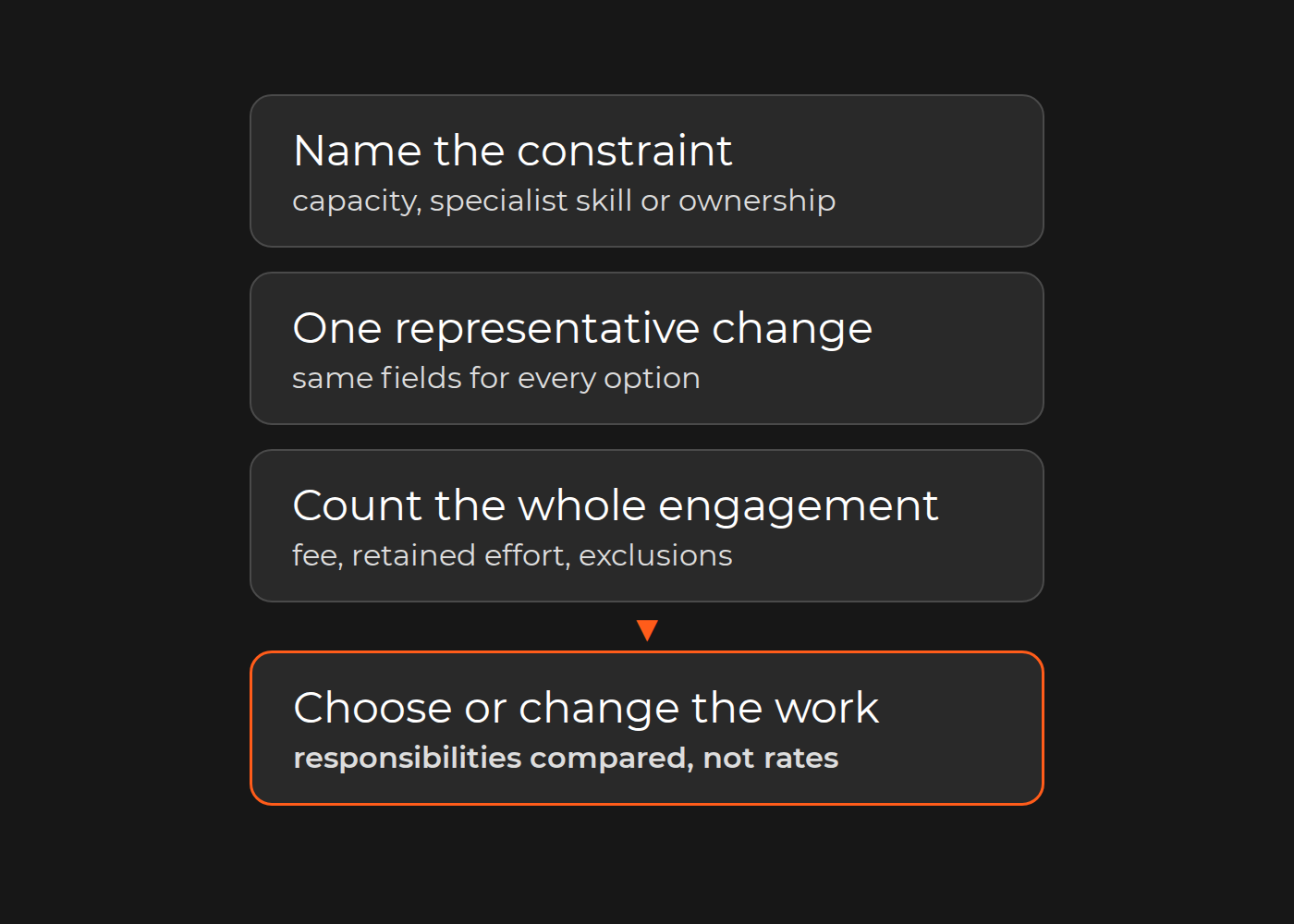
Start with the constraint. If your team lacks capacity for work it can direct and review, a freelancer or an embedded partner role can fit. If it lacks specialist skill, you need someone who can make and verify those decisions, and a junior rate will not buy that. If delivery ownership is unclear, none of the three options fixes it until someone is named as accountable for the result. Then compare the options by supervision, continuity and client responsibility. A cheaper day rate is not an equal comparison when onboarding and review differ.
Investigate an in-house hire for continuing ownership, a freelancer for a narrow task your team can direct and accept, and a white-label partner for an agreed mix of engineering, integration, QA, and handover responsibilities. None is automatically faster, cheaper, available, or safer.
This comparison is for an agency, or an in-house team, buying engineering capacity. A merchant choosing an ecommerce agency to run its project is making a different decision. Dinarys sells engineering and team-extension services, so it has a commercial interest in the partner option. The comparison below deliberately includes cases where hiring, a freelancer, or a simpler product is the better fit.
If you cannot yet name the uncovered work, its dependencies, and who will accept it, define that first: none of these options can be priced or compared without it.
Compare the three options on one representative change
Give every option the same piece of work and fill in the same fields. In this illustrative checkout change, rates and actual availability are left unquoted on purpose; the comparison is about who carries which responsibility.
Field
In-house hire
Freelancer
White-label partner
Role and skill
Checkout developer, verified by your tech lead
Same
Same, verified in a technical interview
Review owner
Your technical lead
Your technical lead
Agency reviewer named in the agreement
Absence cover
Agreed internal cover
A named substitute
Agreed partner backup
Client visibility
Part of your team
Agreed in the contract; no direct client contact by default
Agency keeps the client relationship
Access
Your repository and environments
Scoped repository access
Scoped repository access
Release authority
Yours
Yours
Yours
IP/confidentiality
Employment terms
Contract assigns work product; client terms flow down
Contract assigns work product; client terms flow down
Onboarding and transition
Recruitment, then onboarding
Onboarding and handover note
Onboarding, handover and exit terms
Day rate or salary
Not quoted here
Not quoted here
Not quoted here
The same illustrative checkout change, compared by reviewer, absence cover and release authority rather than by rate. Illustrative Dinarys editorial diagram.
Decision rule: reject any option whose named reviewer or absence cover is missing, however attractive its rate. In all three, the buyer keeps the repository and release authority; an option that needs the supplier to hold exclusive release access fails before cost is discussed.
Acceptance test: before scaling any option, run one representative change through your real process. It passes when it gets through your agency’s review and your own team can build, release and roll it back without supplier-only access. Record the review time it took; that number belongs in the cost comparison below.
Compare governance on the same technical problem
Give each option the same workstream, interfaces, acceptance tests, and client boundaries. Ask who approves architecture, reviews code, handles a failed API call, communicates with the client, and receives the code at handover. Then test what happens if the key engineer is unavailable: who covers, what knowledge exists, and who pays for replacement onboarding?
Ask a partner for evidence of the contribution you are buying. For each case it cites, note the claim, the source page, what the partner contributed versus what the client led, how any result is defined, and its limits and date.
For the embedded model, Dinarys’ BORN Group collaboration shows what a continuity answer can look like. BORN Group is a global digital and ecommerce agency; Dinarys provided senior Salesforce Commerce Cloud (SFCC) specialists who worked inside BORN Group-led projects from February 2021 to July 2024. The case page describes a multi-stage selection process starting with technical validation and Dinarys HR, legal, and operations taking responsibility for NDAs, payroll, compliance, onboarding, and adaptation; it reports “0 specialists replaced throughout the whole collaboration period.” That is evidence about embedded SFCC specialists in BORN Group-led projects—not proof of white-label workstream ownership, of rates, or of a future replacement commitment.
For Magento, the Magento development outstaffing case describes engineers embedded in the existing agile, US-based teams of an unnamed California-based consulting firm, with Dinarys handling HR, payroll, legal, infrastructure, and compliance, and a dedicated account manager as the single point of contact for escalation. The Kaizen Technology Solutions case describes a Salesforce integration developer engagement in which the account manager “serves as a point of escalation when necessary and resolves hot issues.” Both support asking how escalation and replacement work; neither is a cost study or evidence that a supplier owns every workstream outcome or the client relationship. Dinarys’ IT outstaffing service is the active service route if the embedded model fits.
The tech lead should verify retained technical work; the account owner should control client communication; the agency owner and finance team should approve the economics. An unclear answer in any of these areas is a cost or responsibility gap, not an advantage for a model.
In-house hire: choose continuing ownership, not a temporary rescue assumption
An employee joins your organization rather than supplying a separately accepted supplier workstream. A permanent backend practice or predictable roadmap may justify retaining technical knowledge internally.
The agency still supplies leadership, onboarding, review, and an operating plan. Verify actual architecture and integration skills; one hire does not automatically cover backend, QA, DevOps, and technical leadership. Recruitment, absence, and retention remain your planning tasks. Without internal cover, departure can restart recruitment and onboarding.
Where this option loses: a bounded urgent need that cannot accommodate recruitment, or a role expected to replace several missing disciplines without support. Do not allocate a whole annual salary to one short project—or ignore employment costs outside salary when estimating the same comparison period.
Freelancer: choose work you can direct, review, and maintain
A freelancer supplies the services and responsibility in the individual contract. A well-defined extension can fit when your technical lead can make decisions, answer questions, review changes, and accept the result.
Confirm actual commitment, whether technical direction is included, and the documentation and handover obligations. Include maintenance explicitly if needed. A specialist can become a single point of failure unless a credible cover arrangement exists.
Where this option loses: even a small task becomes risky if nobody at the agency can review it and the freelancer is not contracted to provide that leadership. A low rate cannot repair an unowned architecture decision.
White-label partner: buy an explicit delivery boundary
A white-label engineering partner performs work the agency presents under its own brand or within its team, subject to the agreed disclosure and communication model. The contract—not the label—defines responsibility.
Distinguish an embedded role, directed and reviewed by the agency, from a bounded workstream with agreed engineering, testing, and handover ownership. A commerce/PIM integration with design decisions, exception handling, and end-to-end tests may justify the latter. Verify the proposed people, allocation, included disciplines, exclusions, and transition terms.
For design, state whether the agency supplies approved UX or needs a design contribution. For integrations, name every interface owner. For support, separate defect obligations, maintenance, and new roadmap work. A partner cannot take responsibility for client-controlled decisions it has no authority to make.
Where this option loses: a proposal promises “a team” but leaves architecture, acceptance, or source dependencies unowned. White-label branding does not automatically protect the client relationship or include backup capacity.
A hosted white-label store platform is a different purchase. If a repeatable storefront product meets the need, assess its features, hosting, licensing, customization limits, and export options before commissioning custom engineering.
Calculate the whole engagement, not just the visible fee
Use the same deliverables, environments, comparison period, and post-launch obligations. Keep implementation and ongoing operation separate.
Illustrative scope boundary, not a price chart: retained agency review, excluded QA and transition costs belong in the comparison even when implementation is inside the quote.
For agency effort, multiply hours for each role by its finance-approved internal cost rate. Record actual quotes and inclusions, employment allocations, currency, tax treatment, and any exchange-rate source/date. Do not add QA or management twice if the proposal already includes it. Unknown QA or continuity costs are not zero.
Here is a fictional effort comparison, not a quote:
Retained agency effort
Option A
Option B
Technical review
6 hours
3 hours
Coordination
4 hours
2 hours
Excluded QA
2 hours
Included in fee
Total additional effort
12 hours
5 hours
If all those internal hours use the same approved rate r, Option B retains seven fewer hours. In this deliberately partial model, a fee difference B − A < 7r makes B cheaper on the listed costs. Different role rates require separate calculations. Transition costs, unresolved exclusions, and continuing support can change the conclusion; this example does not establish a market price or a winner among the three models.
With actual offers, complete the same inputs for each option:
Supplier fee or finance-approved employment allocation for the same period.
Retained agency hours by role × the approved internal cost rate for that role.
Essential excluded work, priced once (check QA, DevOps, design, and management).
Agreed transition and replacement-onboarding costs.
Currency, tax treatment, and a dated FX source if needed.
Unresolved costs and assumptions—left as unknown, not zero.
Comparable cost is the sum of items 1–4; do not add an included discipline twice. Do not invent failure probabilities or lost revenue to make a preferred option win.
Choose a model—or change the work
If no option can meet essential acceptance requirements and client boundaries, reduce or resequence scope. Resolve access and source decisions with their authorized owners before buying people to wait for them.
Have authorized commercial and legal reviewers align confidentiality, IP and licensing, subcontracting permission, client contact, acceptance/payment, escalation, and exit terms with the client agreement. If you are only introducing a client, obtain consent and disclose commercial interests; a referral is not delivery, repository access, or a reference right.
To explore the partner option, bring Dinarys the same defined workstream: a sanitized backlog and interfaces, acceptance criteria, comparison period, retained agency hours by role, essential exclusions, and client communication constraints. That makes the next conversation a comparison of responsibilities and scope—not a contest between incomparable rates.