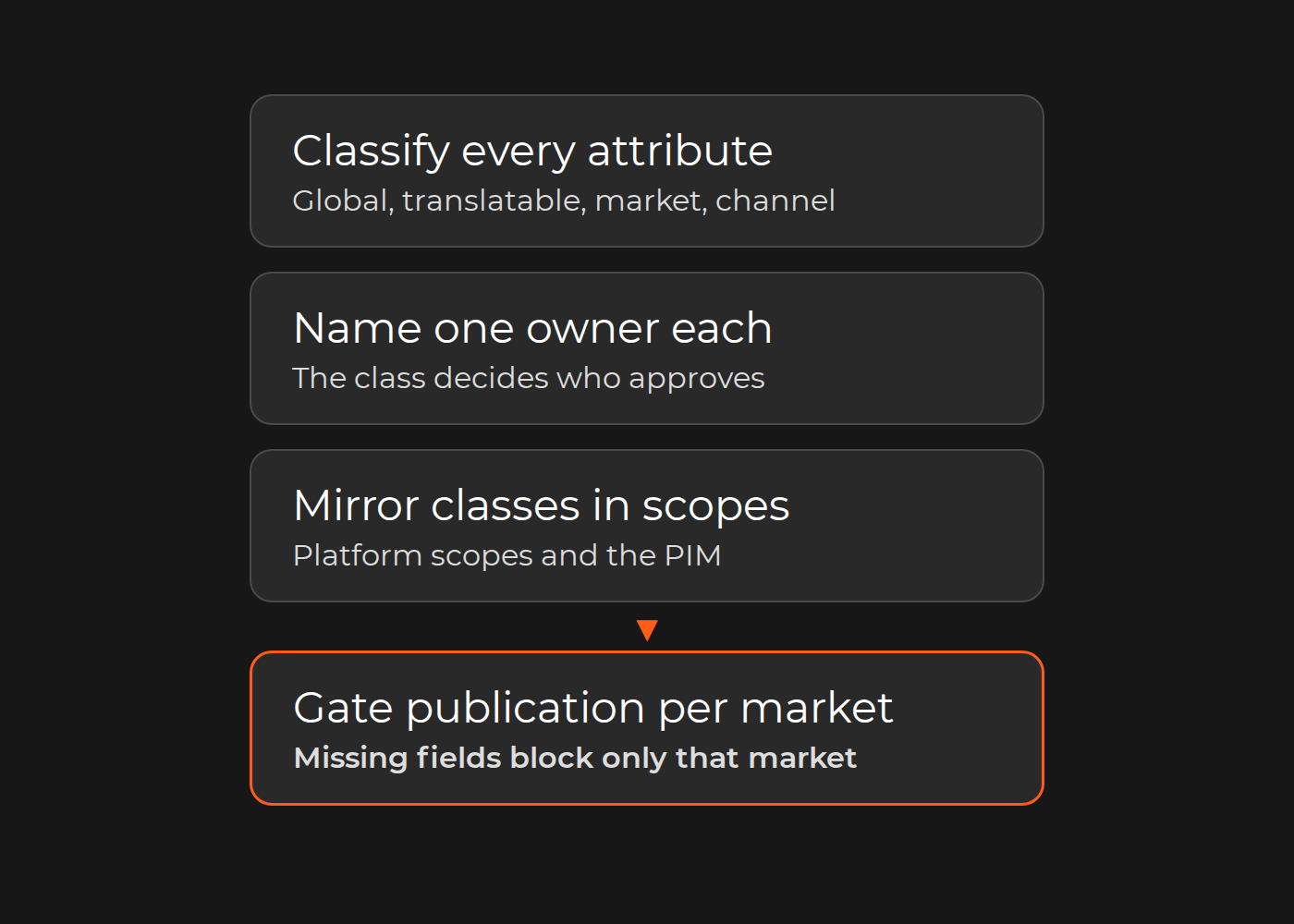
Product data localization starts with one decision per attribute, not with translation. Before a product publishes in a new country, put every attribute into one of four classes:
Global facts, such as GTIN, MPN, dimensions, materials and technical specs, are owned centrally and never edited per market.
Translatable text, such as names, descriptions and care instructions, has one source language and reviewed translations.
Market-specific data, such as price, tax class, availability, unit-price base quantity, safety texts and regulated claims, belongs to the market owner.
Channel-specific data, such as marketplace titles and feed categories, belongs to whoever runs that channel.
Then mirror the classes in your platform's scopes and in your PIM, and block publication in a market, and only in that market, when one of its required fields is missing. The classes also settle approvals: the product-data owner approves changes to global facts, the content lead approves translations, the market owner approves market data (with compliance for legal and safety texts), and the channel manager approves channel data.
Payments, delivery and returns are covered in launching ecommerce in a new country; this guide, for PIM and catalog owners, stays with the product data model.
Why translated stores still publish wrong product facts
A common error is a fact edited in the wrong place, not a bad translation. Someone copies a product into a new language, translates the text and, while the record is open, "corrects" a dimension or a material. The next import overwrites one language and not the other, and two countries now disagree about the same physical product.
Illustrative example (fictional): a German outdoor-furniture maker sells through Shopware 6, with Akeneo as its PIM, and is adding France and the Netherlands. Its old export carried 64 attributes per product, and 9 of them were edited per country in the shop. As a result, dimensions differed between the German pages and the French pages already drafted in the shop for 310 SKUs. Nobody had decided that dimensions are global, so nothing stopped the edits.
The fix is a rule that says which attributes may differ by market, enforced by the systems.
Four classes: global, translatable, market-specific and channel-specific
ERP, PIM and DAM supply the data. Each attribute gets one class and one platform scope, and a per-market gate publishes a product only where that market's required fields are complete.
Global attributes describe the physical product and its identity: SKU, GTIN, MPN, dimensions, weight, materials, specs and product images. Option values such as a color can stay global while their labels are translated. Identifiers stay global for a reason beyond the store: GS1's GTIN Management Standard requires a new GTIN for a product that is new to the market, and its rule list covers product changes such as declared net content, dimensions or gross weight and the primary brand. Translating a listing is not on that list.
Translatable attributes say the same thing in another language: name, description, care text, image alt text. Each has one source language and one approved translation per target language.
Market-specific attributes may differ between countries that share a language: price, tax class, availability, unit-price base quantity, safety warnings and regulated claims. Each needs a named market owner.
Channel-specific attributes exist because a channel asks for them: a marketplace title with its own length limit, a shopping-feed category, a shorter text for an app.
The attribute localization matrix
Fill one row per attribute with the people who own the data. Each row's platform scope follows its class, as mapped in the next section. This version is filled for the fictional furniture maker; your rows will differ.
Attribute
Class
Source → owner
Akeneo setting
Validation rule
Blocks publication in
SKU
Global
ERP → ERP owner
Identifier
Unique, matches ERP
All markets
GTIN
Global
ERP → product-data owner
Identifier, read-only
13 digits
All markets
MPN / model number
Global
PIM → product-data owner
No value per locale or channel
Present
None
Dimensions
Global
PIM → product-data owner
Read-only
Numeric, unit set
All markets
Weight
Global
ERP → logistics
Read-only
Numeric
All markets
Material
Global value
PIM → product-data owner
Select, option labels translated
Value from list
None
Color
Global value
PIM → product-data owner
Select, option labels translated
Value from list
None
Product images
Global
DAM → content lead
Shared asset
At least one image
All markets
Manufacturer name and contact
Global
PIM → compliance
No value per locale or channel
Present; EU responsible person if the manufacturer is outside the EU
All EU markets
Product name
Translatable
PIM → content lead
Value per locale
Present, translation approved
Markets of that locale
Long description
Translatable
PIM → content lead
Value per locale
Present, translation approved
Markets of that locale
Care instructions
Translatable
PIM → content lead
Value per locale
Present
None
Price
Market-specific
ERP price list → market owner
Not in the PIM
Present, above zero
That market
Tax class
Market-specific
ERP → finance
Not in the PIM
Rate set for the country
That market
Unit-price base quantity
Market-specific
PIM → market owner
Value per channel
Present where unit pricing applies
That market
Availability
Market-specific
ERP → market owner
Not in the PIM
Stock source mapped
That market
Safety warnings
Market-specific
PIM → compliance
Value per locale, approval status
Required language, approved
That market
Assembly guide (PDF)
Market-specific
DAM → compliance
Asset per locale
File in the required language
That market
Marketplace title
Channel-specific
PIM → channel manager
Value per channel
Within the channel's length limit
That channel
Feed category
Channel-specific
PIM → channel manager
Value per channel
Mapped to the feed taxonomy
That feed
How to use it:
Export your attribute list and start with the 20 attributes your products use most.
Assign one class per attribute. If a customer in another country would expect a different value for the same physical product, it is not global.
Name one owner per attribute; the class decides who approves a change.
Write each validation rule and where it blocks publication.
Lock global fields wherever they are edited today. The furniture maker made dimensions, materials and GTIN read-only in the PIM. In Akeneo, a read-only attribute "will only be updated through imports, API or rules"; the help center lists the property for the Enterprise Edition only.
Classification is easier on a consistent catalog. On a BigCommerce catalog project, Dinarys reviewed, updated or downloaded data on over 137,000 products and "had to run some scripts and workarounds to make the data consistent", with AI-assisted categorization. That was catalog cleanup, not localization, but the order of work carries over: make values consistent, then classify. For the wider rulebook, see our guide to PIM practices.
Mirror the classes in platform scopes and the PIM
A class holds only if the systems enforce it: map each class to the narrowest scope that allows the variation it needs.
Class
Akeneo
Adobe Commerce
Shopify
Shopware 6
Global
No value per locale or channel
Attribute scope: Global
Product field, not translated or adapted
Default language only; left untranslated elsewhere
Translatable
Value per locale
Store View scope, one store view per language
Translations (Translate & Adapt, CSV or an app)
Translation per language
Market-specific
Value per channel, or locale specific
Website scope; Catalog Price Scope set to Website
Market catalog for products and prices; market adaptation
Behind the table: Adobe describes store view scope as "typically used to support multiple languages" and says "Commerce does not allow setting a product price for each store", only per website. Shopify catalogs "control which products are available in each market and at what price". Akeneo's "locale specific" property covers cases such as "a Canadian tax only for Canada". In Pimcore, translatable attributes go into localized fields with mandatory languages.
Watch fallbacks. Shopify displays default-language content when a translation is missing; Shopware shows the inherited language's content for untranslated fields; Pimcore checks fallback languages. A fallback hides a missing description from shoppers, so the gate, not the storefront, must catch it; for a safety warning a fallback is never acceptable, which is why warnings are market-specific with a blocking rule rather than merely translatable.
Translation workflow: source language, machine translation, review and glossaries
One source language. Translate from the source only, never from another translation.
Machine translation as a draft. Shopify's Translate & Adapt app offers AI translations from Shopify, and "in some countries" an Auto-sync feature keeps automatic translations up to date each week. Whatever the engine, store a review status per locale.
A glossary and a do-not-translate list: brand names, product lines, model numbers, and terms with legal meaning.
A retranslation trigger. When source text changes, its translations go back to "needs review".
The right reviewer. A native speaker reviews customer-facing text; compliance reviews safety and legal text.
In the example, French and Dutch names and descriptions are machine translated, then reviewed; assembly warnings never publish from machine output and pass a legal check.
Market rules that create required fields
Unit pricing in the EU. Directive 98/6/EC requires the selling price and the unit price for products offered by traders to consumers. The unit price is per kilogram, liter, meter, square meter or cubic meter, "or a different single unit of quantity which is widely and customarily used in the Member State concerned", and member states may waive it where it "would not be useful". So the net quantity is a global fact, while whether unit pricing applies and its base unit are market-specific fields.
Safety information. Under the General Product Safety Regulation (EU) 2023/988, Article 19, an online offer must show at least the manufacturer's name and contact details, the EU responsible person where the manufacturer is outside the EU, information identifying the product "including a picture of it, its type and any other product identifier", and any warning or safety information "in a language which can be easily understood by consumers, as determined by the Member State in which the product is made available on the market". The manufacturer and identification fields are global (the matrix's manufacturer row; the responsible person applies only when the manufacturer is outside the EU); the language of the warnings is set per member state.
Category law. Food, cosmetics and electrical goods carry their own labeling rules. Those attributes need a regulatory reviewer, not a translator.
Variants and SKUs per market: when it is not the same product
If a market needs a physically different product, such as another plug, voltage, sizing standard or net content, create a separate SKU rather than a market-specific attribute, and assign its GTIN under GS1's rules. GS1 adds that "local, national or regional regulations may require more frequent GTIN changes".
If the product is the same and only the assortment differs, availability is market data. The Undrgoods project involved three regional stores for the UAE, Saudi Arabia and Kuwait, with regional payments, "advanced inventory synchronization across all 3 regional stores" and a custom bundle management solution with "automatic inventory adjustments when bundle components change". The case shows inventory synchronized across three regional stores; it does not describe per-market assortment rules.
On myfelt's multilingual Magento to Shopify migration, Dinarys transferred a multilingual catalog and built a PDF generator that captures a customer's "color, size, design, and material choices" for production units. A downstream process like that reads option values, which is a reason to keep option codes global; the case page does not describe how option values were modeled.
Publication checks and a new-market readiness report
Run the gate per market and per SKU: if every blocking rule passes, the product publishes there; if not, it stays unpublished in that market only, with the reason recorded. Akeneo's completeness covers part of this: it "is defined by a family, a locale, and a channel", and a product is complete when all its required attributes have a value. Approval status and legal checks need their own rules in the export or a pre-publish job.
Readiness report for the fictional maker, after the matrix:
Market
Active SKUs
Passing
Blocked
Blocking reason
Germany
1,200
1,200 (all)
0
None
France
1,200
1,060 (88%)
140
French safety text missing
Netherlands
1,200
1,163 (97%)
37
Dutch description not approved
The 140 SKUs stay live in Germany and the Netherlands while compliance completes the French texts. Run the check at every release, not only at launch: on Flash Style's Magento 2 platform, with Czech and English content and CZK and EUR pricing, every sprint's QA included "Multi-language content verification". New SKUs that wait in this queue are covered in why new products wait weeks before going live; if missing fields start in supplier files, fix them upstream with catalog and product data management.
Exceptions
One language across several countries (Germany, Austria, Switzerland): share translations, not prices, tax or legal texts.
Marketplaces impose their own attribute schemas; keep them in the channel-specific class.
Regulated categories need regulatory review per category.
Very small catalogs may not justify a PIM; platform scopes and a spreadsheet matrix can be enough.
Region-specific variants (plugs, voltage, sizing) are separate SKUs.
Test your model
Classify your 20 most-used attributes, map each to a platform scope, and run one market's readiness check. It passes when every attribute has one class and one owner, no global attribute is editable at a store view or language level, the check lists blocked SKUs with reasons, and blocking one market leaves the others live.
The matrix organizes ownership and checks; it does not replace your compliance review, and the Dinarys cases above show multilingual and multi-store catalog work, not regulatory sign-off.
Your next step
Fill the matrix for one target market and run its readiness check on a sample of SKUs. If you want a second pair of hands on the classification, the scopes or the publication gate, talk to us about PIM consulting and implementation.
FAQ
Should product names be translated or kept global?
Translated from one source language, with an approval status per locale.
Is price a product attribute or market data?
Market data, owned by each market through the platform's market or website scope.
What happens when a translation is missing?
Most platforms fall back to another language for display. Treat that as a safety net, not a pass: the gate blocks a market whose locale lacks an approved name or description, and a safety warning never falls back.
Does a translated product need a new GTIN?
Not for the translation. GS1 ties new GTINs to new products and to listed product changes, though local regulations may require more frequent changes.