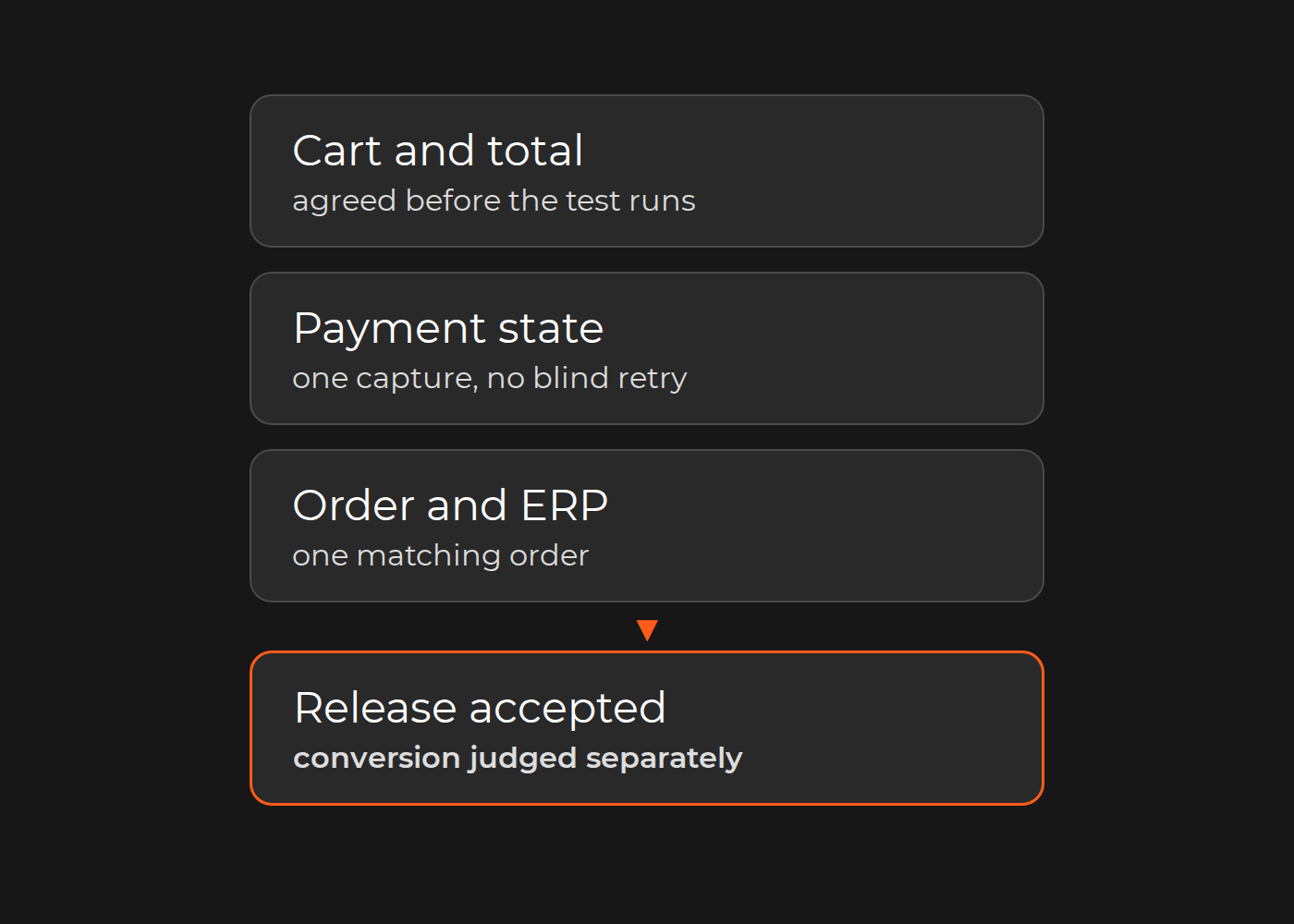
A successful payment screen is not enough. A checkout release must preserve the link from the buyer's agreed cart and total to the appropriate payment state, one correct commerce order, and an order the fulfillment process can handle.
For an ecommerce leader choosing a delivery partner, checkout redesign acceptance testing should answer two questions: who owns that entire release, and what evidence separates technical correctness from an unproven conversion effect? Set those terms before the final demo—not after traffic reaches the new flow.
Accept linked payment, order and ERP/OMS outcomes from agreed control carts, with a named release owner and a rehearsed recovery route. Evaluate conversion separately using a comparison agreed before launch and written criteria for keeping, extending or rolling back the release.
1. Name the release owner and freeze the scope
Give one accountable release owner the combined checklist, dependency decisions and escalation route. That does not replace specialist approval. Ecommerce accepts the buyer journey; promotion, shipping and tax owners approve rules and totals; payment and commerce/ERP owners validate states and reconciliation; QA records evidence; operations accepts monitoring and recovery. The authorized budget owner approves investment and material scope changes.
One person may hold several roles, but no required boundary should lack an accepting owner. Freeze one storefront, agreed buyers/carts, payment methods, delivery options and target device/browser combinations. Identify unchanged components and exclusions. A full replatforming is not a hidden checkout acceptance task.
Ask the delivery partner for component-level evidence
A published Dinarys example is the Goddess case: a Magento 1 to Magento 2 migration that included a one-page checkout, moved discount and checkout fields, custom validation and a courier delivery timeframe, with QA in the project team. The project required “full-regression testing along with raw testing of each involved module”—the same principle this guide applies: test each changed part, then retest the whole flow. Treat it as a reference for test scope, not as a conversion benchmark.
The Prostor case is a wider Magento 2 migration with OTP authentication, card tokenization, guest checkout, unified loyalty and offline pickup. These components are useful for discussing login, repeat payment and delivery acceptance—not proof that your own release passed.
The Prostor case also reports early inventory synchronization inconsistencies that required manual reconciliation, followed by sync-frequency adjustments and a validation layer. Use that lesson to ask who detects and owns a cross-system mismatch after launch. Do not infer a payment defect or isolated checkout uplift from the wider migration. The fictional tests below are proposed acceptance work, not the test record of either project.
Dinarys offers ecommerce testing services and has a commercial interest in this work. Evaluate the scoped evidence and ownership, not the case name alone.
2. Approve control carts before execution
Each case needs a cart/rule version, buyer mode, currency, promotion/bundle, tax expectation, fulfillment method, expected amount, payment outcome, order outcome and evidence owner. Use finance/tax-approved expectations for real tax cases.
Include ordinary purchases and problematic combinations, guest and authenticated flows, eligible and ineligible delivery, price/stock changes, decline handling, further authentication, mobile return, and pending or failed dependencies. Invalid business conditions should produce the agreed explanation or alternative—not a fabricated successful order.
Choose coverage based on the problem and consequences, then record exclusions. A finite suite cannot prove every future cart or network condition. Before the tests run, agree in writing the expected total and delivery eligibility for each control cart.
3. Test what happens after payment succeeds
This scenario is fictional and uses an authorized sandbox fixture, not real transactions or tests performed by Dinarys. Cart C-81 has $90 merchandise, a $10 approved discount, $5 shipping and a fixed $0 tax fixture: expected total $85 USD. This fixture requires capture and a matching accepted order before fulfillment release.
Sandbox condition
Expected behavior
Evidence to keep
Normal success
One $85 payment captured, one matching order, fulfillment release allowed
Matching references and totals in the payment provider, store and ERP/OMS
Browser closes after capture
Checkout looks up the payment result; no automatic new charge
Payment, order and ERP records linked; recovery message shown
Event delivered twice
No second capture, order or release effect
Both deliveries linked to one outcome
Event delayed or initially missed
Order shown as pending; an authorized person reconciles it
Exception with a named owner and a recovery record
Order creation fails after capture
No false “order complete” screen and no request to pay again
Captured payment linked to an open order case
Issuer declines
Appropriate message and usable next step
Decline record and observed UI
ERP rejects delivery method
No false fulfillment success
Recorded mismatch and recovery decision
For a real integration, adapt the fixture to provider and business semantics. Authorization is not capture or settlement. Webhook acknowledgment is not proof of order creation or fulfillment. Different payment methods may need different observation windows and release conditions.
Test linked outcomes, not three isolated green screens. Record actual results and evidence for every required condition. A blank result or unexplained capture/order mismatch is not a completed acceptance test.
4. Test duplicate, delayed and retried events
Where Stripe is involved, its webhook documentation notes possible duplicate delivery and no guaranteed event-delivery order. Use the actual provider documentation for other integrations. Ask candidates to demonstrate repeated, delayed and differently ordered events under approved conditions rather than merely asserting “idempotency.”
Distinguish four kinds of repeat:
Browser resubmission: recover the linked outcome without assuming another payment is needed.
New payment attempt: establish whether it is separately authorized, not a replay of an earlier result.
Event redelivery: verify that processing it again creates no additional business effect.
Downstream-processing retry: inspect the linked payment, order and fulfillment outcome, including partial completion.
The acceptance goal is no unintended duplicate effect in the tested cases, with uncertainty visible and recoverable—not repeating a charge until a screen turns green. Use sandbox fixtures managed by the authorized team, not real card/customer data. This guide is not a complete payment-security design.
5. Test the mobile journey, including the return from payment
Test agreed real device/browser combinations in the authorized environment. Include keyboard and validation behavior, cart and selected-delivery preservation, authentication handoff, backgrounding and return, refresh/back navigation, and pending-result messages. Retest payment/order state after the UI journey, not just the final screenshot.
For each defect, retain reproduction steps, expected/observed behavior, rule/build version, permitted identifiers, logs and retest result. Classify legitimate declines separately from technical defects and measurement gaps. A missing completion event despite a verified order is a measurement problem to investigate; an event without a valid order is not evidence of a sale. Resolve every failure whose cause is still uncertain before signing off.
6. Rehearse rollback without losing orders or payments
Before launch, rehearse disabling or reverting the new checkout route in the test environment. Explain how in-flight attempts, pending orders, queued events, reservations and downstream fulfillment continue to be reconciled. Reverting frontend code does not reverse a payment or undo an order.
Assign the person who can pause exposure, owners of unresolved payment/order cases, and the communication path to support. Set monitoring thresholds and escalation from your baseline and risk tolerance—not a universal timeout or incident budget. Rehearse the manual recovery route with the receiving team.
7. Sign off the release separately from conversion results
The release packet should contain control-cart results, linked payment/order/ERP records, critical defects/retests, device coverage, exclusions, monitoring and rollback instructions, access/ownership boundaries, and the business evaluation plan. Do not approve a missing recovery procedure because the demo looks faster.
After technical acceptance, measure completed orders with stable definitions and the appropriate observation window. Passing sandbox tests does not establish revenue uplift.
When feasible, plan a side-by-side comparison of the old and new checkout: assign each buyer to one version at random and keep them there. Keep eligibility and observation windows consistent. Compare completed orders per eligible session alongside payment/order mismatches, duplicate effects, refund-handling exceptions and support contacts. Analytics should verify assignment, instrumentation and whether the sample supports the decision; keep device, traffic and payment segments visible. Agree exposure limits, duration and stop rules before viewing results.
If traffic cannot be split safely, compare equivalent weekdays and observation windows before and after. Record campaign, price, stock, payment-method and concurrent-release changes. This weaker comparison shows observed change, not an isolated causal effect; listing confounders does not remove them.
Write down who decides to keep the release, extend evaluation or roll back, and which baseline-derived guardrails trigger each decision. The actual team supplies thresholds from its data and risk tolerance.
Bring the scenarios that worry your team
Discuss checkout acceptance with Dinarys. Bring problematic carts, minimized payment/order/event references without card data, source-rule owners and release constraints. Agree the authorized test environment and acceptance owners before sharing sensitive material.
Use those scenarios to agree a payment-provider–order–ERP test and recovery plan, with an owner and evidence requirement for each release decision. This is the deliverable to commission—not an unqualified promise of more conversions.