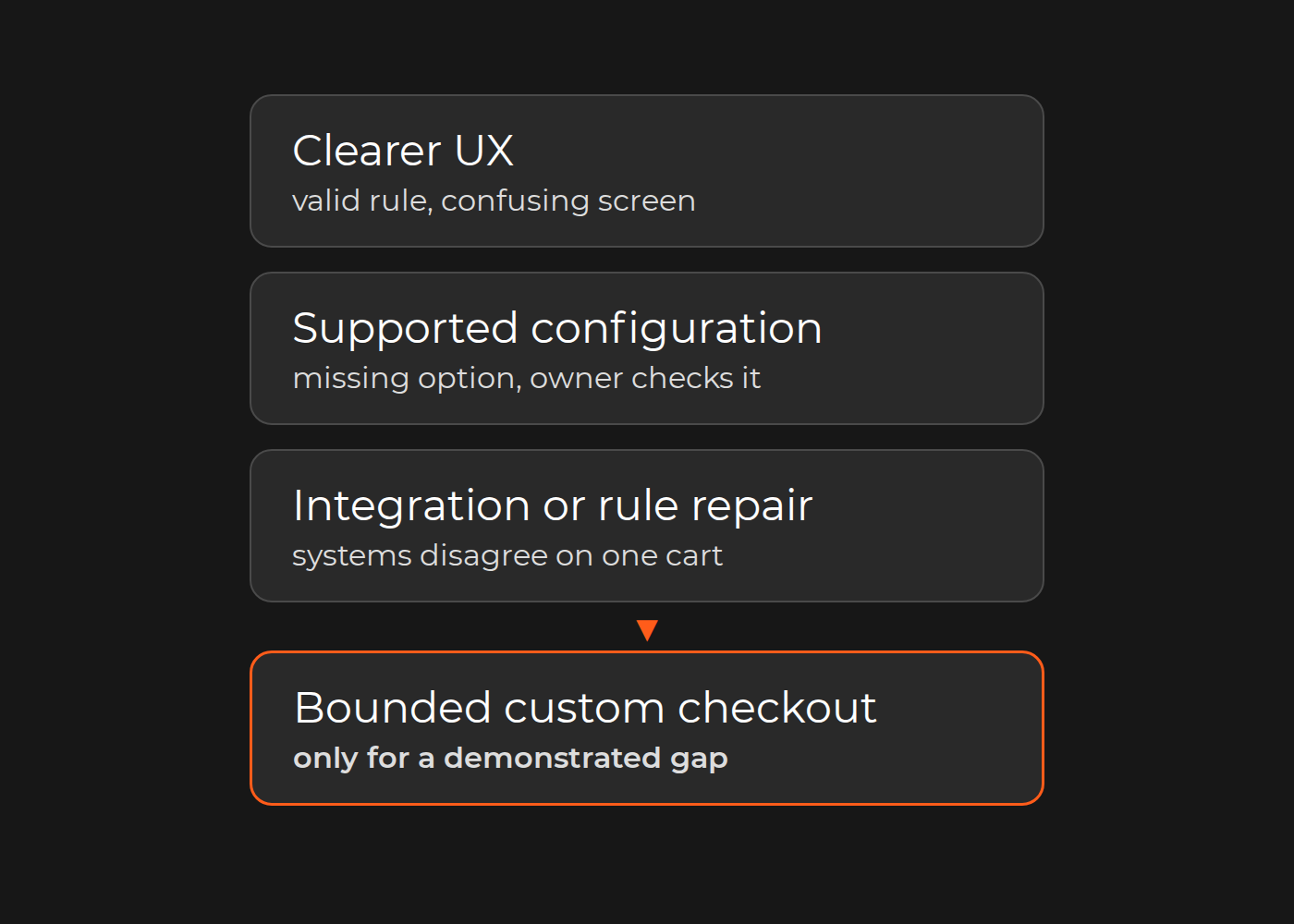
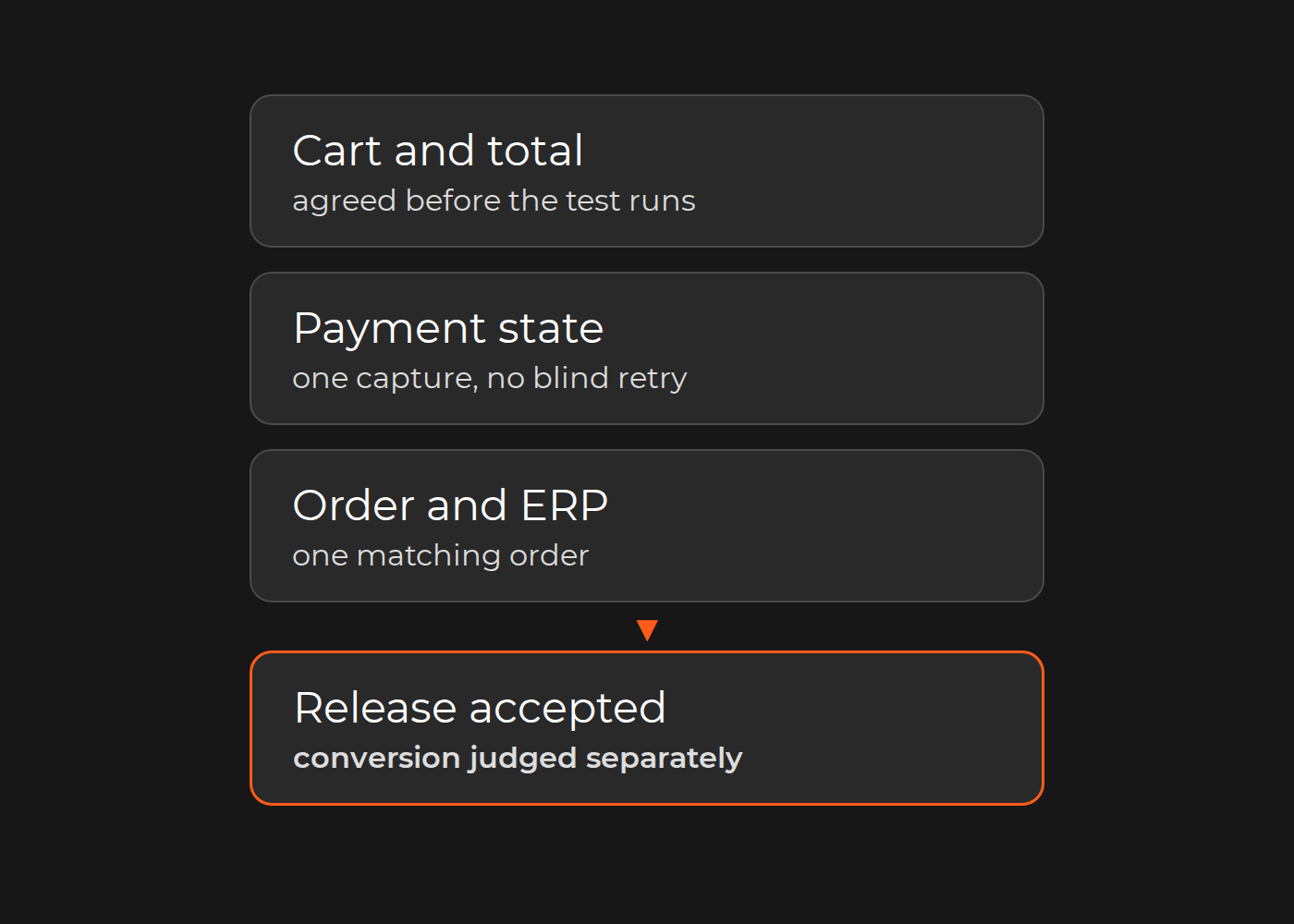
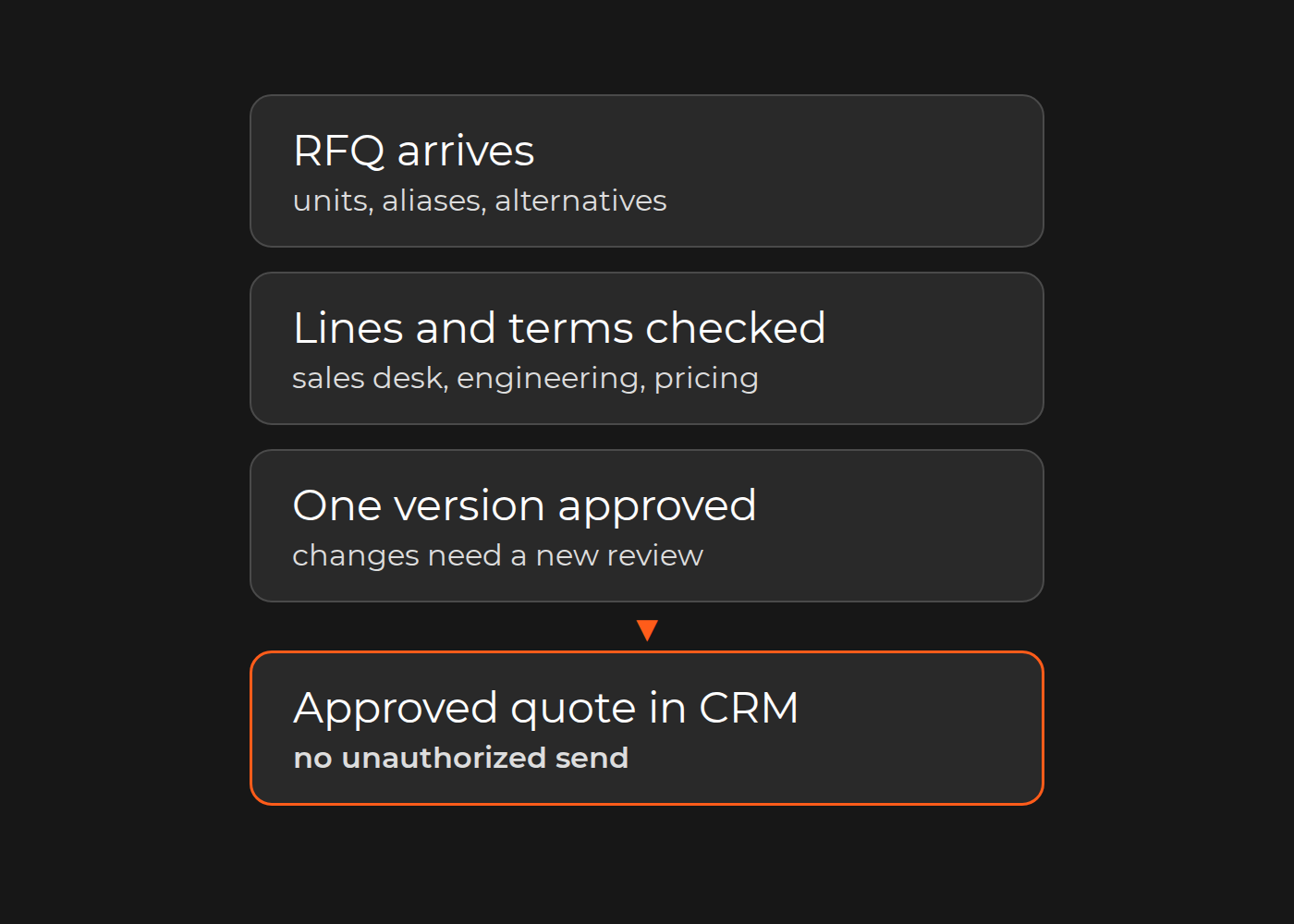
A convincing product discovery demo can find easy products. Acceptance must show what happens with an unfamiliar synonym, an incompatible combination, or a price belonging to another account.
Start with one category, one channel, and a buyer-owned acceptance set. Give candidates the same authorized catalog and rules. Define successful lookup, verified selection, and correct handoff separately, and keep critical control failures outside the general relevance average. Accept the operating handover as well as the answers.
Write cases that expose different defects
Fictional catalog example, not product advice or a client result. P-24 is a 24 V pump. S-A is its only verified seal; S-B is explicitly incompatible; S-C has no verified fit record. Account North may view P-24; South may not. North’s price comes from its authorized source.
Use these six examples to specify observable behavior, then replace the products and rules with your own approved evidence:
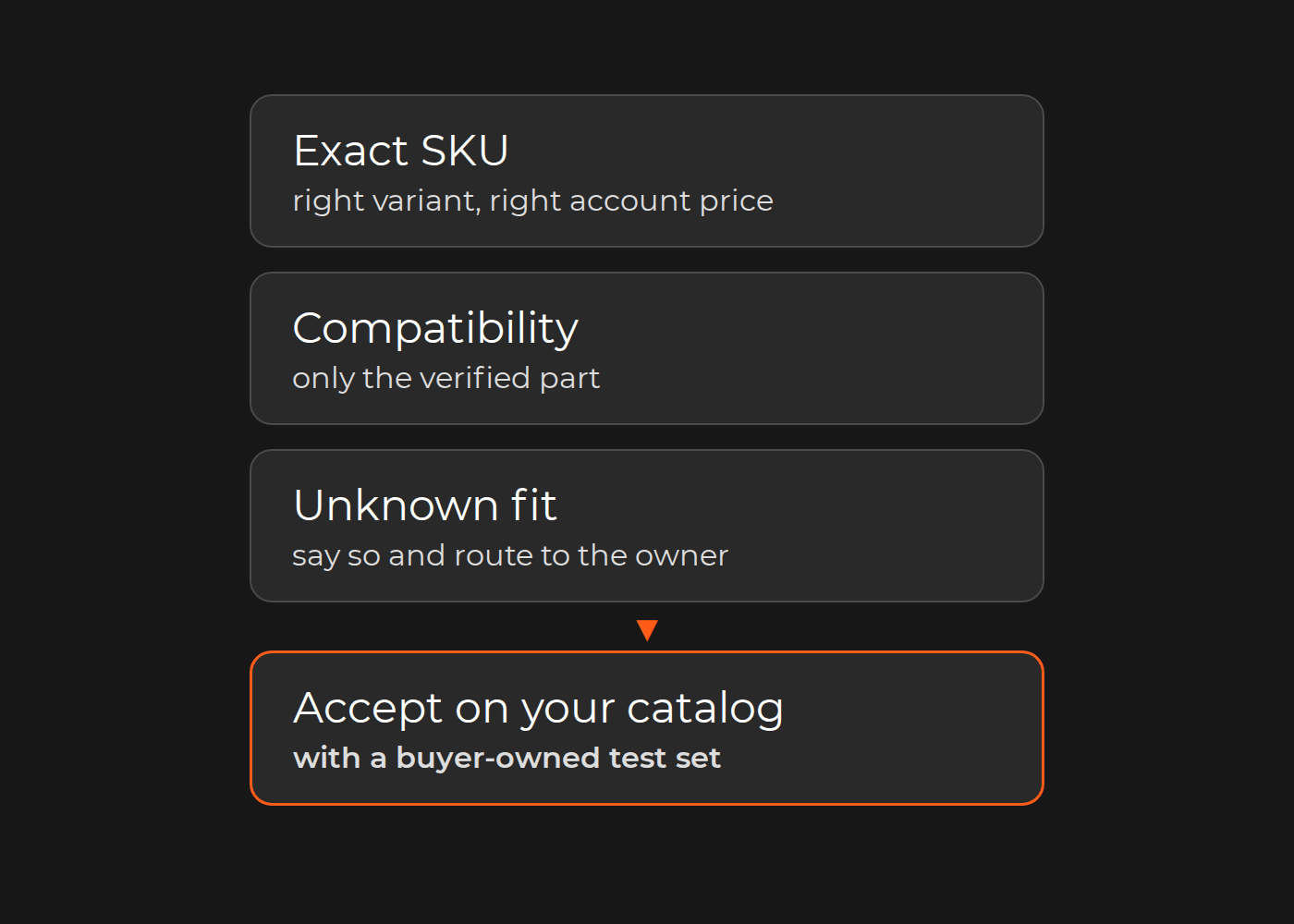
A1 — Exact item. North searches for P-24. Find that exact authorized variant at North’s current source price. A similar variant or another account’s price fails.
A2 — Compatibility. North asks for a seal for P-24. Offer S-A with its approved rule source. Recommending S-B is a blocking defect.
A3 — Unknown fit. North asks whether S-C fits. Explain that compatibility is unverified and route verification to the product owner. Inventing a relationship fails.
A4 — Restricted item. South asks for P-24. Follow the approved restricted-item response without exposing protected product or North’s price information. A browser-hidden result that leaks through an API or assistant response is still a defect.
A5 — Price changes. North selects P-24, then its source price changes before quote confirmation. Revalidate and show the change before confirmation. Silently carrying the earlier price forward fails.
A6 — Missing requirement. A buyer describes a pumping task without voltage. Ask the required clarification rather than assuming 24 V and calling it verified.
Turn each case into one row of your acceptance set. Before the run, record the input, buyer account, expected behavior, blocking condition, and rule basis; during the run, fill in the observed output and the reviewer’s decision.
A correct refusal or handoff is useful, but different from unnecessarily sending a solvable task to staff. An exact SKU result, an exploratory candidate list, and a verified selection need different success definitions.
Freeze the comparison before candidates tune the demo
Use the same catalog snapshot, buyer roles, source rules, and tasks for every candidate. Provide practice examples while keeping a second buyer-owned set unseen until evaluation. Record configuration changes between runs so retests are reproducible.
Build the set from permitted search logs and real sales questions. The catalog owner approves acceptable products, unknowns, and rejection reasons. IT validates visibility, price, stock, and access rules. The ecommerce lead approves task completion; the sponsor decides the category rollout based on the agreed evidence.
Include synonyms, attribute combinations, common tasks, consequential edge cases, and requests with no valid answer. A set made only of easy or high-volume lookups is insufficient. Include current search with corrected synonyms and filters as a baseline. If it completes the tasks, stopping custom scope is a valid outcome.
Separate relevance quality from release-blocking controls
Agree on scoring definitions and business-specific thresholds before the run. Report exact-SKU correctness, relevance judgments, and guided-task completion separately. Where you measure recall, identify the expert-approved relevant set; where you judge ranked results, use the same result depth for every candidate. Record response time under specified load and source conditions, plus the reasons for zero results.
For critical cases, a useful proposed gate is no observed forbidden or incompatible recommendations. A protected-price exposure cannot be canceled out by many successful lookups. A correct no-match response should not automatically count as a failed sale.
Report case counts and risk coverage together. A small clean sample is weaker evidence than a demanding set, even if the demanding set exposes a defect. Include authorized near misses from sales or support, investigate critical failures, and rerun affected cases plus broader checks after repair.
This is a finite acceptance condition, not proof of future safety. Any conversion improvement needs a separate business evaluation; passing relevance tests does not establish uplift.
Keep enough evidence to explain every decision
For each case, retain input, buyer role, catalog and rule versions, configuration version, expected output, observed output, timestamp, and reviewer decision. For conversation, preserve the clarification sequence too. A final screenshot cannot show where an unsupported fit claim entered the answer.
Separate data defects from application defects without excusing either. If the approved rule is wrong, assign its correction and retest. If the rule is right but ignored, locate the enforcement failure. Do not silently rewrite the expected answer to match the demo.
Test ordinary changes as well: a corrected attribute, revoked account entitlement, removed SKU, or updated compatibility rule should reach the customer-facing result through the agreed refresh or invalidation route. Recheck the current price and stock at cart or quote handoff. Define what happens if an authoritative source is unavailable rather than silently treating stale information as current.
Accept ownership, monitoring, and fallback
Name owners for compatibility rules, source corrections, account visibility, price/stock revalidation, and incident decisions. Require the acceptance set and results, versioned configuration, known gaps, monitoring instructions, escalation route, and rollback method at handover.
Have the receiving team walk through a rejected recommendation and a price-change incident. Confirm who can suspend the flow, what triggers escalation, and how the previous route remains usable. A limited rollout should have a named decision-maker and a documented fallback—not just a launch date.
Use delivery evidence for the component it actually proves
An acceptance run can expose source-data work rather than a discovery defect. Dinarys’ BigCommerce case shows that side of the job: for an unnamed office supplies product wholesaler, a team with project management, business analysis, frontend, backend, and QA roles reviewed, updated, or downloaded data on more than 137,000 products, including names, SKUs, and images. In the page’s words, the team had to “run some scripts and workarounds to make the data consistent.” That is data-preparation evidence, not a discovery solution passing fit, account-access, or live-price tests, so ask any proposed supplier to demonstrate the missing behavior on your own acceptance set.
If your set reveals product-data gaps, Dinarys’ PIM services and catalog management services are relevant service paths. Keep data preparation and discovery acceptance as identifiable responsibilities even if one team performs both.
Agree on a category pilot using your difficult cases
Have the catalog owner, ecommerce lead, and IT owner agree on difficult queries, verified rules, account boundaries, and the intended cart or quote action. Use permitted, minimized material rather than an unrestricted customer export.
Talk to Dinarys with that sanitized set, current baseline results, platform/version, authoritative source locations described without credentials, access constraints, proposed acceptors, and rollback requirements. These inputs support a bounded scope and estimate tied to buyer-owned tests—not a demo on convenient products.