Content
E-Commerce
Nov 17, 2026
Fixing Checkout Across Promotions, Payments and Fulfillment
Time to read: 6 minutes

A new checkout design can clarify a shipping fee. It cannot, by itself, decide which promotion applies, reconcile a successful payment with a missing order, or prevent an old payment event from triggering a second fulfillment instruction.
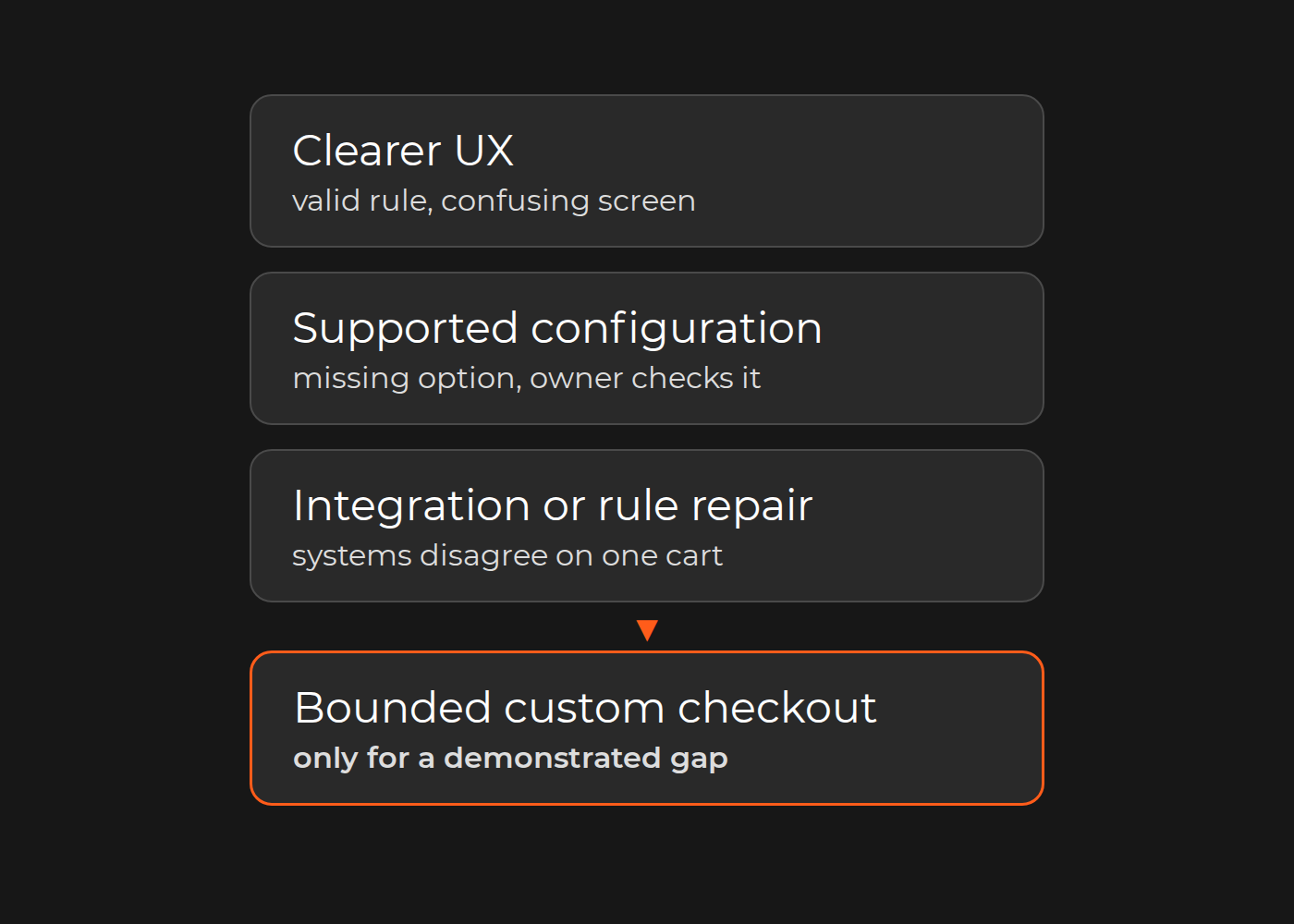
For an ecommerce lead comparing solutions, the question is which barrier is demonstrated. Start with the smallest sufficient change: clearer UX, native configuration, a provider fix, or coordinated engineering across checkout, payment and fulfillment. Consider custom checkout only after supported options cannot implement a necessary rule—not simply because abandonment is high.
Match the scope to the failed boundary
Compare approaches against the same problematic carts. Each option should explain what it fixes, what stays unchanged and who owns the outcome. A broader build should earn its scope by closing a demonstrated gap.
Keep a correct rule; repair its presentation
When buyers cannot understand a valid fee or field, test clearer content, form behavior and validation. Retain the underlying rule if it is correct. Stop at UX when affected carts reach their approved outcome and the confusion is resolved; a presentation problem alone does not justify a new payment or order flow.
Check supported configuration before adding code
For a missing delivery or payment option, verify the native setting or provider configuration with its owner. Retest the affected carts and eligibility. Broader work becomes relevant if a necessary condition spans systems and the supported route cannot express it—not merely because the first configuration was wrong.
Repair the specific integration or rule disagreement
An isolated event-handler failure may need a targeted repair. If an order or payment sits in different states in two systems for the same control cart, involve both state owners and define reconciliation. That is a state problem, not evidence that two systems calculate different totals.
Promotion, tax and delivery disagreements need a calculation check: compare each system's result for the same cart and rule version. Agree the authoritative outcome with the rule owners, then change the affected mapping, rule or event path. A new screen cannot resolve contradictory business definitions.
Consider bounded custom checkout only for a demonstrated gap
A custom checkout becomes a candidate when a commercially important control cart cannot reach its agreed outcome using supported configuration or extensions, and the business decides the underlying rule must remain. Compare custom development and maintenance with changing that rule or retaining the supported flow. A failing cart does not automatically justify replacing the whole checkout.
An issuer decline is not automatically a technical failure. An unaffordable delivery fee is a commercial condition, even when its presentation needs improvement. A broken payment-return screen may be a UX/technical defect while payment itself succeeded. Separate these causes in your payment and order records before a redesign is scoped.
Turn the rules into a control-cart matrix
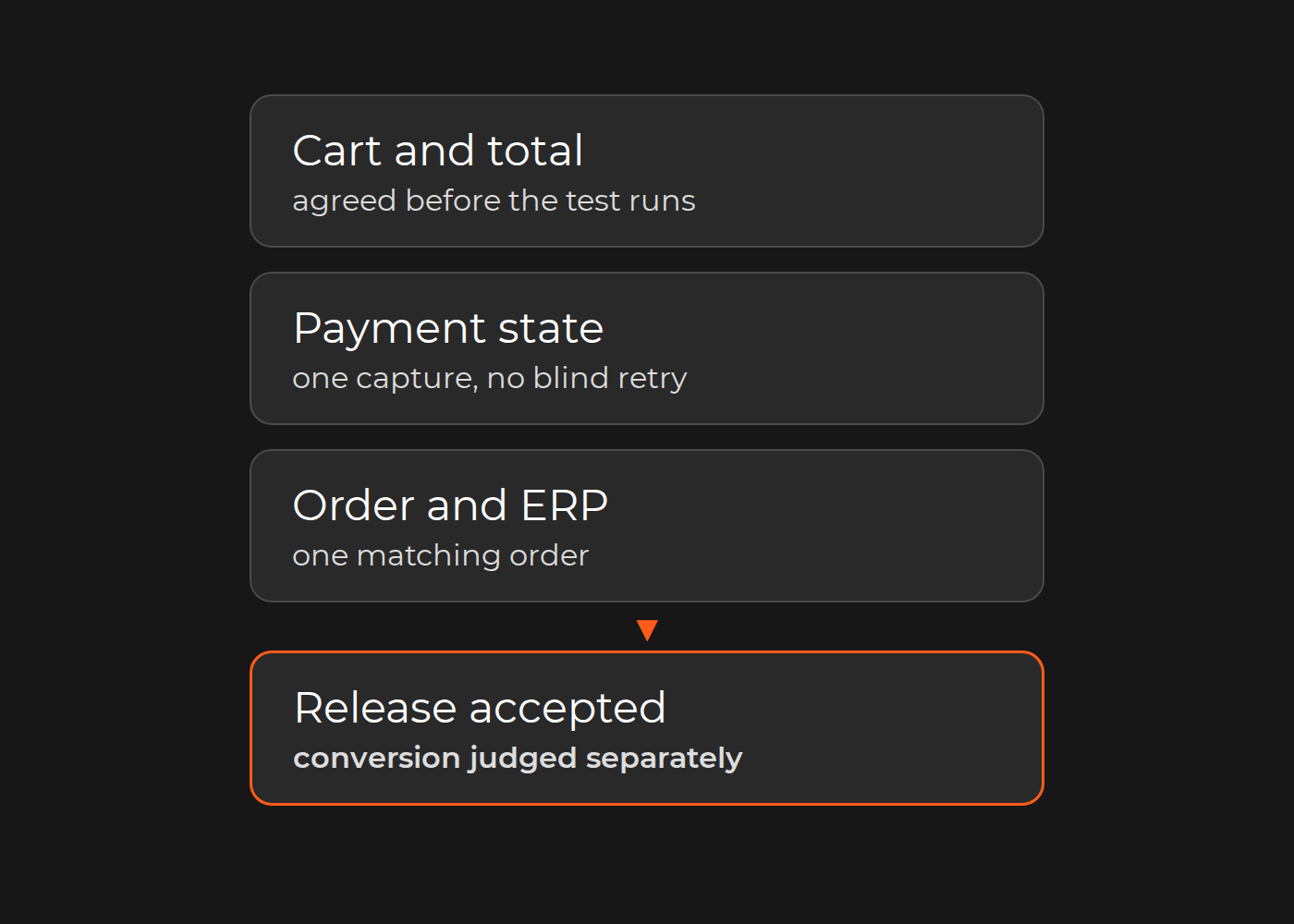
Agree expected outcomes before comparing implementations. Include payment method, promotion/bundle, tax fixture, fulfillment mode, currency, guest/login and device/browser. Select combinations around the observed fault, common flows and high-consequence exceptions. No small matrix proves coverage of every possible cart.
The following fixture is entirely fictional. Merchandise is $120; SAVE10 takes 10% off merchandise; free standard shipping requires a post-discount merchandise amount of at least $110. Otherwise shipping costs $8. Pickup is free and available only at location L1. Tax is fixed at $0 solely to isolate this example; real tax expectations require the authorized tax/finance owner.
The promotion owner approves the discount and threshold interaction, the payment owner checks the requested amount, and the fulfillment owner approves shipping or pickup eligibility. One person may hold several roles; each boundary still needs an accountable owner.
| Control cart | Expected result | Scope acceptance check |
|---|---|---|
| Standard shipping, no promo | $120 + $0 shipping + $0 tax = $120 | Provider request and order agree |
| Standard shipping, SAVE10 | $108 + $8 shipping = $116 | Buyer sees $116 before payment confirmation |
| Pickup L1, SAVE10 | $108 + $0 pickup = $108 | Correct location reaches the order |
| Pickup L2, SAVE10 | Ineligible; explain permitted choices | No payment request for invalid option |
| Standard/SAVE10, further payment action required | Proposed total $116; payment pending | No false paid confirmation |
| Standard/SAVE10, provider success/order unknown | Expected amount $116 | Reconcile; no blind repeat charge |
The discount makes the shipped total fall by $4, not $12: $120 becomes $116. That may be intentional policy or an undesirable offer. The business owner decides. Engineering must implement and explain the agreed rule consistently rather than silently changing the threshold to make a demo look better.
What coordinated checkout work looks like in a case
The Prostor case describes Dinarys' Magento 2 migration with checkout changes including OTP authentication, bank card tokenization and guest checkout, plus unified loyalty and offline pickup. These components show why a purchase-flow change can involve more than page design: identity, payment convenience and fulfillment eligibility meet in the same journey.
The case also reports inventory-state inconsistencies during early ERP synchronization work that required manual reconciliation, followed by adjustments to sync frequency and a validation layer. That is a useful coordination lesson: put operational reconciliation and a named integration owner in scope. It is not a report that Prostor had the fictional promotion defect above, nor a transferable checkout-uplift estimate. The case's wider migration scope is not a reason to migrate your platform.
Dinarys sells retail software development and back-office integration, so we have a commercial interest in the engineering route. Native configuration or a targeted support fix should still win when it satisfies the control carts.
Payment and order state need their own acceptance rules
Agree which provider state permits order creation or fulfillment release, and who reconciles an unknown result. Event receipt alone is not proof of completion. Carry these boundaries into scope rather than treating a new payment screen as an end-to-end fix.
For a custom route, document the failed supported option, bounded behavior, control carts, target-device checks and operational handover. Test a return from payment on the affected mobile device as well as the desktop happy path. Include duplicate, delayed and missing-event recovery—not just a feature demo.
Keep a full platform migration, every country, pricing-strategy changes and revenue guarantees outside this bounded scope unless separately justified. None of the faults described here requires AI as its repair mechanism; model-controlled payment or refund decisions do not belong in this proposed first release.
Accept the selected scope in two steps. First, every control cart must reach its agreed outcome. Then measure completed orders and business guardrails against a consistent baseline. Checkout redesign acceptance should cover linked payment/order state, rollback and a plan to measure effect separately from traffic or campaign changes.
Choose a bounded redesign scope
Discuss an end-to-end checkout scope with Dinarys. Bring problematic carts, minimized linked event/payment/order records without card data, business-rule definitions and the promotion, payment and fulfillment owners.
Use the control-cart matrix to agree why the intervention is sufficient, what remains unchanged, who accepts it and who recovers the flow. Ecommerce owns business priorities; IT and the state owners validate feasibility and release risk; the authorized budget owner approves the scope. Estimate after those boundaries are clear.


Lassen Sie Profis Ihre Herausforderung meistern
Unsere zertifizierten Spezialisten finden die optimale Lösung für Ihr Unternehmen.