Content
E-Commerce
Nov 17, 2026
Choosing a Partner for AI-Assisted RFQ-to-Quote Integration
Time to read: 6 minutes

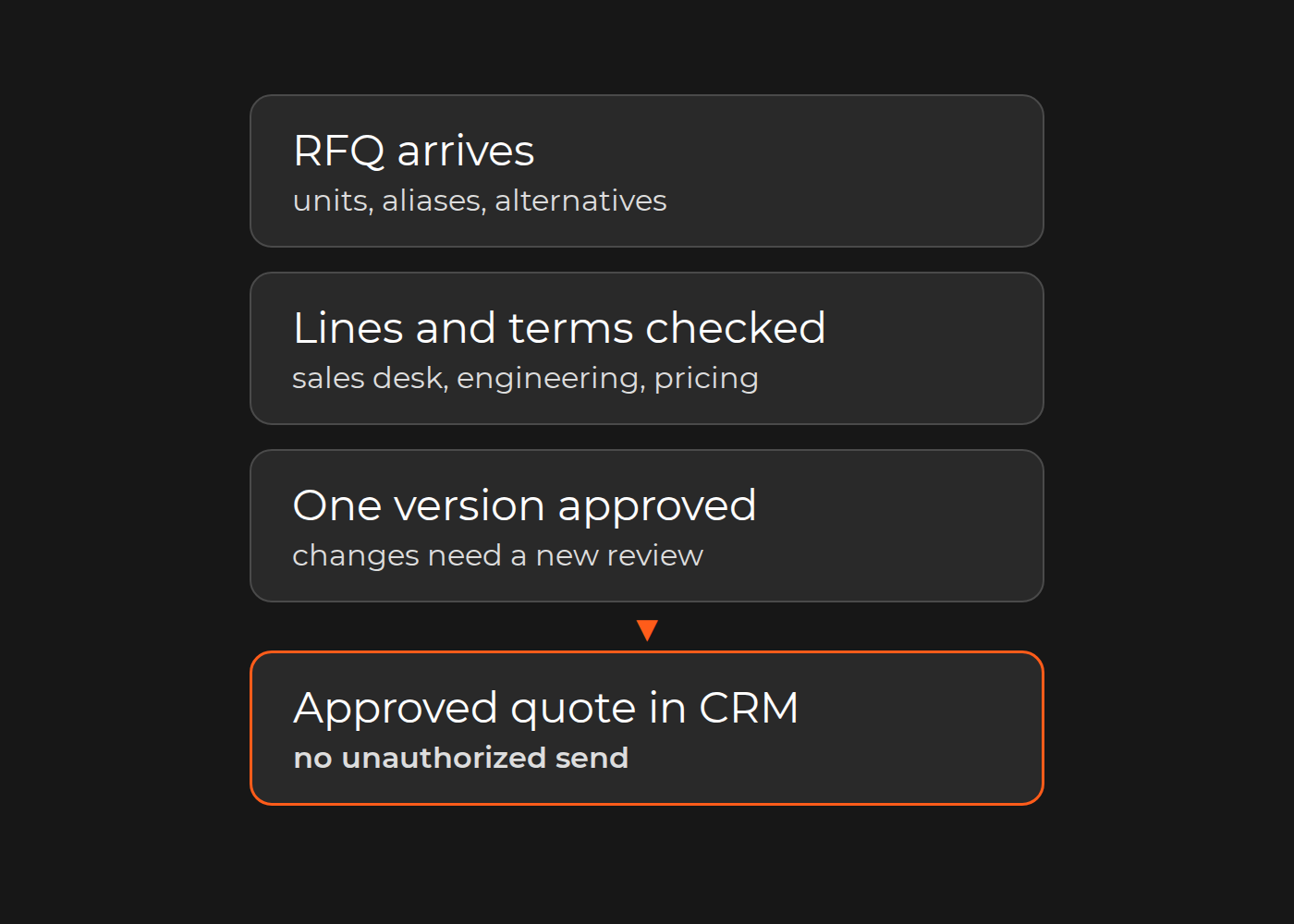
A convincing RFQ demo can end with a polished document. Your pilot needs something harder: a traceable, approved quote record in the agreed CRM workflow, with correct products and terms and no unauthorized customer send.
For a commercial director buying this integration, selection should revolve around who accepts product matching, pricing, and approval—not just who builds extraction. Bring the pricing owner into evaluation before the proposal fixes the scope.
Dinarys publishes this guide and is a potential integration supplier. Apply the same tests to us. This is a method for selecting a scoped delivery partner, not a ranked vendor list or a claim that one company covers every RFQ discipline.
Ask for evidence of the competence you actually need
Separate document processing, technical catalog work, pricing/CPQ integration, and controlled delivery. A connector demonstrates exchange, not engineering compatibility; extraction demonstrates neither correct terms nor approval authority.
Ask candidates to name the responsible people and show permitted artifacts: a source-linked review screen, mapping test, commercial exception, or handover demonstration. Request references only where disclosure is authorized. A domain/CPQ specialist may be the better lead when product rules are the main challenge.
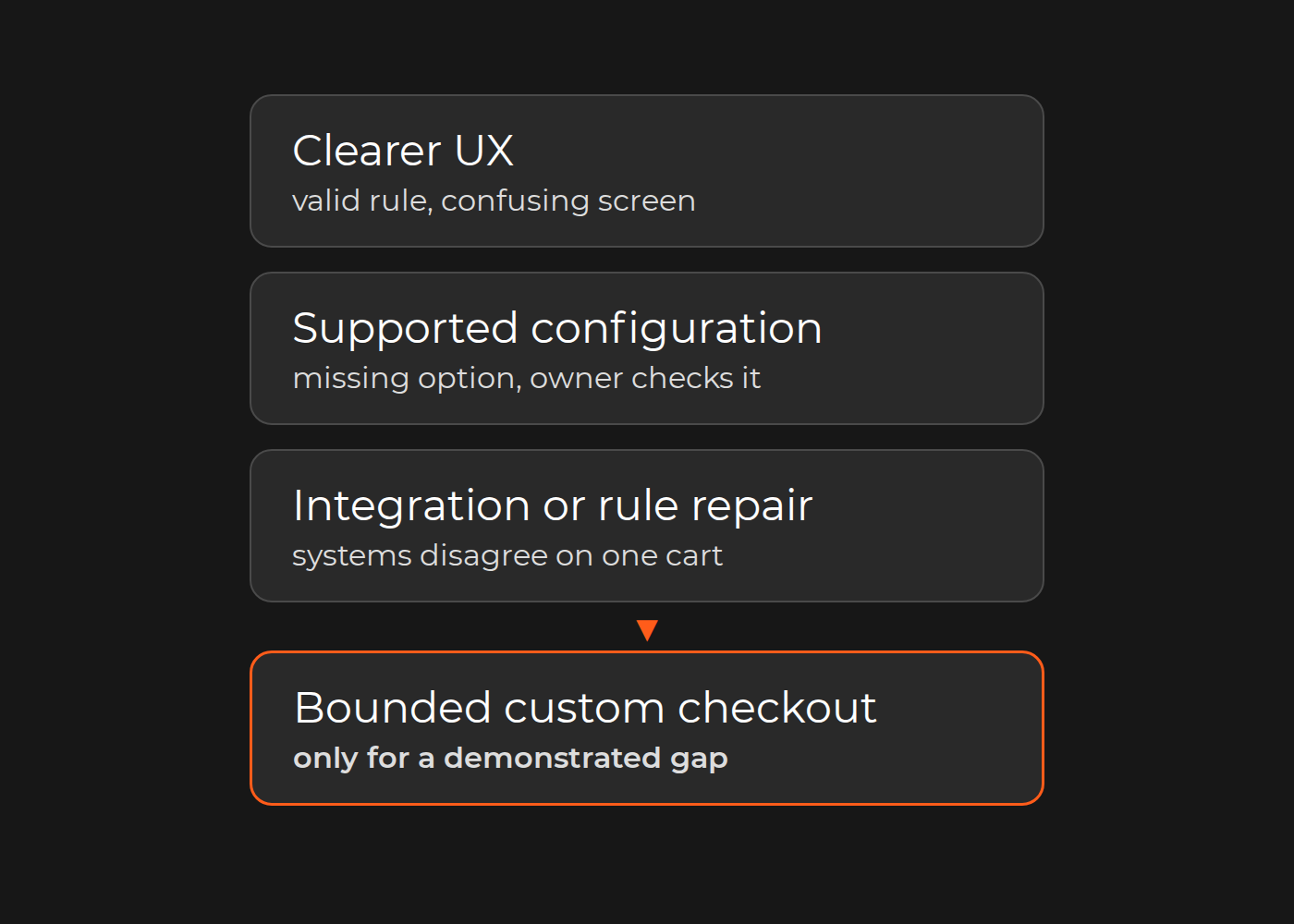
Evaluate your existing provider first. A structured price template or standard cart may be sufficient. Custom work belongs around demonstrated gaps such as variable inputs, nonstandard nomenclature, and cross-system review—not an assumed replacement of the entire CPQ. If the approach is undecided, compare CPQ, rules-based, and AI-assisted quote automation on your own control RFQs before selecting an implementer.
The SanMar ERP case illustrates relevant but bounded Dinarys work: Magento 1-to-2 B2C migration, B2B technical documentation, and a custom API connector for a legacy ERP data format, connecting the B2B and B2C websites to the existing ERP for real-time product and order data exchange. The BigCommerce case, for an unnamed office supplies product wholesaler, describes inconsistent-field normalization, AI-assisted categorization, and request-to-quote functionality.
Those are actual integration/catalog components, not proof of a completed AI RFQ/CPQ deployment, compatibility engine, or pricing-approval workflow. Ask for evidence of the additional competence and test the proposed team on your scope. Dinarys’ nearest service route is ERP integration services.
Freeze the test set before the demonstration
Prepare permitted requests and reference answers with sales engineering and pricing. Validate historical final quotes before treating them as correct. Keep a later-period set unavailable to prompt/mapping tuning and use the catalog, prices, and customer terms available at the historical decision time.
Give candidates the same product family, sales-desk boundary, interfaces, exclusions, and approval rules. A proposal that omits a boundary owner or excludes a changed-quantity test is not comparable. Agree the test environment, critical defects, evidence to retain, and who may accept residual risk.
Run eight buyer-owned checkpoints
These are proposed requirements, not executed results. Use separate controlled variants when necessary; do not carry an unresolved line into approval merely to keep the demo moving.
1. Expose a missing quantity basis
Show a request that does not establish pieces versus packs. The sales desk checks the source-linked unresolved field. Stop if the candidate guesses or hides the missing unit.
2. Expose an ambiguous alias
Use a customer alias mapping to two SKUs. The catalog owner or sales engineer checks that both candidates and the ambiguity remain visible. Stop if the system silently selects one.
3. Keep an unapproved alternative unresolved
Suggest an alternative without compatibility approval. Engineering checks its technical exception and source evidence. Commercial approval or model confidence must not bypass that decision.
4. Challenge commercial constraints
Test a minimum-order violation, expired price/wrong currency, and discount below the approved floor. Pricing checks that invalid terms block approval until authoritative terms are retrieved and reviewed; the commercial approver handles the discount exception. Stop if a constraint is silently waived or the offer changed without authority.
5. Bind approval to one version
Suppose a fictional quote for 50 packs is approved as version 1. Show who approved it, its prices/terms, and the exact approved version. Only a separately authorized sending step may release that version under company policy.
6. Change quantity after approval
Change the fictional quote to 60 packs in version 2. Keep version 1’s history, but require version 2’s applicable review. A refreshed PDF with a copied approval badge is not sufficient. Stop if approval for the old terms is treated as approval for the changed offer.
7. Attempt an unauthorized send
In the controlled environment, attempt to transmit an unapproved draft. The sales/process owner checks denial and the recorded attempt. Stop if a generated document or stale approval permits sending.
8. Interrupt and replay the CRM handoff
Simulate a timeout/replay. IT checks the recoverable exception, duplicate handling, and destination CRM record with the approved version and linked source history. A generated quote is not receipt evidence. Stop if local success conceals unknown receiving state or creates a duplicate business quote.
Business/legal owners define actual approval and transmission authority. Adobe’s quote documentation illustrates distinct drafts and submission, subject to its B2B prerequisites; it does not define your company’s authority rules.
Record acceptance without averaging away critical defects
For each checkpoint retain fixture/source IDs, expected behavior, actual result, evidence references, build/configuration version, acceptance owner, and defect disposition. For example, a fictional entry could read: “Quantity change / quote v1→v2 / new review required / copied approval observed / trace Q-2 / commercial process owner / blocked.” That is a sample record, not a reported failure.
Keep critical defects separate from aggregate extraction accuracy. Require no unauthorized prices, substitutions, or sends in the agreed acceptance tests; finite tests do not prove there can be no future failures. A weighted score cannot compensate for an unresolved blocking defect.
Among candidates meeting those gates, compare the same remaining scope, review effort, recurring software/operating costs, support, and handover. The authorized P&L owner or CEO/CFO approves investment; IT/security and product/pricing owners retain their acceptance responsibilities.
Buy operational control as well as integration
For one product family and sales desk, specify the inputs, exclusions, system of record, and owner who can pause processing. The seller should see the source RFQ beside proposed lines. Define reconciliation to the CRM, failed-handoff alerts, and how operators resume the current manual process.
Accept handover when your operators can resolve an exception, maintain an alias under change control, and retrieve decision history without the provider’s live assistance. Include ownership of mappings, test sets, integration contracts, configuration, access, monitoring, and support/change responsibilities. Obtain appropriate contractual review rather than treating this guide as legal advice.
Measure review effort, completeness, turnaround, and rework against comparable requests, including difficult and unresolved ones. Faster drafts alone do not establish recovered engineering capacity, more wins, or ROI.
To discuss a demonstration boundary with Dinarys, bring permitted control RFQs/final quotes, alias and pack mappings, pricing/approval policy, the destination CRM boundary, and product, pricing, and IT acceptors. End the pilot with an approved receiving record and a rehearsed exception. Expansion to another desk or family is a new scope decision.


Lassen Sie Profis Ihre Herausforderung meistern
Unsere zertifizierten Spezialisten finden die optimale Lösung für Ihr Unternehmen.