Content
E-Commerce
Nov 18, 2026
AI Inventory Forecasting: Platforms, Data and Replenishment Decisions
Time to read: 6 minutes

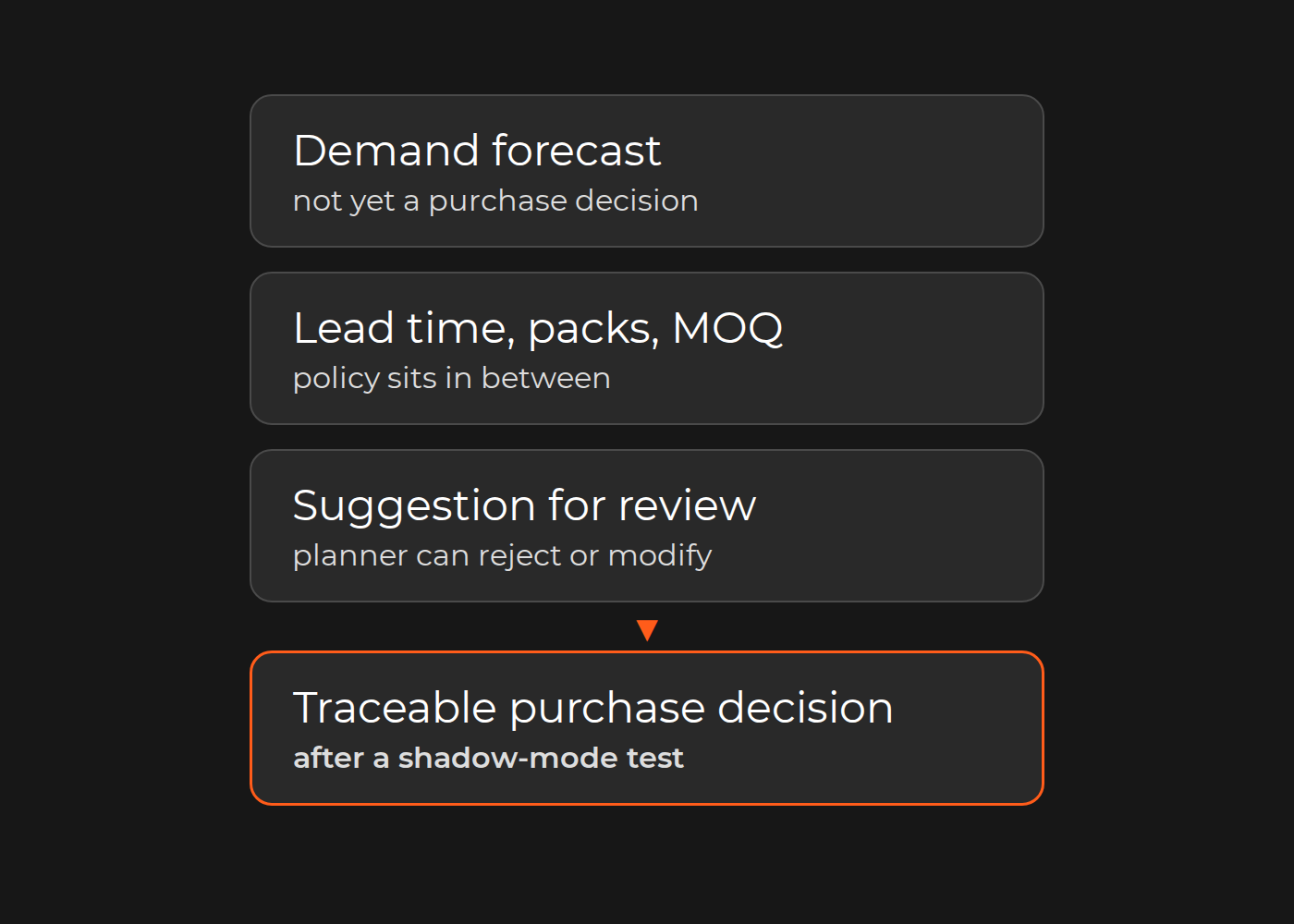
A better demand forecast does not automatically produce a better purchase decision. Lead time, minimum order quantity (MOQ), packs, capacity and service policy sit between the prediction and the order. Evaluate AI inventory forecasting as part of a replenishment cycle—not on a forecast-error chart alone.
For a retailer, distributor or manufacturer comparing inventory forecasting software, the choice is between maintained ERP rules, a planning platform and specialist modeling. Keep ERP rules if they meet the category's lead-time, pack and MOQ needs. Evaluate a platform when locations, promotions or seasonality overwhelm those rules. Commission a specialist model only if a fair comparison still exposes a predictive gap that available software cannot address.
Compare the operating alternatives
Apply the same criteria to each route: usable inputs, constraints, planner control and support after launch. Start with one category and defined locations.
Existing ERP replenishment rules are a reasonable starting point for stable patterns and known purchasing constraints. Check parameter maintenance and exception visibility. Rules lose their advantage when planners must work around them in spreadsheets to handle recurring, material exceptions.
A planning platform with a supply-chain specialist is worth evaluating for multiple locations, seasonal demand and promotions. Verify actual constraint coverage, data requirements and override behavior. A feature name does not prove the product implements your purchasing policy.
A specialist forecasting model addresses a demonstrated predictive gap after baseline comparison. It does not, by itself, provide inventory policy, procurement integration or an accepted planning workflow. Include those separately when comparing total scope.
A custom data/integration layer connects fragmented ERP, WMS, POS and commerce inputs and decisions. It is complementary to the other routes, not a fourth forecasting method. Its cost includes reconciliation, ownership and maintenance—not just the first interface.
Demand forecasting estimates future demand; demand planning turns that estimate into an agreed operating plan. A seasonal naive baseline repeats the last observed value from the corresponding season. Machine-learning models can use additional promotion and price inputs, as RELEX's forecasting guide describes. Whether those inputs improve your decisions must be tested on your data.
A worked comparison: two forecasts, the same suggestion
This fictional worksheet demonstrates policy mechanics, not a validated ordering algorithm. Assume one item/location, individual units, one-week lead time, weekly review and a two-week protection period. Demand is flat for this illustration. There is no safety stock, pipeline stock, backorder or reservation; 15 usable units are on hand. Packs contain 10 units and MOQ is 30 units.
| Calculation | Forecast A | Forecast B |
|---|---|---|
| Weekly forecast | 20 | 18 |
| Two-week target | 40 | 36 |
| Less 15 on hand | 25 | 21 |
| Round up to packs; apply MOQ | 30 | 30 |
A: 20 × 2 − 15 = 25; B: 18 × 2 − 15 = 21. Both gaps round to a 30-unit suggestion. Neither establishes which forecast is more accurate or economically preferable. Either could still stock out before receipt or create excess if demand falls.
That is not a rule that forecasts never change the suggestion. With weekly forecasts of 20 and 30, targets become 40 and 60, gaps become 25 and 45, and rounded suggestions become 30 and 50—a 20-unit difference under the same rules. All are suggestions for planner review, not orders. Measure predictive differences and purchasing differences separately.
Design a backtest around the purchasing horizon
Forecasting: Principles and Practice's rolling-origin method uses only observations before the forecast origin. Apply that principle to the current process, a seasonal baseline and the proposed model. Keep a later-period holdout out of tuning, and repeat comparisons over relevant seasonal and promotional periods where history permits.
Use the promotion calendar as known at each planning date, not the final promotion outcome. Separate expected supplier lead time from receipt delays learned later. Those later facts belong in the evaluation of what happened, not in inputs to an earlier forecast.
Match the evaluation horizon to lead time plus review cadence for the policy being considered. Report bias with its sign convention and absolute error by segment; inspect uncertainty calibration where provided. Percentage errors can mislead around zero demand, so a portfolio score is not enough for intermittent items.
Then replay feasible inventory decisions with explicit starting stock, transit orders, reservations, receipts, pack/MOQ constraints, capacity and service policy. Report availability and inventory value together using finance-approved definitions. Where stockouts censored sales, vary plausible demand assumptions rather than calling reconstructed demand observed truth. A simulation's estimated lost-sales reduction is not observed live benefit.
What to ask a forecasting vendor to demonstrate
Ask for a demonstration on one of your difficult item/location records, with the same input snapshot for every compared approach:
- Which lead-time, pack, MOQ and capacity constraints are respected, and where are they configured?
- How are censored sales during stockouts distinguished from genuinely low demand?
- Can the team backtest against current rules and a seasonal baseline using the same information and horizon?
- Does an override retain the original suggestion, the planner's change, reason and eventual outcome?
For multichannel data, reconcile returns, cancellations and orders so a transaction is not counted twice. Decide whether each warehouse forecast represents local demand, fulfilled demand or network demand: shipping another region's orders can distort the local picture. Long lead times require an appropriate horizon and receipt-uncertainty assumptions, not automatically a more elaborate model.
If the planner cannot reconcile a sales/stock sample, identify missing intervals, locate authoritative pack/MOQ rules or state service and inventory objectives, repair that foundation first: a category-level stockout-and-overstock diagnosis belongs before any platform comparison.
Who builds the data connection and who owns the forecast
The SanMar case describes Dinarys building a custom API connector to convert legacy ERP data into formats required by Magento, connecting the client's ERP with its B2C and B2B websites for real-time product and order data exchange. For the location question above, the Prostor case describes real-time inventory sync across 427+ physical stores and the online storefront: the kind of store-level stock feed a local forecast would read. These components are relevant to the data connection a planning evaluation may need; neither is evidence of a delivered forecasting model or inventory optimizer.
Use Dinarys ERP integration services to discuss the engineering boundary. Assign forecast validation and replenishment-policy competence to a qualified planning/ML specialist, with the supply-chain owner accepting the operating process. Confirm that specialist's role before committing to delivery, rather than assuming an integration team supplies it.
Test the planner's decision before connecting execution
Run suggestions beside the current plan in shadow mode, without placing orders. Show the input snapshot, constraints, explanation and comparison. Let planners reject or modify suggestions for supplier disruption, known account demand, storage limits or data errors. An override is information to investigate, not automatically a mistake to retrain away.
Supply chain should accept the planning behavior; finance should accept the service/working-capital trade-off and budget; IT should verify access, reconciliation, stale-data handling and fallback. Before procurement integration, define what planners must be able to override and how an approved suggestion becomes one traceable purchase decision.
Bring a sanitized, planner-reviewed backtest brief, one decision worksheet, systems list and constraint sample when you contact Dinarys. The useful next step is to identify the remaining data or workflow gap and its owner before estimating a pilot—not to assume a custom optimizer or guaranteed inventory saving.


Lassen Sie Profis Ihre Herausforderung meistern
Unsere zertifizierten Spezialisten finden die optimale Lösung für Ihr Unternehmen.