Imagine sales reports a 40% product margin while finance reports about 28% for the same product and customer. The pricing meeting becomes an argument about spreadsheets instead of a decision about price.
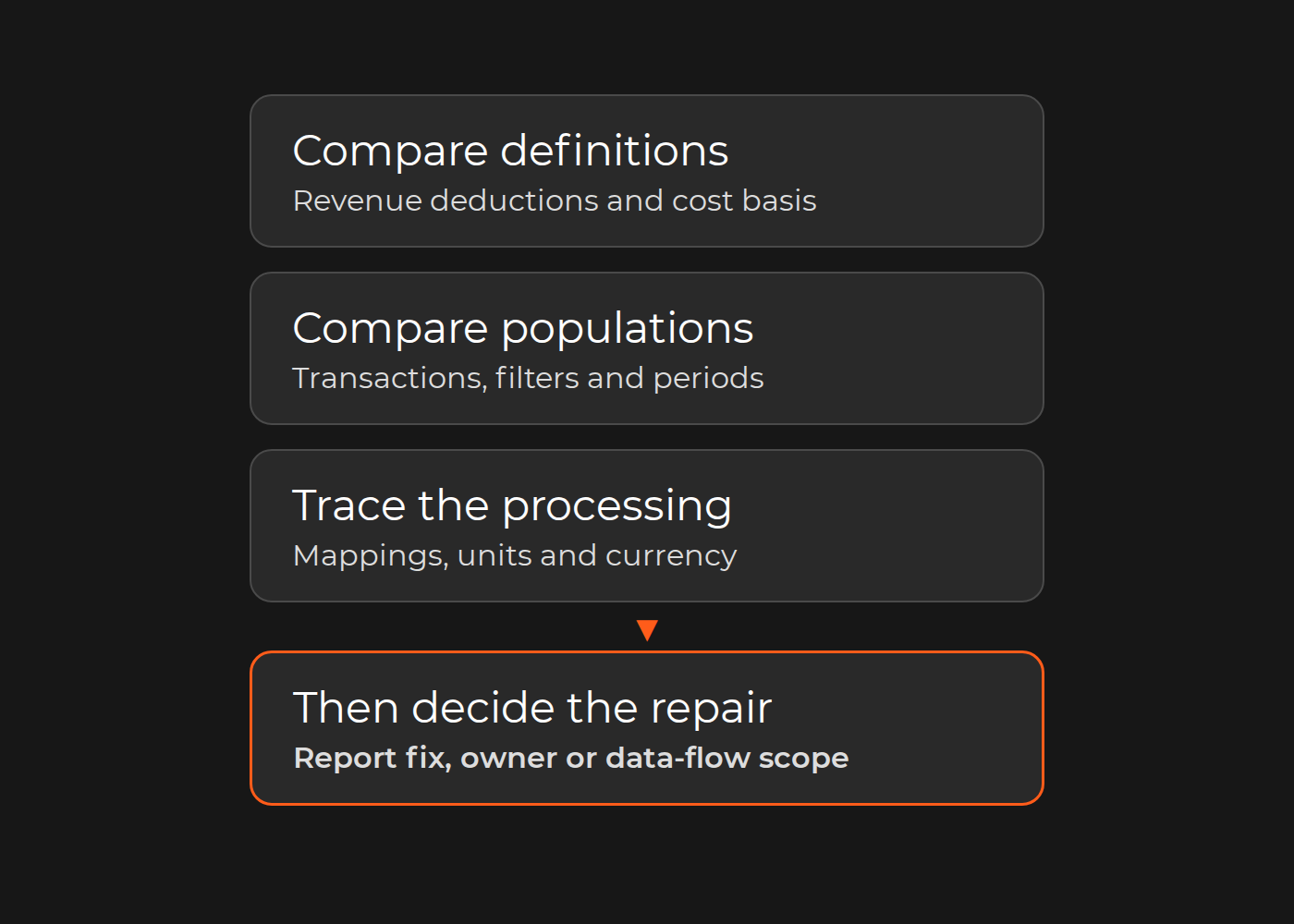
Neither number has to contain an arithmetic error. Compare definitions, then transactions and periods included, then how source rows were processed. Rebates, standard versus actual cost, late adjustments, units, currency, and customer keys can all change what appears under the same “product margin” label.
For the management-reporting example here, margin percentage means (net revenue − included cost) / net revenue × 100. Each report may use different revenue deductions and cost bases. Finance must approve those inclusions and the treatment of zero or negative revenue; this is not a universal accounting rule.
Different margin definitions: gross, contribution, or fully allocated
Gross margin, contribution after selected costs, and a fully allocated management result answer different questions. A standard-cost sales view may support quoting, while finance uses actual cost at close. A late adjustment should not be presented as information the salesperson had at the time of the quote.
Write the formula beside each number, including revenue deductions, cost basis, allocations, returns, freight, and rounding. Ask the controller to confirm the intended decision and metric version. If approved definitions explain the entire gap, label or correct the reports. Do not commission new infrastructure to make deliberately different measures look identical. Keep any unexplained balance open.
How one invoice produces 40% and 28.42%
Illustrative example, not a client result: a customer buys 100 individual units of P-100 in an illustrative September reporting period. All amounts are EUR; there is no FX conversion. The source identifiers below are invented.
Invoice INV-01 has €10,000 revenue. Standard-cost snapshot SC-09 supplies €6,000 cost. An approved rebate accrual RB-01 reduces revenue by €500; actual-cost record AC-09 replaces the standard cost with €6,800 total cost. It does not add another €6,800 to the original €6,000.
View
Net revenue
Included cost
Margin amount
Sales starting basis
€10,000
€6,000
€4,000
After rebate
€9,500
€6,000
€3,500
Actual-cost basis
€9,500
€6,800
€2,700
The starting percentage is €4,000 / €10,000 = 40%. The reconciled percentage is €2,700 / €9,500 = 28.42%, rounded to two decimal places. The €1,300 margin-amount difference is a €500 rebate plus an €800 cost-basis difference—not evidence that a system lost €1,300 or that changing the report will recover it.
The bars show running balances, not deduction sizes or percentage-point changes. The percentage denominator changes from €10,000 to €9,500 too. Finance must approve the rebate's period and actual-cost treatment; quantity is constant, and returns, freight, overhead, and tax are excluded from this example.
Different transactions and periods: same formula, different populations
Two reports can apply the same formula to different transactions. Compare product/customer selections, legal entities, report versions, filters, and extraction times. Invoice, shipment, and posting dates are not interchangeable. Close status, late entries, and adjustments may put the same business event into different periods.
Compare source record counts and control totals for the same entity, product, customer, and period before aggregation. Preserve both original reports and document each selection change. If aligning intended filters and cutoffs closes the gap, repair the existing report. Otherwise, identify missing, extra, or different source lines before blaming the destination platform.
Different data processing: mappings, units, and currency conversion
Trace original identifiers, customer/product mappings, quantities, units, currencies, and retained corrections. A customer key may be reused across entities; an Excel correction may never have reached the underlying flow. Currency conversion needs an approved rate source, date, direction, and rounding rule.
Here is a separate illustrative processing counterexample—not another step in the rebate reconciliation. P-100 has 100 units and €10,000 revenue, with correct cost of €60 per individual unit. The feed stores €360 per pack of six. Applying €360 to each individual unit produces €36,000 cost and (€10,000 − €36,000) / €10,000 × 100 = −260%, instead of 40%. The definition can be right while unit conversion breaks the result.
Follow a deliberately varied sample through each transformation: a normal sale, return, rebate, foreign-currency transaction, and unmapped product where those situations exist. Check source and transformed totals as well as individual rows. Two incorrect products may offset in a convincing grand total.
Stop when finance and the data owner agree the explanation, sample, and acceptable differences. An unexplained balance remains an owned issue, not an accepted result. One explained row does not prove whole-report completeness.
Keep a discrepancy record, not another competing spreadsheet
Document one disputed product–customer–period combination in a single record with these fields:
business decision and metric owner;
entity, product, customer, period, currency, and unit;
for each report: owner, version, extraction time, filters, amount, and percentage;
formula versions, including the treatment of zero or negative revenue;
revenue deductions, cost basis, and allocation rules;
date, cutoff, and adjustment-period rules;
currency conversion and unit rules;
product, customer, and entity mappings;
source row identifiers and correction references;
explained difference and remaining unexplained balance;
issue owner, next test, and disposition;
finance approval reference and date.
For the illustrative P-100 example, the disposition is “definition difference explained; finance approval of rebate period and actual-cost treatment pending.” It is not “pipeline accepted.” Keep the original reports unchanged so another analyst can reproduce both calculations.
The controller or CFO owns the management metric; the commercial director confirms it answers the pricing question; the BI/data owner traces and reconciles the records. If implementation is needed, the authorized sponsor approves that separate scope. The first working session should settle the definition or assign the unresolved difference—not select a database.
Decide the repair after explaining the difference
A filter or formula problem calls for report correction; a bad source value or mapping needs its owner. Repeated manual mapping, multiple ERP extracts, undocumented adjustments, or fragile reloads may justify a scoped data-flow change. A new warehouse is not the automatic next step.
Dinarys' iSi Group case describes, within an ESG-reporting proof of concept, automating a pricing/margins report previously prepared manually in Excel and a data simulation mode for historical pricing, margin, and volume scenarios. The useful parallel is testing whether agreed reporting logic can run as a repeatable flow with traceable data transformations; as a proof of concept, it is not a production reporting platform. It does not supply a universal margin formula or establish that the illustrative P-100 example occurred at iSi Group.
For source-system connection work, see ERP integration services. For a SAP-specific example, the iSi Group support and transition-analysis case describes SAP BW/BI support (daily health checks, incident response, and post-incident summaries) followed by an analysis of BW/analytics data flows, integrations, and reporting dependencies for the ECC to S/4HANA transition. These are separate scopes for the same client; the page describes transition analysis, not a completed S/4HANA migration, and neither case shows a multi-ERP warehouse.
Bring one explained—or still disputed—margin result
Start internally with finance, commercial, and the data owner. If that review identifies a reporting-flow change, share one anonymized discrepancy record with Dinarys: the decision, formula versions, period, system list, source identifiers, current explanation, and unresolved balance. Bring redacted descriptions first, not sensitive financial extracts in the inquiry form.
You may share this article
Lassen Sie Profis Ihre Herausforderung meistern
Unsere zertifizierten Spezialisten finden die optimale Lösung für Ihr Unternehmen.