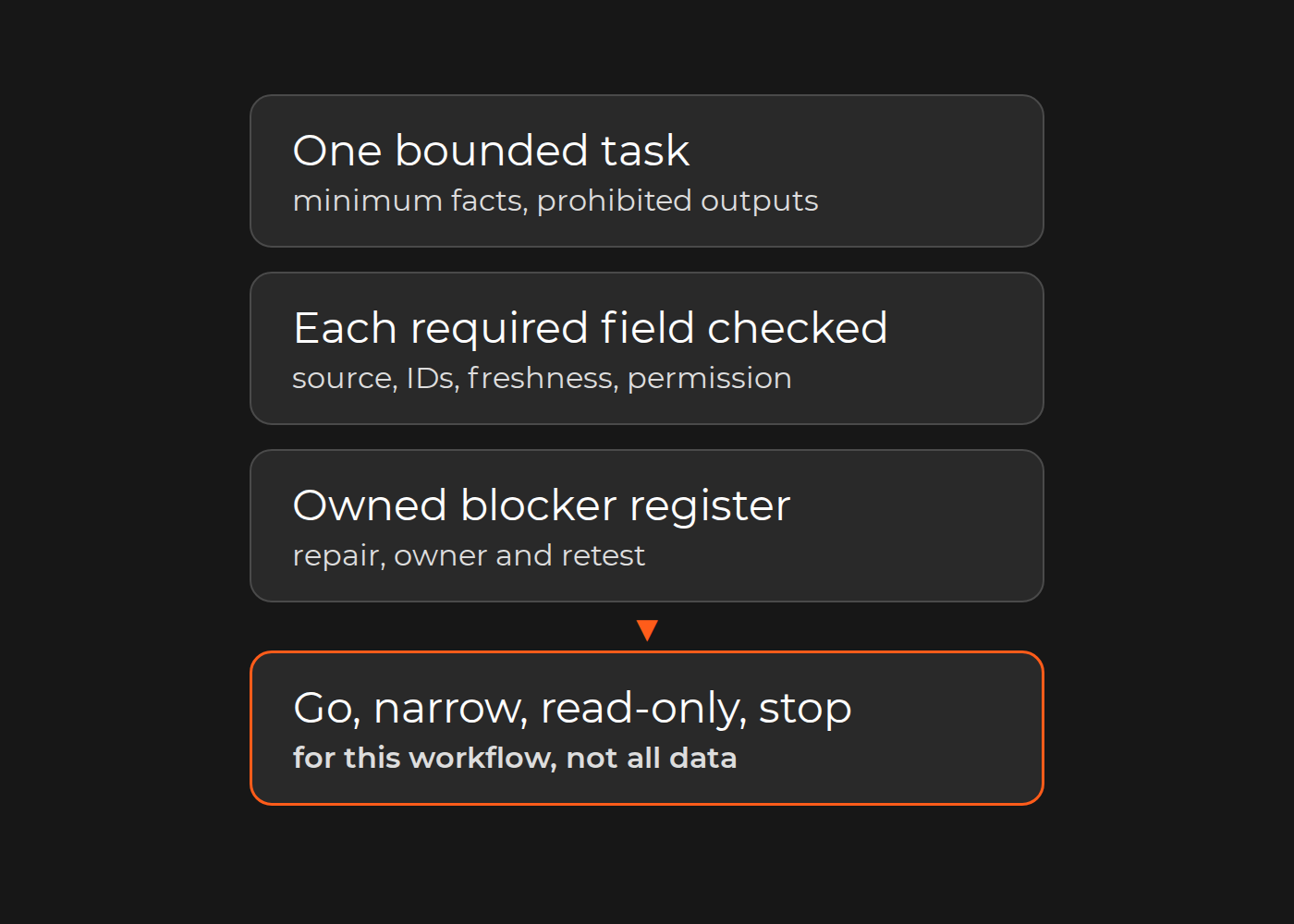
Your data can be ready for one AI task and unsuitable for another. Approved product facts may support description drafts even when customer identities cannot be reconciled. The same catalog may still be unready for compatibility recommendations or promises about delivery.
Readiness means the chosen workflow has usable, permitted, traceable data—and a defined response when that data is missing or stale. It does not mean every field in the business is perfect or that all records must move into a new platform.
For a CTO, ecommerce operations lead or PIM owner, the practical output is a short blocker register: which fields the workflow needs, who owns them, what failed, and whether to repair, narrow the pilot or proceed read-only. The field card and result record below give you a format for that decision.
Define the task before inspecting the database
Choose one outcome, such as proposing categories for a product family or answering an authenticated customer's order-status question. Identify the minimum facts needed and the prohibited outputs or actions.
A description draft may need supplier specifications, approved language and a reviewer—but no customer history. Personalized recommendations may need product eligibility, permitted behavior data and reliable item/customer links. An order update additionally requires current state, authority and a tested transaction path. Do not collect customer data merely because the project includes AI.
Check product, customer, inventory and order data separately
One “complete” record can contain an incorrect unit, an obsolete relationship or another account's price. Inspect meaning and relationships, not just nonempty cells.
Dataset
Questions to resolve
Blocking example
Product
Which SKU/variant, units, source version and approved claims?
Parent dimensions copied to a different variant
Customer
Which account/person, permitted purpose and entitlements?
Two companies merged because they share an email domain
Inventory
Which item/location, sellable quantity and timestamp?
Physical stock presented as available to promise
Order
Which business order/revision, owner and current state?
Retried event treated as a second order
For products, include media-to-SKU relationships, category definitions and compatibility evidence where required. A photograph may show appearance without establishing a material, load rating or fit. For customers, distinguish guest, person, business account and authorized buyer; matching a name is not authentication.
For inventory, document how reservations, damaged/quarantined units, buffers and location restrictions affect sellability. Avoid subtracting the same held units twice if source categories overlap. For orders, separate payment, warehouse, shipment and refund states. “Parcel received” must not silently become “refund completed.”
Establish source authority and stable identifiers
For each required field, record the authoritative source, its owner, source identifier, transformation and destination identifier. Authority can be split: PIM owns approved descriptions, ERP owns contract prices and the OMS owns fulfillment state. Choose the source for the field, not one system to be “master of everything.”
Customer/account → permitted price list and catalog.
SKU plus location → inventory record and unit.
Commerce order → ERP/OMS order, revision and event references.
Preserve meaningful leading zeros and identifier types. Do not fuzzy-match near-identical SKUs into the same product without an approved alias rule. Test missing parents, orphan media, reused codes, variants and customer-specific units. A reversible mapping should explain how a displayed value was derived—not merely which batch created it.
Record each required field on a short card:
Record and field; source ID → internal ID → destination ID, with types and leading zeros preserved.
Authoritative system and owning role; source version or location and any transformation.
Source event timestamp, ingestion timestamp and timezone; acceptable age and the reason for it.
What happens when the value is missing or conflicting, and the consequence for the workflow.
Allowed purpose, users and receiving services; retention, deletion and export requirements.
Decision (block, narrow, read-only or monitor), repair owner, evidence to close, retest and review date.
Dinarys' SanMar integration case is a non-AI illustration of these boundaries. The B2B and B2C websites had to be integrated with the client's existing ERP, and the stated goal was real-time data exchange for the product catalog, order fulfillment and product availability. The route was a custom connector that translates the ERP's legacy data format. An AI workflow reading such data inherits the same questions: which system owns each field, in what format it arrives and how current it is.
Make freshness and conflict behavior explicit
Store the source event time and ingestion/refresh time separately. A record fetched now can describe an old event. Agree acceptable age by decision: a stable material specification and a last-unit availability claim do not have the same freshness requirement.
Document what happens when the limit is exceeded: omit the claim, fetch the authoritative source again, show uncertainty or hand off. A model should not choose whichever conflicting source makes a more confident answer. Keep conflict detection and source precedence inspectable.
Dinarys' Prostor case shows why this belongs in the plan. During the Magento 2 migration for an omnichannel drugstore chain, ERP data synchronization in the early sprints produced inventory-state inconsistencies that needed manual reconciliation. The case page says they were identified and resolved during the first month of post-migration operations, and that the resolution involved adjusting sync frequency and adding a validation layer. Those amount to a freshness setting and a conflict check. The project was not an AI implementation, but any AI step reading that inventory would have depended on both.
Hypothetical example: a warehouse record shows 12 physical units, with 5 reserved and 2 quarantined in separate, nonoverlapping groups. Under this merchant's simplified rule, 12 − 5 − 2 = 5 sellable units. A storefront cache still shows 8. The readiness finding is a freshness/reconciliation gap, not permission for AI to promise 8—or an instruction to adopt this formula for every warehouse.
Example record
IDs and authority
Owner
Readiness finding
Product P-041, blue
SUP-41B → SKU-041-B; spec v3
Catalog
Material sourced; load rating missing
Inventory SKU-041-B
WH-A record; warehouse source
Inventory operations
5 sellable; cache 8 must be resolved
Order O-702
Commerce O-702 ↔ ERP E-991
Order operations
Revision/state needed before update
These are fictional records. On each field card, add actual source timestamps and acceptable-age policies. A blank timestamp is unknown freshness, not evidence of real-time data.
Confirm permissions and minimize personal information
Before exporting records for a readiness test, list where the chosen workflow's data would travel—source systems, middleware, model services, logs, indexes and reviewer tools—and confirm the permitted purpose and receiving roles. Privacy/legal and security owners decide the applicable requirements for the actual deployment.
Test with synthetic or minimized samples where they can exercise the behavior, and keep authentication secrets and payment credentials out of evaluation files. A sample is not anonymous just because names were removed: order IDs, free text and attribute combinations can still identify people, so treat pseudonymous data under the applicable policy.
Include access cases in the readiness sample itself: another customer's order, a restricted B2B price list and a role change. An internal analyst's database access does not automatically authorize sending the same data to a model provider or customer-facing assistant.
Quality checks for recommendations and descriptions
These uses have different readiness gates. Do not accept one overall “data quality score” as proof for both.
Recommendations: distinguish similarity from verified fit
Check valid SKUs, current eligibility, compatibility rules, account visibility and stock/price sources. Use product-expert judgments for relevant, invalid and unknown selections. Historical clicks or purchases can help a relevance test, but do not establish compatibility or causality.
If behavior history is sparse or not permitted, compare nonpersonalized rules, filters and category-based suggestions. There is no universal minimum history length that makes every recommendation project viable. A new item may need content-based evaluation, while a behavioral model needs its own coverage and leakage checks.
Keep evaluation inputs consistent with what was knowable at the time. Do not let later purchases, future stock or corrected product facts leak into a historical prediction test. Include cold-start items, unusual variants and cases where no recommendation is justified.
Descriptions: every factual claim needs an applicable source
Compare proposed text with the approved product/variant specification and claims policy. Check units, material versus finish, included accessories and unsupported suitability claims. Missing required facts block the relevant publication; optional unknown facts can be omitted.
For fictional P-041, “oak-effect finish” does not authorize “solid oak.” An unknown load rating must not become a plausible number. Save the source version and field location with the proposal, then bind approval to that version. Editing a required fact should invalidate any approval that depended on it.
The BigCommerce catalog case reports AI-assisted categorization and scripts/workarounds to normalize inconsistent names, SKUs and data types. It is relevant evidence for catalog preparation and categorization—not proof of automated supplier-document intake, recommendation accuracy or AI-caused conversion uplift. Its overall catalog scope is not an AI-processed SKU count.
What to fix before the pilot—and what can wait
Classify each issue by its effect on the chosen task:
Block: no right to use the data; unresolved required identity/unit/claim; inability to enforce account boundaries; no trustworthy expected outcome. Do not release that workflow.
Narrow: one product family or source type is usable, but others are not. Exclude unsupported records explicitly and measure that coverage loss.
Proceed read-only: inputs support comparison, but write controls or operating approval remain incomplete. This authorizes evaluation, not transaction changes.
Monitor: an optional field does not affect the scoped outcome. Record the limit and an owner rather than expanding cleanup indefinitely.
Build a representative sample containing normal records, missing values, conflicts, stale events, duplicate/revised orders and restricted accounts. Keep tuning examples separate from final evaluation. Count all sampled records: accepted, held, rejected and unresolved. High accuracy on a tiny accepted subset can hide unusable coverage.
The data owner accepts definitions and source evidence; operations accepts exception handling; IT/security accepts access and interface behavior. The authorized sponsor approves the limited scope and cleanup budget. Use observed failures and reviewer capacity to set thresholds, not a generic readiness score.
Leave with a small, owned repair backlog
Each blocker should have an affected field/record, source, consequence, responsible owner, repair and retest. A mapping correction can go straight to implementation; a shared ownership problem may need a workflow change.
Keep the result record in one place: sample selection and size with its rationale; accepted, held, rejected and unresolved counts that sum to the total; critical field errors, unsupported claims and access failures; coverage by product family, source and account type; full review and correction effort; remaining blockers with owners; and the scoped go, read-only, narrow or stop decision with its accepting owners. Unchecked or unknown is not passed, and no total score overrides a critical data-rights, identity, unit or authorization defect. PIM services are relevant when catalog modeling, review or controlled distribution is the demonstrated gap—not because every AI task needs a new PIM.
Discuss readiness with Dinarys using a non-sensitive workflow description and a sanitized SKU/order/stock example. Identify your data and technical owners, current controls and the decision you want the pilot to support. Real records can follow once a permitted transfer route is in place. The next purchase should repair the identified gap or test a bounded use case, not clean the entire business “for AI.”
You may share this article
Lassen Sie Profis Ihre Herausforderung meistern
Unsere zertifizierten Spezialisten finden die optimale Lösung für Ihr Unternehmen.