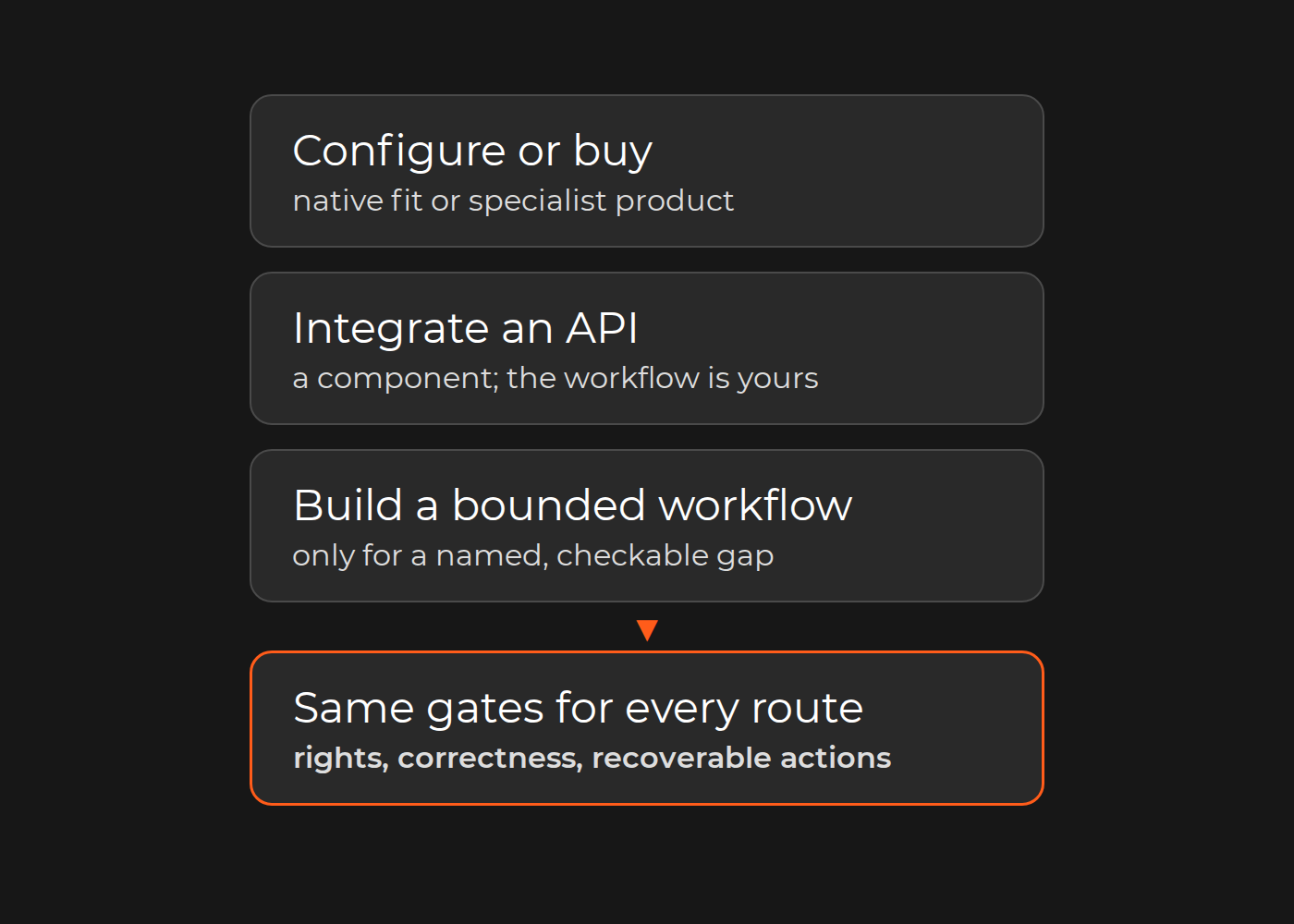
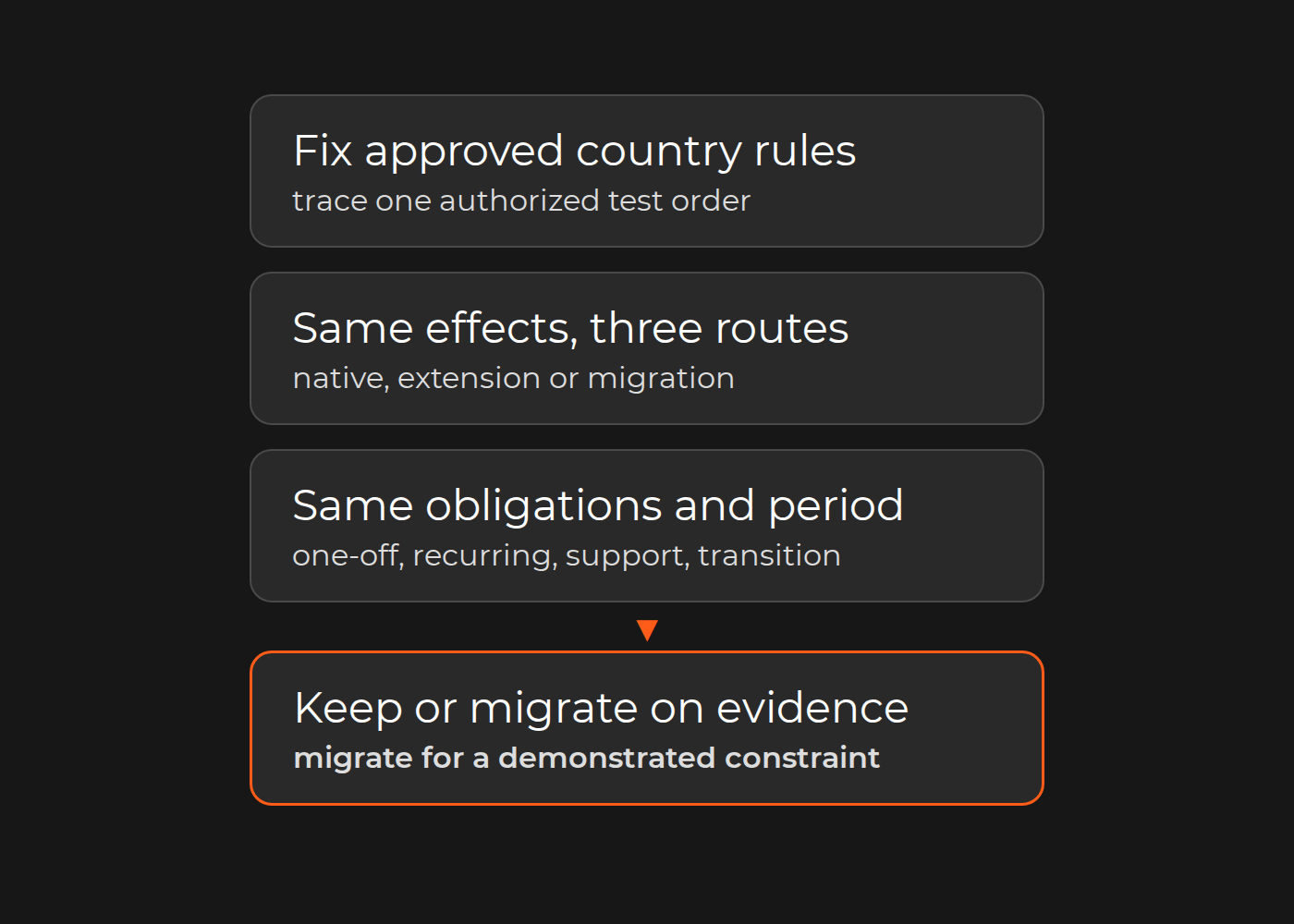
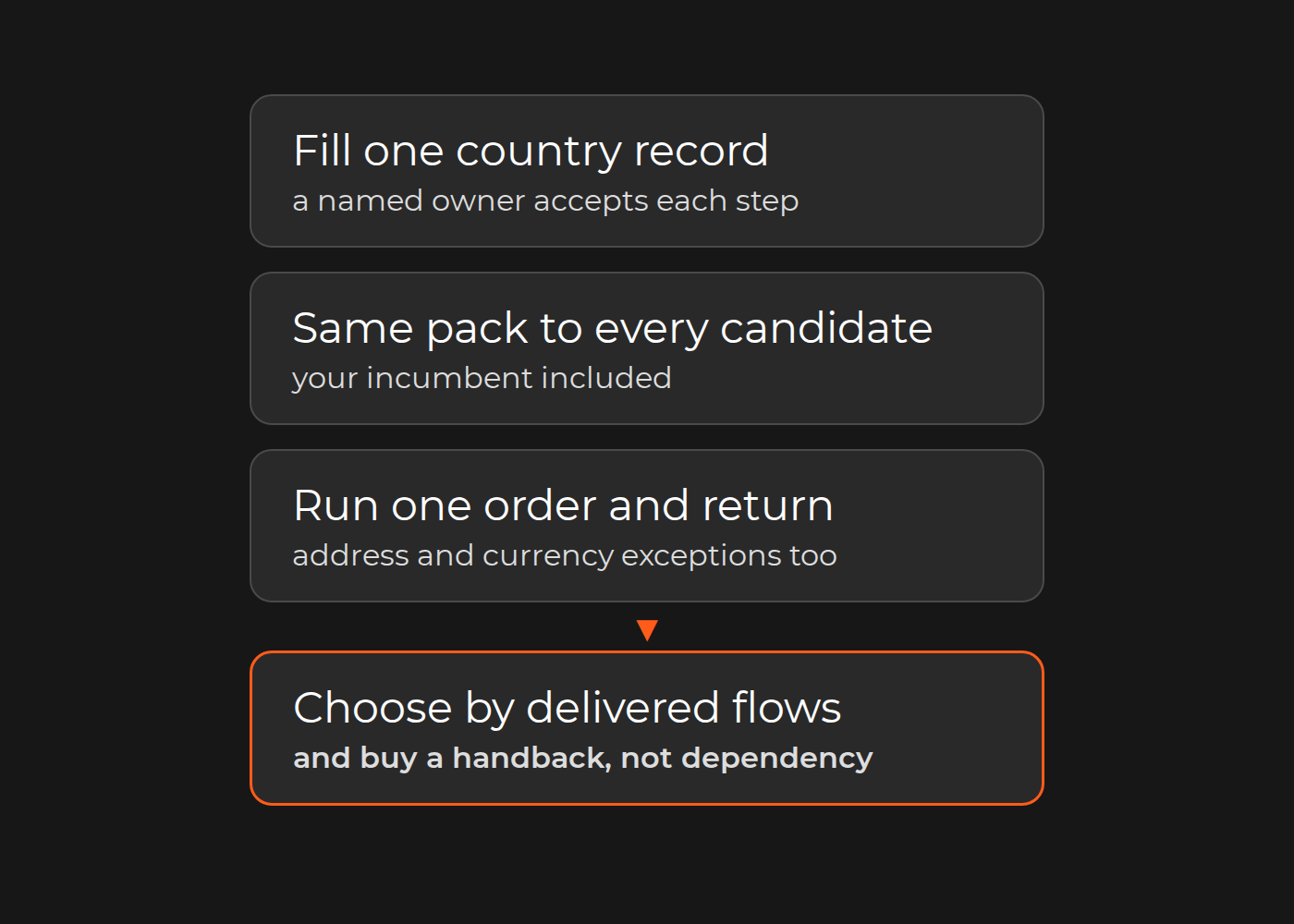
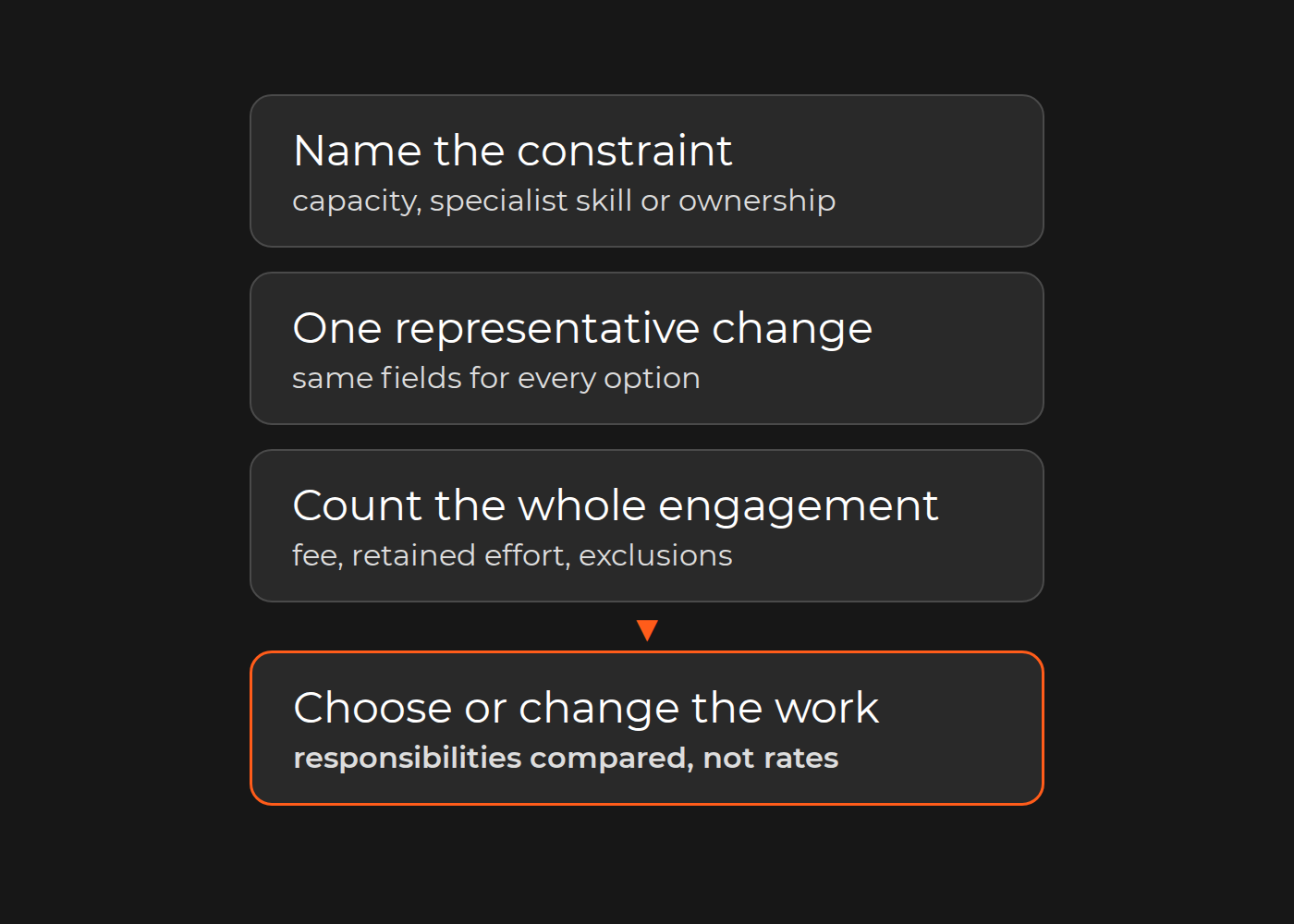
Buy the capability that already works; integrate the part that is missing; build only the workflow you can justify owning. For an ecommerce operator, those choices often coexist. A packaged helpdesk can use a custom ERP adapter, while a rules engine—not a language model—decides whether an order may change.
The choice is not “cheap app versus expensive custom AI.” It is who will own the data, exceptions, operating work and failure recovery when the demo ends? A COO needs a reliable business process. A CTO needs an architecture the team can support. The budget signer needs comparable total costs and a defensible exit route.
Start with the job, not the AI product
Name the required outcome and what the system must never do. For example: “Answer a verified customer's delivery question using current order data; hand off conflicting statuses; do not change the order.” Compare options on that job before expanding to address changes, cancellations or refunds.
Use existing functions as the baseline. Better policy text, synonyms, a supported connector or a deterministic routing rule may solve the problem without another AI layer. A broken stock feed should be repaired, not disguised by a conversational answer.
Separate three decisions:
Capability: rules, search, document extraction, conversation or another function?
Sourcing: existing platform, specialist product, API component or owned implementation?
Authority: read, propose, approve or execute—which party is permitted to do each?
A product being “native” does not prove its fit. A workflow being “custom” does not prove its quality or give you ownership of its third-party dependencies.
When a ready-made app is enough
Prefer configuration when the product covers your actual systems, policy and exceptions with acceptable operating effort. Test supported versions and permissions, not just the presence of an integration logo.
An app is a strong candidate when the required sources and actions are supported, an operator can maintain the rules, failures remain visible and the commercial/data terms are acceptable. Include any work needed to prepare feeds, map IDs and train the operating team. “Installable” is not the same as “ready for your workflow.”
For example, Gorgias' AI Agent documentation, as of November 2026, describes opt-in configurable actions and human handover. Those functions mean an action-capable support workflow does not automatically require a custom agent. They do not establish subscription eligibility, supported behavior for your backend or tested permission enforcement.
Keep human-led handling when the stream is small, the policy is unsettled or exceptions require authorized judgment. Manual processing with clear instructions can be a better purchase decision than maintaining automation for a rare task.
When an API is a component—not a complete solution
An API can supply extraction, retrieval or language processing while you retain control of the surrounding workflow. The missing work still includes authentication, source mapping, error handling, evaluation, reviewer tools and operation.
This route fits when a reusable component solves the hard capability gap but the process must connect to your systems or interface. Ask who owns the connector, who pays for retries and rejected work, and how behavior changes are detected when the provider updates a model or endpoint.
An adjacent example from lending: in the Oze case, Dinarys and the client's internal team built a bank-statement processing pipeline in which the AI analysis runs asynchronously. Around it sit the steps that make it usable—document upload, status polling, retries on failure, a manual template fallback for edge cases and error remediation grouped by error type. Buying the analysis as an API would not remove any of those steps; they are what you build, buy or integrate next. It is lending work, not an ecommerce deployment.
For catalog work, a categorization API may propose a category. Your product schema, source evidence and publishing approval remain separate responsibilities. Dinarys' BigCommerce case documents AI-assisted categorization together with inconsistent field cleanup, menu customization and separate checkout/request-to-quote work. It supports those delivered components, not a universal catalog agent or an independently established AI conversion uplift.
When custom workflow engineering earns its place
Custom work is worth comparing when a material, repeatable gap remains after configuration and specialist-product testing. State the missing behavior precisely: a legacy format translation, a customer-specific entitlement, a revision rule or a cross-system approval that the shortlisted tools do not handle acceptably.
For SanMar, the documented gap was specific: the client's ERP ran on poorly built APIs that could not exchange and update catalog and order data in real time. Dinarys built a custom API connector that translates the ERP's legacy data format for the Magento B2B and B2C sites, and documented the B2B site's functionality. That is a non-AI example of the test: a named, checkable gap that justifies building an adapter rather than replacing the ERP.
Do not rebuild a standard product because one connector is missing. A specialist product plus a bounded adapter may preserve useful queues, administration and reporting. Conversely, avoid forcing an app into a critical workflow if operating its workarounds costs more than closing the documented gap.
A build, buy and integrate decision matrix
Record evidence, owners and unresolved tests for each route in one shared sheet. Mark “unknown” where you lack evidence; do not convert a vendor's answer into a verified result.
Route
Best fit to test
Responsibility you retain
Configure current platform
Supported task and rules
Data quality, policy, acceptance
Buy specialist software
Packaged capability plus usable queues
Fit-gap, integration, vendor/exit terms
Integrate an API
Component fits; workflow is yours
UI, controls, review and recovery
Build bounded workflow
Important gap remains uncovered
Engineering, operation and change tests
Do not average away a disqualifying defect. An option that exposes another buyer's price list is not rescued by a low monthly fee or good answer quality. Rights, critical correctness and recoverable transaction behavior are gates; preference and cost comparisons follow.
Collect the same evidence for every route, and name the owner who accepts each finding:
Criterion
Evidence to collect for each route
Accepting owner
Workflow outcome
Same input cohort and required final state
Operations
Native baseline
Configured functions and failed scenarios
Platform owner
Data sources
IDs, source precedence, freshness, permitted use
Data owner
Exceptions
Visible queue, reason, receiving person, recovery
Operations
Critical correctness gate
Expected outcomes, including refusal and handoff
Domain owner
Access gate
Negative tests against another customer or tenant; no excess scopes
IT/security
Action gate
Exact approval, current-state recheck, duplicate and timeout tests
Backend owner
Operating effort
Preparation plus review, correction and reconciliation
Process owner
TCO
Setup, internal effort, recurring, change, exit, actual terms
Finance
Data terms
Retention, deletion, training use, subprocessors, export
Privacy/procurement
Exit exercise
Usable export including IDs, source and approval relations
Technical owner
Change exercise
Operator updates a rule and replays the tests
Operating owner
Support and fallback
Scope, responsibilities, pause and manual route
Operations and IT
Decision
Retain, configure, buy, integrate, build or stop; evidence; limits
Authorized signer
Data ownership and lock-in: test the exit, not just the contract
Inventory input documents, catalog records, embeddings/indexes, prompts, policies, evaluation labels, logs, configuration and code. For each, establish who may use it, who owns or licenses it, where it is stored, who can export it and what happens at termination. Confirm retention, deletion, subprocessors and training-use terms for the exact service and agreement; do not infer them from a generic “enterprise” label.
Request a sample export and reconstruction exercise. Can another operator recover product IDs, source links, approval history and exception reasons in a usable format? An export that loses those relationships can make a migration expensive even when it is technically downloadable.
Custom code can also create lock-in through undocumented rules, proprietary services or a contractor-only deployment process. Require your authorized team to run a test, change a rule and recover a failed job using the handover material. Ownership of source code alone does not establish operational independence.
Compare cost after human review and exceptions
Price every route on the same volume, horizon, quality requirements and cost definitions. The comparison usually turns on the human work each route leaves behind—preparation, review and correction—rather than on the license line. Distinguish an incremental workflow cost from already-paid platform licenses.
Hypothetical comparison: each route processes the same 200 cases. Route A requires 40 minutes of preparation and 160 minutes of review/correction. Route B requires 80 minutes of preparation and 80 minutes of review/correction. A uses 200 human minutes; B uses 160. B's slower preparation is offset by 80 fewer review minutes, leaving 40 fewer minutes overall—0.8 versus 1 minute per case.
This does not make B cheaper automatically. Its license, integration and maintenance may outweigh the labor difference. Nor does less review establish correctness. Keep critical defects, rejected work and unresolved cases visible; compare monetary totals only after obtaining actual terms and internal effort estimates.
If a model must only repeat a stable lookup, a rule or API response may be sufficient. If source attributes are missing, neither a packaged nor a custom model can legitimately invent them.
Human approval must mean the same thing across options
Ask every vendor and every internal design the same question: what exactly does the reviewer approve, and what does the system enforce afterwards? A route where approval covers an open-ended conversation, or where a prompt telling the agent to “ask a human” is the only control, is not equivalent to one where approval binds to exact values and the backend rechecks current state before writing.
Score this as the action gate in the matrix above, not as a feature checkbox. Read-only trials need no production write credentials; sandbox action tests need their own permission. Neither buying a product nor building an adapter makes a route safe until those tests pass on your scenario.
Accept the pilot on your scenario, not a score quota
Agree the sample and expected outcomes before comparing tools. Include normal work, high-consequence exceptions and cases that should be refused or handed off. Keep a held-out set out of tuning, and record which configuration/version produced the result.
For catalog work, inspect required attributes, supported categories, provenance, review effort and blocked publication when facts are missing.
For order intake, check whole-line correctness, packs, revisions, duplicate behavior and total handling time.
For support, verify the answer or action against the authoritative system, including repeat contact and a usable handoff.
For product selection, distinguish finding candidates from verifying compatibility and eligibility.
Operations accepts the workflow and exception queue; IT/security accepts access and integration controls; the relevant catalog or commercial expert accepts domain rules. Finance and the authorized signer accept costs and assumptions. No universal accuracy percentage can replace those decisions.
The decision record should say retain, configure, buy, integrate, build or stop, with failed tests, unresolved dependencies and a named operating owner. Passing a finite pilot supports a bounded next step, not unlimited autonomous authority.
Scope the gap with Dinarys
Dinarys sells engineering, so its commercial interest includes custom integration. That is a reason to keep the native and specialist comparisons explicit. If your gap is commerce-to-ERP exchange, ERP integration services are the relevant route.
Bring one scenario to Dinarys, along with retained tools, baseline effort, a sanitized exception inventory and your process/technical owners. Real records can follow once data-sharing rights are settled. Ask for a comparison and a bounded scope for the remaining gap—not an automatic commitment to build.
You may share this article
Lassen Sie Profis Ihre Herausforderung meistern
Unsere zertifizierten Spezialisten finden die optimale Lösung für Ihr Unternehmen.