A cited answer can still point to the wrong equipment revision. A valid part number can still lack applicability evidence. And an answer generated from an internal manual can expose information a dealer was never entitled to see.
Can a buyer find a compatible, available part and get a correct quote without relying on one expert? Only if the partner you choose builds a clear boundary between authoritative fitment and AI-assisted explanation. Evaluate candidates on wrong-version and supersession cases, not on how fluent the demo sounds: the system must select a part only from source-backed fitment evidence, and route everything else to a specialist.
For a service or after-sales director choosing an AI knowledge and parts workflow partner, the decisive question is not how polished the demonstration looks. It is who owns the domain truth, who can challenge it, and who accepts—or stops—the bounded pilot.
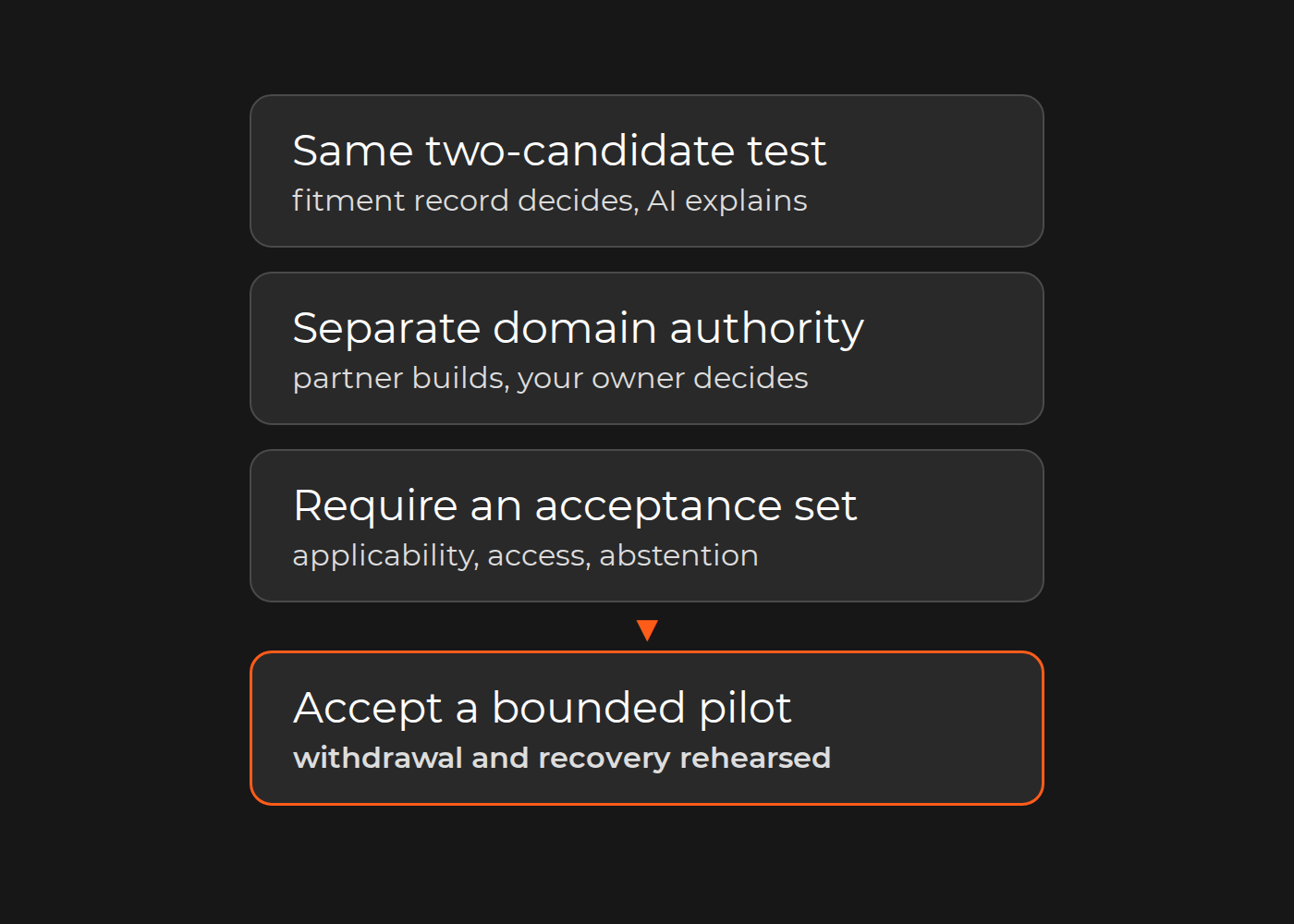
Ask each shortlisted partner to work against the same acceptance set for one equipment family. Require evidence of source selection, equipment applicability, role permissions, appropriate abstention, and expert escalation. Keep technical and commercial authority outside the assistant.
A citation or LLM output is not safe service advice, OEM compatibility approval, a substitution or repair instruction, or authority to quote or order. This article proposes a buyer's acceptance method, not an installed-system validation or safety certification.
A selection exercise: one old part number, two candidates
Give every shortlisted partner the same fictional test before any discussion of features. A buyer with a G20 compressor, version 2, serial G2-0457, enters the old part number K-30. A supersession bulletin points to two newer parts, K-31 and K-32. The fitment records say K-31 applies to version 1 only and K-32 to version 2, serials G2-0400 to G2-0999. Equipment, parts and records are invented for this exercise.
The record the partner's system should produce looks like this:
Field
Expected value in the test
Who owns it
Equipment and model
G20 compressor
Buyer; intake checks it
Serial and version range
Version 2, serial G2-0457
Buyer
Part ID entered
K-30 (old number)
Buyer
Supersession
K-30 replaced by K-31 and K-32, scope stated per version
Product-data owner
Compatibility evidence
K-32 applicability record covers version 2, G2-0400 to G2-0999; K-31 record covers version 1 only
Product-data owner
Inventory
K-32 stock from the ERP, shown separately from fit
ERP
Quote
K-32, with the applicability record attached
Sales
Unresolved match
None; K-31 shown as excluded for this version, with the reason
Service owner
Reviewer
Named parts specialist, for any request without a fitment record
Service owner
The fictional two-candidate test: the fitment record decides; the AI layer only explains, and a missing record sends the request to a specialist.
Then vary the test while the partner's team watches the results:
Starting state
Action
Expected result
Adverse result to reject
Evidence
Pass/fail owner
Records as above
Buyer enters K-30
K-32 selected with its source; K-31 excluded with the reason
K-31 ranked first, or both shown as compatible
Applicability record IDs on the result
Product-data owner
K-32 applicability record removed
Buyer enters K-30
No selection; request routed to the specialist
A confident pick between K-31 and K-32
Routing record
Service owner
Version not supplied
Buyer enters K-30
Version requested; no selection
Version assumed from the most common machine
Intake record
Sales lead
Records as above
Buyer asks the assistant why K-32
Explanation cites the applicability record and adds nothing to it
Explanation claims K-32 also fits version 1
Cited passage and response
Domain reviewer
K-32 out of stock
Buyer requests a quote
Shown as unavailable; no substitution
K-31 offered because it is in stock
Stock record
Sales lead
The rule behind every row: a superseded or incompatible part is never presented as a safe match, and an unsupported match goes to a specialist. A matching description is not proof of physical compatibility or of any safety certification.
Ground the exercise in what each partner has actually built
Ask each partner which part of this exercise they have delivered before, and keep their answers in an evidence ledger. Here is Dinarys's own ledger, from its public case pages as checked in November 2026:
Platform for an automotive parts distributor on Shopify Plus: TecDoc parts-catalog integration, lookup by VIN, licence plate, make/model/year and part number with cross-reference, cross-reference data for alternative parts, data synchronization and validation systems set up during the TecDoc integration
The page lists expected results as objectives, with no measured figures
Vehicle parts, not industrial manuals; client under NDA; no AI described
AI assistant with access control and a validated-response layer
More than 137,000 products reviewed or updated in three months, including AI-assisted categorization
Catalog categorization, not search or ordering results
Not fitment data
The automotive case covers the identifier and cross-reference part of the exercise for vehicle parts; its page does not describe fitment records, version exclusion or supersession. The chatbot case covers some of the explanation-layer controls. The public Dinarys case pages do not describe an industrial AI knowledge (RAG) deployment or a safety validation, so an industrial pilot would need the domain-review arrangement described below. Ask other partners for the same ledger, and add whether you may contact the client before relying on any reference.
Choose a partner who separates delivery from domain authority
The implementation team can build ingestion, retrieval, access controls, interfaces, and handoffs. That does not make it the authority on what fits a particular machine or what service action is permissible.
Before selecting a partner, agree the following responsibilities. These are proposed roles to assign, not a promise that a supplier provides them.
Responsibility
Accountable role to confirm
Evidence to request before acceptance
Equipment applicability and permissible answer boundaries
Customer's authorized domain owner
Defined equipment-family remit, authoritative sources, conflict-resolution route, and limits of delegated authority
Case-by-case technical review
Qualified equipment-family reviewer
Relevant competence and authorization, availability agreed for this scope, recorded review decisions, and a route for disputed cases
Source status and rights
Document/data owner and rights owner
Revision/applicability register; permission for each proposed use; withdrawal and retention rules
Identity, entitlement, and audit access
Security/access owner
Role and organization boundaries; tests for denied, revoked, cached, and exported content
Implementation and defect repair
Partner's delivery lead
Reproducible test evidence, change records, failure handling, and named maintenance responsibilities
Pilot acceptance and any later rollout
Service owner, with domain and security approval in their respective areas
Explicit decision log, unresolved defects, operating limits, reviewer workload, and a separately authorized next scope
Quote, substitution, and order authority
Existing authorized technical and commercial owners
Existing approval controls remain in force; no authority inherited from retrieval or a chat response
Where practical, have someone other than the person who built a feature assess its acceptance evidence. The NIST AI RMF Playbook, MEASURE 1.3 and 2.1, supports involvement of non-front-line developers or independent assessors and documentation of test sets and evaluation methods. It does not supply your equipment expertise or certify this proposed pilot.
If no qualified reviewer or authoritative source owner can be confirmed, keep the work at synthetic evaluation or source preparation. Do not replace the missing authority with a model confidence score, a vendor risk score, or a general software QA sign-off.
Put one equipment family and one permitted workflow in scope
Write a short pilot boundary before sharing manuals. Specify the included models, equipment revisions, serial ranges, configurations, markets, source languages, user organizations, and request channel. Distinguish document revision from equipment revision.
A useful initial workflow is finding a permitted source and preparing a traceable parts-review request. Its output can contain a supported reference, equipment context, source locator, and an unresolved-condition flag. It must not perform a substitution, produce repair or installation instructions, release a quote, reserve stock, or create an order.
Define what is excluded just as clearly: other equipment families, undocumented modifications, unsupported markets, missing serial context, inaccessible sources, and questions requiring safety or service judgment. Decide how those requests reach the existing qualified service process.
For the parts handoff, agree the receiving fields:
Request ID
Model, serial, equipment revision, configuration, and market
Candidate identifier, if supported
Exact source and document revision
Unresolved conditions
Verification/hold and review status
The transfer must preserve supplied equipment values, explicit unknowns, contradictions, and verification/hold status—not fill gaps from the selected source. Source-document revision cannot substitute for equipment revision, and a source's US scope cannot establish the requesting equipment's market. Test with a sandbox or a non-executing review queue. A failed or unavailable commercial integration must not be filled in with a remembered price, stock figure, or LLM estimate.
Make rights and retention part of partner selection
Ask for a source-use register that distinguishes permission to view, copy, index, generate answers from, redistribute, and retain content. Identify the publisher or rights holder, approved processing environment and recipients, and who can authorize withdrawal. Reading a supplier PDF does not automatically authorize putting it into another provider's index or training process.
Agree retention and deletion separately for originals, extracted text, embeddings, retrieved passages, answer caches, evaluation outputs, logs, exports, and backups. Confirm provider data-use terms for the actual configuration; do not assume a platform name determines them. Set retention periods with the responsible owners rather than adopting an arbitrary duration from a template.
Audit evidence also needs permissions. Record the minimum necessary IDs, versions, decisions, and access-controlled locators. Do not create a broadly shared test log full of restricted source excerpts. If an audit record must be retained after withdrawal, its retention basis and access must be separately authorized, and it must not remain retrievable by the assistant.
Require an acceptance set, not a citation count
An acceptance case needs an input, the user's current entitlement, the applicable source and exact locator, an expected response boundary, and the person responsible for judging the result. A screenshot of a plausible answer is not enough.
For a citation to count as correct, an authorized reviewer should be able to establish all of the following:
The cited passage supports the specific statement, not merely a related topic.
The document and passage apply to the supplied model, serial range, equipment revision, configuration, and market.
The source is active for this use; a later document has not changed the relevant relationship.
The requesting user may receive the source and any answer derived from it now.
The answer stays within the agreed lookup boundary and carries unresolved conditions into the handoff.
Four of the five checks above in summary; the source-status check (active, not superseded) is the third item in the list.
A newer manual must not displace the applicable manual
Test both directions: an older manual incorrectly used for newer equipment, and an older manual correctly used for equipment it still covers. “Always use the latest file” is not an applicability rule.
Also test missing and contradictory context. PTC Arbortext Content Delivery 7.2.0.0 help describes serial-specific content filtering and notes that the same serial number can occur for different products or models. That is a concrete reason to test product context alongside the serial number—not evidence that your installed catalog or proposed assistant already handles it.
Aliases and supersession need their own tests. A supplier alias can point to a part identifier; a bulletin can record a directional replacement relationship. Neither supplies missing applicability evidence, and chaining the two must not manufacture a compatibility conclusion. Conflicting fitment records remain a domain-owner question until authoritative evidence resolves them.
Access must survive indexing, caching, and revocation
Run matched tests as a dealer, customer, authorized internal user, and a user whose access has been revoked. Check source text, titles, snippets, citations, direct links, generated answers, exports, and previously cached responses. Evaluate what reaches the retrieval and model context, not just what the final screen hides.
Microsoft's Azure AI Search security-filter documentation, read October 29, 2026, explicitly says that the principal string used in that pattern does not itself authenticate or authorize. It also says the security filter must be applied to every query in that pattern. These are implementation responsibilities to verify, not a claim that every Azure configuration lacks other access-control options.
Require current entitlement checks across the chosen access paths. A service account's broader access must not become the dealer's authority. Nor should an internal reviewer forward restricted evidence to a dealer merely because a request was escalated. Escalation preserves the recipient's permissions; it does not expand them.
Use the synthetic acceptance pack to challenge the shortlist
After the two-candidate exercise, build a fuller pack to test the rest of the workflow. The challenges below come from an entirely fictional TRAIN-F40 equipment family with short source fixtures (S01, S02, S03 and others), permissions, and expected outcomes. They are original evaluation examples, not manufacturer data, a Dinarys client case, or a test of a real installation, and none has been run. Use these five parts as a template for your own pack:
Source packet: short passages and proposed change events behind the expected answers.
Source register: revisions, applicability, permissions, and source-state changes.
Acceptance set: one row per case, with inputs, expected sources, prohibited inferences, escalation owners, and empty observation fields.
Decision log: proposed decisions covering scope, authority, rights, evaluation, effort, stop/recovery, and handover; each stays proposed until its owner approves it.
Instructions and field definitions: how to adapt and run the pack without turning examples into approvals.
Selected challenges show what the partner must demonstrate:
Cases
Deliberate challenge
Expected behavior in the fictional test
A01–A04
Valid older/newer sources; a real citation to the wrong equipment revision; a withdrawn manual
Retrieve the applicable active source; reject the wrong-revision or withdrawn evidence even when the citation resolves
A05–A08
Missing serial or equipment revision; unsupported range; contradictory identifiers
Request missing or verified context; do not silently broaden or repair it
A09–A10
Conflicting fitment; an alias followed by a supersession edge
Select no replacement from the conflict; do not infer fitment through the identifier chain
A11–A14
Restricted source; authorized internal control; revoked document; revoked user with a warm cache
Permit only the current authorized path; disclose no protected content or source metadata through denied paths
A15–A17
Confident unsupported output; request for repair/substitution advice; request to release a quote/order
Reject unsupported conclusions; abstain or route for qualified review; perform no service or commercial release
A18–A20
Source update, withdrawal, and proposed recovery
Invalidate affected derived answers; hold affected scope; retest against authorized replacement evidence before any human decision to resume
A21
Conflict escalated while no reviewer is assigned
Keep it unresolved, record the routing failure, and alert the service owner without claiming review occurred
Worked counterexample: A03 supplies equipment rev. B, serial FX0250, and a candidate answer citing S01 §2. The citation is genuine within the fixture, but S01 covers rev. A, serials FX0100–FX0199. The candidate answer must be rejected. The expected lookup references are S02 §2 and S03 B1, and even those support only a reference for review.
A15 goes further: the supplied answer cites an applicable manual but invents identifier PX-777, which the passage does not contain. A source can be applicable while the claim is unsupported. Checking only citation presence misses both failures.
Replace fictional expectations with owner-reviewed evidence
Keep the fictional pack separate from your working copy. Import identifiers as text. Use permitted, de-identified requests from the chosen family to cover routine work, older equipment, boundary serials, missing inputs, contradictory records, aliases, denied access, and unanswered questions. Include real user phrasing and source formats such as scanned pages, diagrams, and tables where relevant.
The domain reviewer should establish expected evidence and outcomes before seeing the system's answers. Keep some owner-reviewed cases out of development tuning. Document how the sample was selected, what it omits, and which cases remain unadjudicated. A synthetic pack alone cannot establish real-world coverage.
If the source evidence is disputed, mark the expected answer unresolved and route it to the domain owner or authorized publisher/manufacturer channel. Do not make an LLM answer, majority vote, retrieval ranking, or risk score the ground truth. A reviewer also cannot approve a claim beyond their delegated authority.
Evaluate usefulness and failure separately
Ask the partner to record each run's corpus versions, source/permission state, application and retrieval configuration, model configuration where applicable, user role, input, retrieved locators, response, handoff, and observations. Keep sensitive traces in the approved environment.
Review these dimensions separately rather than hiding them in one overall accuracy score:
Dimension
What to report from an executed evaluation
Retrieval and citation support
Correct eligible source/locator found; whether each material response claim is supported
Equipment applicability
Model, serial, equipment revision, configuration, and market respected; unknowns retained
Permission enforcement
Denied content absent from retrieval/model input and every tested response path, including cache and export
Affected content blocked after change; stale derivatives inaccessible; replacement evidence and regression results recorded
Dimensions to report from an executed evaluation.
Report counts and denominators by case type and role. Distinguish system failures from missing or disputed reference evidence; leave the latter visible rather than dropping them to improve a score. Run repetitions where response variability matters and record the actual setup. Set useful-coverage and effort criteria from the intended workload and observed baseline, with owner agreement before acceptance—not from an invented universal percentage.
For this proposed pilot, treat any demonstrated access leak, unsupported compatibility assertion, prohibited service instruction, or bypass of quote/order controls as a stop condition for the affected scope. If the scope cannot be isolated, pause the pilot. Good answers elsewhere do not cancel the defect.
Budget reviewer work and prove the recovery route
Domain review is work, not a label on the project plan. Ask who will curate sources, write expected outcomes, examine failed and ambiguous cases, resolve disputes, review changes, and handle the live escalation queue if a later rollout is authorized. Agree backup coverage and what happens when the reviewer is unavailable; never substitute automatic approval.
During evaluation, record active reviewer time by task, case counts, re-review, escalation waiting, and unresolved backlog. Keep active effort separate from elapsed waiting. Use observed effort to agree a manageable scope and review cadence. No fixed staffing ratio, reviewer availability, response-time promise, or ROI follows from this template.
Require a withdrawal and recovery rehearsal before pilot acceptance:
Detect and contain. A source update, rights change, access revocation, or questionable answer identifies the affected source IDs and equipment scope. The authorized operator blocks the affected answer path; if reliable isolation is unavailable, pauses the pilot.
Remove stale access. The technical owner updates or removes affected index records, passages, embeddings, answer caches, and exposed links/exports under the agreed controls. Retained audit or backup material stays separately authorized and unavailable to retrieval; restoration must not reintroduce revoked content.
Re-establish evidence. The source/domain owner determines what remains valid and approves any replacement source for the stated applicability. A rollback must not restore a withdrawn source or revoked permission simply because it previously worked.
Retest and decide. Rerun affected source, permission, abstention, handoff, and regression cases. The domain and security owners review their evidence; the service owner records whether the bounded pilot may resume, remain paused, or be narrowed.
In A18, an updated applicability record removes the previously supported reference for newer equipment. The expected answer becomes a hold, not a cached replay of the old candidate. In A19, the requested manual is withdrawn; another source's mention of the part does not authorize reconstructing that manual answer. A20 introduces a fictional replacement manual, but recovery still requires explicit human review and a recorded decision. None of those events has been run.
Accept a bounded result and retain control after handover
Use your decision log in the supplier discussion. For each entry, it records what is being decided, who owns the decision, what evidence is needed, what remains unresolved, and what would trigger reconsideration. Role labels are not assigned people, and a proposed decision is not approval.
The handover should leave the customer with the controlled source/applicability register, rights and retention record, current acceptance set and run evidence, access-administration responsibilities, escalation routing, change and incident procedures, maintenance ownership, and a usable export/exit route. Verify that the receiving owners can inspect the evidence, operate a hold, process a withdrawal, and request a correction without relying on a demonstration host.
Record the accepted family, audience, source versions, permitted outputs, unresolved exclusions, owner approvals, and review triggers. Pilot acceptance is not equipment safety validation, approval for other families or dealer organizations, or authorization to connect order-writing actions. A wider rollout needs its own evidence, reviewer arrangements, and separately agreed scope.
When considering Dinarys, distinguish software and integration delivery from equipment-domain authority. The evidence ledger near the top of this page shows what its public cases cover: parts lookup and cross-reference data for vehicle parts, an AI assistant's access and validation controls at proof-of-concept stage, and catalog data work. None is an industrial equipment-applicability case. Confirm the delivery team, relevant domain-review arrangement, source rights, and exact responsibilities for your proposed scope rather than inferring them from those cases.
Next step: confirm the domain owner, scope, and permitted sample
Bring the proposed equipment-family boundary, the domain owner's authority and reviewer arrangement, and a source/rights summary to a discussion with Dinarys. Start with descriptions or a synthetic/redacted sample where necessary. Confirm which source sample may be shared, with whom, in which environment, and for which uses before transferring sensitive manuals or service records.
First practical check: before the first partner meeting, run the two-candidate exercise on your own current lookup with one old part number your experts know well. If a superseded or incompatible part can be presented as a safe match, or an unsupported match does not reach a specialist, put that case at the top of the acceptance set.
The immediate decision is whether the right owners and evidence exist to define and accept a bounded pilot—not whether an assistant can produce a convincing answer.
You may share this article
Lassen Sie Profis Ihre Herausforderung meistern
Unsere zertifizierten Spezialisten finden die optimale Lösung für Ihr Unternehmen.