After checkout, an order becomes a moving operational record. A customer may ask to change an address while the warehouse is releasing it, or an agent may retry a request whose first response was lost. Understanding the sentence is the easy part; deciding whether a change is still permitted is the engineering problem.
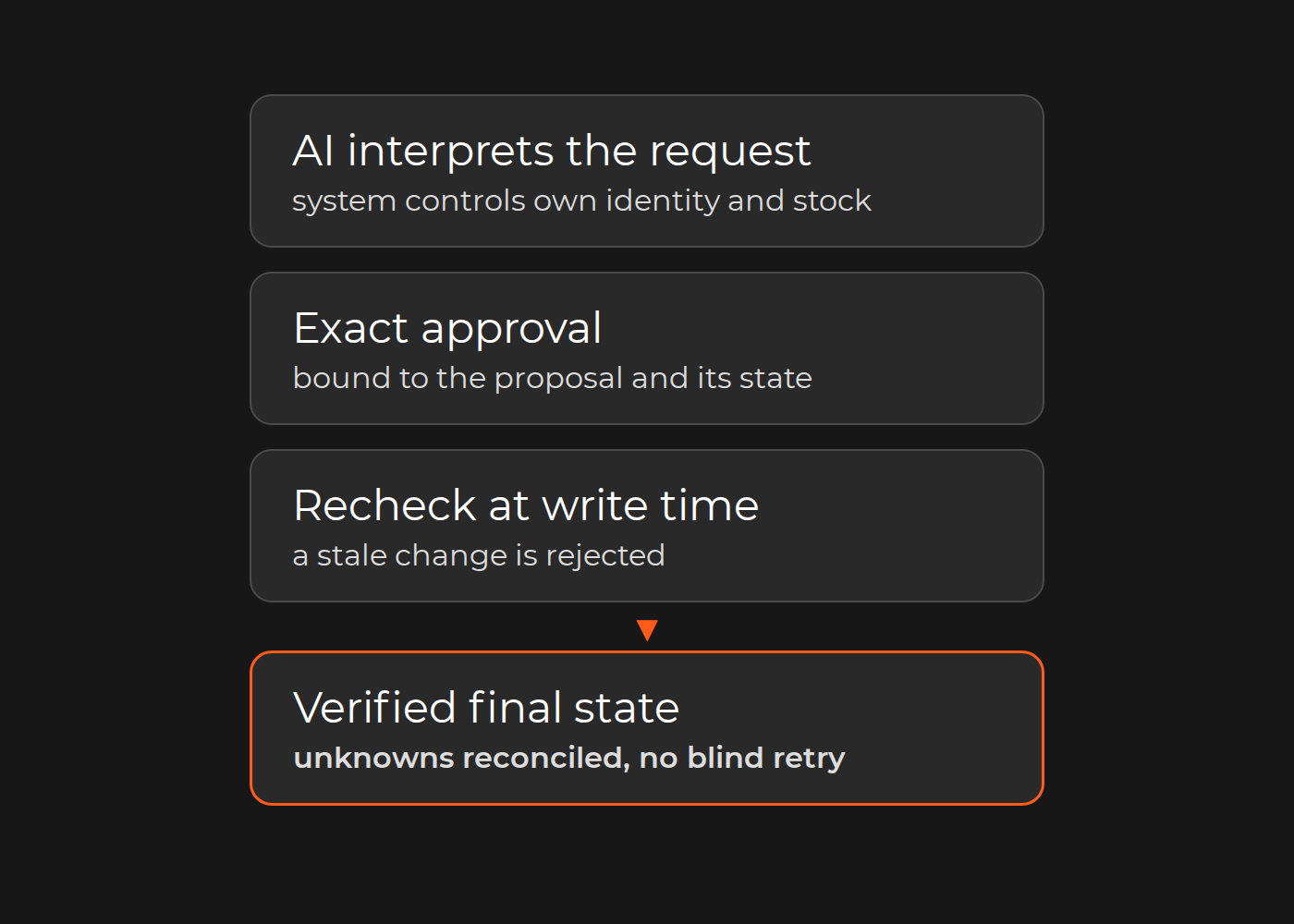
Use AI to interpret a request or prepare a proposal. Keep identity, stock, business permission and transaction execution under explicit system controls. Some journeys need no AI: a native self-service form, routing table or supported OMS function may already cover them.
This guide helps a COO, order operations lead and CTO design one post-checkout workflow. It concerns changes to existing orders—not extracting new orders from email or PDFs, and not choosing an entire order management system.
Separate reading, proposing and changing an order
Start with one journey and one backend. A status lookup has different consequences from changing a destination, substituting a line or issuing money. Record which actions are excluded as clearly as those included.
Request
Possible AI contribution
System-controlled boundary
“Where is my order?”
Interpret and explain sourced status
Owner check, timestamps, source precedence
“Ship it to my office”
Collect and propose the new address
Identity, cutoff, policy and exact approval
“Use the other warehouse”
Classify the exception
Allocation rules, reservation and capacity
“Cancel and refund it”
Identify intent and route the request
Cancellation eligibility and separate money authority
Do not give a model a general-purpose backend account. Expose only scoped operations and validate the actor, account, order, fields and business preconditions outside the model. Customer confirmation of an address is not automatically staff authorization to override a fulfillment rule.
Model the order's state before allowing updates
Agree which system owns payment, reservation, warehouse release, shipment and refund facts. These are related states, not synonyms. A paid order can still be unallocated; a label can exist before carrier handover; one line can ship while another remains open.
For a first address-change journey, an illustrative merchant might permit changes only while the affected fulfillment is open, with customer confirmation and authorized staff approval. Its normal route stops once the warehouse commits release. Actual state names and cutoffs must come from your operation.
This simplified diagram is not a complete OMS schema. Split orders need line/fulfillment-level decisions. A request affecting an unshipped line must not silently modify the address of a shipment already released.
Keep command status separate from order status. “Proposed,” “awaiting approval,” “submitted,” “confirmed,” “rejected” and “unknown outcome” describe the requested change. They must not overwrite the order's actual fulfillment state.
Walk through an address change with a concurrent release
Consider fictional order O-518. The customer asks to change its address while the fulfillment is open. The agent authenticates the customer through the approved route, obtains the order within that customer's scope and prepares a normalized address proposal. Validation includes the merchant's delivery restrictions; it is not permission to guess missing address fields.
The reviewer sees the old and proposed values, order/fulfillment ID, current state and timestamp, policy version, customer confirmation and any uncertainty. Approval binds to that exact proposal and an expiry/state condition. If the proposed address changes, the approval is no longer reusable.
Before the write, the warehouse releases O-518. The execution service must recheck eligibility and reject the now-stale proposal, using a conditional update/version check or an equivalent enforced mechanism supported by the backend. A read immediately followed by an unchecked write leaves a race. If the backend cannot enforce the necessary condition, keep this journey human-led or resolve the interface gap first.
The correct customer response is that the change was not completed and the request has entered the authorized exception route. “Done” would be a failure even if the model understood the request perfectly. Approval grants no right to pretend the warehouse has not moved on.
Routing and stock checks need an authoritative decision
For routing, verify SKU, unit, location, sellable availability, reservation state, carrier/service constraints and cutoff against the sources that own them. AI may classify an unusual request; it should not invent a feasible route or availability.
A stock lookup is not a reservation. If two orders compete for the last unit, the inventory authority must accept or reject the hold under its concurrency rules. Rechecking the displayed stock does not by itself prevent overselling. Define one accountable writer or coordination contract for each reservation, and retain its reference through changes and cancellations.
Do not create a second inventory ledger inside an agent merely to simplify prompts. For stable rules, configure the OMS or existing routing engine first. Compare a specialist product when core allocation or operational queues are missing; custom integration should close a demonstrated gap, not recreate those capabilities accidentally.
Two Dinarys integration projects show sales channels synchronized with back-office systems instead of each channel deciding on its own. For Prostor, an omnichannel drugstore chain, the case page describes real-time inventory sync across 427+ physical stores and the online storefront, and offline pickup. In SanMar's B2B2C website builder, orders placed on a distributor's microsite are automatically routed to SanMar's central B2B panel, with event-driven sync of product updates, inventory and pricing. Neither project involves AI order changes; they show the structure an AI step would have to sit behind rather than bypass.
Retries and idempotency: one intent must not become two effects
Assign a durable business action reference to the approved command. A retry of that same command should reuse its identity and unchanged parameters, not generate a fresh operation because a response timed out. A genuinely new customer change needs a new command and its own approval.
Check the backend's documented behavior. Does it support idempotency, for which operations, within what retention period and with what handling of concurrent or changed requests? Keep an application-level action ledger and business reconciliation where needed; a transport key alone is not an end-to-end guarantee across several systems.
Stripe's idempotent-request documentation, as of November 2026, illustrates why details matter: its API v1 saves the first executing request's response for a key, including errors, while v2 has different retry semantics. This is a technical reading example, not a recommendation to put refunds in this pilot or assume an OMS behaves like Stripe.
If a timeout happens after the order service may have accepted a change, mark the command unknown, retrieve the original result where supported and reconcile against the authoritative record. Do not tell the customer it succeeded, or retry with a new identity, just to clear a queue. Delayed or duplicate events must not regress the order to an older state.
Audit and recovery are not an “undo” button
Retain the authorized actor, source states/timestamps, proposed and approved values, policy/configuration versions, action reference, execution result and reconciliation outcome. Protect the journal and minimize sensitive payloads; it should explain the decision without becoming an uncontrolled copy of customer records.
Recovery depends on what happened. Before execution, a proposal can be withdrawn. After an address write, another authorized change may be possible if the order remains eligible. After dispatch, a carrier intervention or other exception process may be necessary. Reverting a database field does not recall a parcel.
Document compensating actions and their owners, not a universal rollback promise. Stop new writes while investigating an incident, preserve unknown outcomes and keep the human operating route available. A queue item is not resolved until someone can verify the resulting business state.
Tracking should explain uncertainty and support escalation
Define which source owns each event and how fresh it must be. Distinguish order received, warehouse prepared, carrier accepted and delivered. If the carrier and OMS disagree, show the supported facts with timestamps and route the conflict rather than inventing a single confident status.
Handoff should carry the permitted customer/order context, requested change, state observed, action reference, attempted operation and unresolved question. Assign a receiving queue and owner. Measure aging unknowns and abandoned handoffs; a friendly escalation message without a recipient does not complete the journey.
An acceptance matrix for the first workflow
Use authorized read-only replay for interpretation tests, then a separately approved sandbox for writes. Before testing, write the action contract: included order and fulfillment types; which capabilities are read-only, proposed, approved or executable; allowed fields and forbidden overrides; state authority and freshness rules; approval binding and expiry; the conditional-write mechanism; reservation authority; idempotency and result lookup; the owner of unknown outcomes; and the limits of recovery and manual fallback.
For each test, record the synthetic fixture and expected outcome, actor and order references, source state and version, approval scope, action identity and submitted parameters, the observed backend result and final business state, the customer message, handling effort, and any defect with its owner and retest. The scenarios below are proposed tests, not results from a client system.
Scenario
Required outcome
Evidence
Another customer's order
No disclosure or change
Ownership denial; no write
Warehouse release after approval
Stale change blocked
State/version check and handoff
Duplicate request
No second business effect
Original action/result reference
Response lost after acceptance
Reconcile; no blind resubmission
Unknown → verified result
Stock consumed concurrently
No unsupported reservation promise
Inventory authority's decision
Partial shipment
Released lines remain protected
Line-level state and decision
Prompt asks to bypass policy
No expanded permission
Rejected action; recorded reason
Changed parameters under an old action identity
Rejected or handled explicitly; no silent new action
Action ledger entry
Delayed older event arrives
No regression to an earlier state
Event order and final state
Order canceled during review
Stale proposal cannot write
Cancellation state and rejection
Workflow suspended
New writes stop; unknowns and manual route preserved
Pause record and queue state
Operations should accept correct outcomes, manageable review load and usable exceptions. IT/security should accept permissions, state checks and recovery. The inventory/warehouse owner accepts reservation and cutoff behavior; finance owns any separate financial scope. The COO or authorized signer approves the business scope and investment.
Agree critical blockers before testing. No observed unauthorized writes in the agreed test set can be a release gate, but a finite test set cannot prove universal safety. Report verified changes, rejected/stale proposals, unknown outcomes, duplicates, full handling effort and customer recontacts separately—not one automation percentage.
Scope implementation around the failed tests
Decide early who owns the state rules the workflow will enforce, and who builds them. In Dinarys' Untamed case, the new subscription backend was built under the direction of the client's CTO, while Dinarys engineers did the backend engineering, integrated a React subscription dashboard and documented the work. The same split suits order changes: your side owns eligibility and state rules; the delivery team implements and tests them.
If the gap is backend exchange, ERP integration services are a relevant route. Estimate source/state mapping, authorization, action adapter, reviewer interface, reconciliation, negative tests, monitoring and handover separately. Data access, API behavior, warehouse dependencies and accepting owners determine the work—not the model's subscription fee.
Discuss one post-checkout scenario with Dinarys. Bring a sanitized event sequence, allowed/forbidden changes, state owners, current tools and a handling baseline. Hold back customer records until the sharing terms are agreed. The first deliverable should clarify the permitted write and its acceptance conditions; expansion follows evidence, not a promise of hands-free order operations.
You may share this article
Lassen Sie Profis Ihre Herausforderung meistern
Unsere zertifizierten Spezialisten finden die optimale Lösung für Ihr Unternehmen.