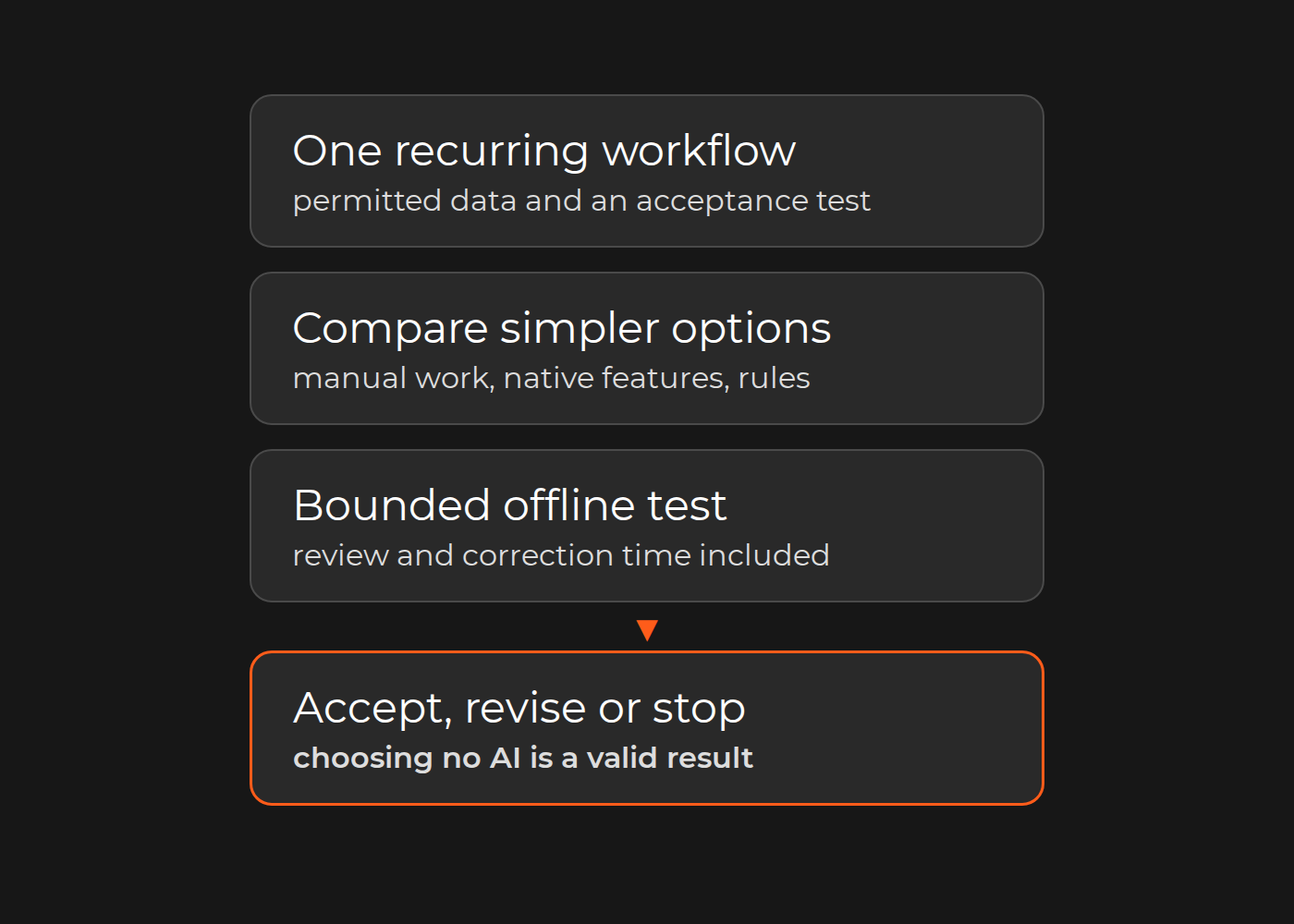
To use AI in ecommerce, treat the roadmap as a sequence of operating decisions, not a list of tools: start now with the one recurring workflow that has enough permitted data and a useful acceptance test, and keep the rest as later decisions. Identify its input, the output someone can accept, and the work that currently happens between them. Compare AI assistance with your platform’s existing features, rules, and manual process before connecting it to live operations.
What does it cost? For one workflow, the cost is preparation (source data, taxonomy and reference answers), tooling and integration, operation including human review and corrections, and maintenance as feeds, policies or models change. There is no universal price, payback period or sales uplift to apply; the cost section shows how to estimate each part for the workflow you choose.
For an ecommerce lead facing a delayed assortment launch, a useful starting question is: Are products waiting on missing facts, repetitive formatting, or a judgment call such as category selection? Those are different problems. The third may justify testing a model; the first two often need better source data or rules. Even for classification, AI may not beat a simple rule.
This guide helps you choose one workflow to investigate. It starts by contrasting three workflows with very different readiness, then uses product-data preparation as the anchor, with short verdicts on other common applications and an AI fit checklist you can complete with the process owner.
Three workflows, three different readiness tests
The three workflows below are often grouped under “AI in ecommerce”. Their inputs, authority and failure costs differ so much that they cannot share one readiness score. The filled record shows how one illustrative retailer would decide which to start now; the verdicts are examples, not general rules.
Field
Catalog enrichment (categorization)
Forecast-driven replenishment
Autonomous refunds
Workflow
Suggest categories for new supplier products from the existing taxonomy
Propose store and warehouse orders from demand forecasts
Decide and issue refunds without a person
Baseline workload
Hours of manual categorization and correction per product family
Buyer and store time spent placing orders; stockout and overstock records
Support and finance time per return; refund errors and reversals
Existing alternative
Supplier-category mapping, keyword rules, PIM features
Replenishment rules in the ERP or planning tool
Returns-platform rules for clearly eligible cases; agent-approved refunds
Data owner
Catalog owner, with approved taxonomy and labelled examples
Planning owner, with aligned sales, stockout and lead-time history
Finance and returns owners, with policy, order, payment and inspection records
Success test
Beats manual work and rules on held-out records, review time included
Beats the current method and a simple baseline on a later historical period
Review of every exception, and recovery of wrong refunds
Operating owner
Ecommerce lead with the catalog owner
Planning or supply-chain lead
Finance controller with the returns lead
Failure cost
Wrong or held category; reversible before publication
Excess stock or stockouts; slow to reverse
Money paid out; hard to recover
Verdict for this retailer
Start now with an offline test
Start only when histories are aligned and a planner owns proposals
Do not make autonomous; start with AI triage and reply drafts for agents
Each column has different evidence behind it. Dinarys's BigCommerce catalog update case documents AI-assisted categorization within wider catalog work, described further down. For replenishment, RELEX's supplier-reported Puuilo case study reports a 4.5% reduction in inventory levels for like-for-like items and up to 30% less workload for store personnel, attributed to automated ordering, after a phased rollout whose pilots had staff review order proposals before orders were placed; those are the supplier's scoped figures for one retailer, not forecast accuracy, a general uplift or a Dinarys result. For returns, Loop's published Tortuga case study describes automating a manual intake that required customers to contact support agents. That is a returns-portal change, not AI, and it does not describe automatic refund permissions. Sometimes the simpler change is the one that removes the costly work.
For the workflow that starts now, accept the pilot only on cases like these (fictional records, illustrative baseline):
Starting state
Action
Expected result
Adverse result to reject
Evidence
Pass/fail owner
200 held-out records with owner-approved categories; manual baseline 5 minutes per record
Run AI suggestions, then review
Accepted categories and total minutes per record, review included, reported against the baseline
Accuracy reported while review time is left out
Review log
Catalog owner
“Replacement rail for letter tray”; no accessories category exists
Run AI suggestions
“Needs review”; no new category
Forced into Desk organizers, or a new live category created
Exception queue
Catalog owner
Keyword rules alone meet the agreed threshold
Compare rules and AI
Keep the rules
AI adopted anyway
Comparison sheet
Ecommerce lead
The pilot passes only if it beats the stated baseline on useful accepted output, with the retained human work visible. The BigCommerce case supports AI-assisted categorization; it does not extend to unrelated AI workflows, a conversion effect caused by AI, or guaranteed model accuracy.
What AI in ecommerce does—and does not do
AI in ecommerce can mean several different things:
A new source of product facts or permission to make a promise
Classification
Product record and taxonomy → proposed category
Authority to change the taxonomy or publish an uncertain assignment
Prediction or ranking
Historical demand or permitted behavior data → forecast or ranked candidates
A guaranteed future sale or an approved purchase order
Deterministic automation
A known field mapping or eligibility rule → repeatable transformation or check
AI simply because it runs automatically
A generative model can also be used for extraction or classification. The distinction is the task and how you validate its output, not just the technology’s label. A plausible paragraph, a category label, and a demand forecast need different tests.
Keep transactions separate from suggestions. Prices, stock, customer entitlements, compatibility restrictions, refunds, and order changes must remain governed by authoritative systems and approved policies. A model’s proposed action—or a sentence in a prompt—does not grant permission to execute it.
Start where the product launch is actually blocked
Trace a few delayed products from supplier receipt to storefront approval. Record hands-on preparation, review and correction, and time spent waiting. Find the step causing the delay rather than assuming description writing is the bottleneck.
Missing source facts: ask the supplier or data owner. AI cannot establish an absent specification.
Known, repeatable transformations: test import mapping, required-field checks, unit conversions, or a better supplier template first.
Variable language or ambiguous categories: test AI assistance against manual work and rules on the same records.
Unclear approval ownership: assign the owner and publication rights. Faster generation will not resolve an approval queue.
Diagnostic categories, not measured findings; AI cannot create missing specifications or replace approval authority.
If your immediate problem is a new supplier collection, choose one product family, one source format, and one destination channel. Do not combine extraction, localization, recommendations, and support into the first experiment.
Seven practical AI use cases, with a verdict for each
The following are candidate workflow designs, not claims that every tool supports them or that Dinarys has delivered each one. The smallest tests are offline comparisons unless stated otherwise; none requires live publishing or customer-facing actions.
1. Supplier-data intake and document checks
Verdict: test extraction only when variable documents create real re-keying work. Keep completeness checks rule-based.
Input → output: an approved supplier file and attribute schema → proposed field values with file, page or row references, plus missing/conflicting-field flags.
Simpler alternative: a standard CSV template, existing import mapping, or a document-processing SaaS tool. Stable files may need a parser, not a language model.
Data and permission need: permission to process the supplier material in the selected environment, agreed required fields, and owner-verified reference records. Exclude unrelated personal or confidential data.
AI boundary: AI may locate candidate values in variable text. Deterministic checks validate identifiers, units, and required fields; the data owner resolves conflicts. Extraction does not authenticate a certificate or establish regulatory compliance.
Exception: a datasheet lists both package weight and item weight. Preserve the ambiguity rather than choosing the more plausible number.
Smallest next test: compare one document type with manual entry and the current parser. Count incorrect fields, unresolved fields, and correction effort—not just extraction speed.
2. Product categorization
Verdict: a useful AI candidate when descriptions vary but an approved taxonomy and correct examples exist.
Input → output: product titles, supported attributes, and existing categories → a suggested category or an explicit “needs review” result.
Simpler alternative: supplier-category mapping, keyword rules, or your PIM’s existing classification functions.
Data and permission need: a maintained taxonomy, permitted product data, and examples labeled by the catalog owner. Reserve separate examples for evaluation rather than testing only the records used to refine the setup.
AI boundary: AI proposes a category. Rules check that the category exists and required attributes are present; merchandisers resolve ambiguity and control publication. A model’s self-reported confidence is not measured accuracy.
Exception: a replacement component and a complete product share a similar name. The workflow must not force both into the same category.
Smallest next test: compare AI, rules, and manual assignment on ordinary and ambiguous records. Inspect errors by category and include reviewer time. Keep rules if they are sufficient.
3. Product descriptions and localization drafts
Verdict: suitable for drafting from approved facts; unsuitable for filling factual gaps or approving a market launch.
Input → output: approved attributes, brand guidance, and a terminology list → draft copy or a translation for editorial review.
Data and permission need: rights to use the source text and assets, permitted processing, approved claims, and a reviewer qualified for the target language and product category.
AI boundary: AI drafts wording. The source record controls specifications; editors approve claims and language. Market-specific labeling, legal requirements, and channel eligibility need their own checks.
Exception: a draft changes “water-resistant” into “waterproof,” or translates a pack quantity as a single-item quantity.
Smallest next test: review one family in one language against a template or current translation method. Track unsupported claims, terminology errors, and editing effort.
4. Product discovery and recommendations
Verdict: improve attributes, filters, and selection rules before adding a conversational layer.
Input → output: a shopper’s question and permitted catalog data → candidate products with source-supported explanations or a clarification question.
Simpler alternative: better search synonyms, facets, native recommendations, a quiz, or a rule-based selector.
Data and permission need: approved attributes and compatibility rules; current price and availability access; permission for any behavioral personalization data. A useful first test can use product data without customer histories.
AI boundary: AI may interpret a loosely worded need or explain retrieved products. Hard filters enforce compatibility; commerce systems confirm current price and stock. Product experts resolve uncertain fitment. Do not let fluent language override an exclusion rule.
Exception: the closest semantic match fails a required voltage or model-compatibility constraint. Return no match or escalate rather than recommend it.
Smallest next test: replay real, permission-cleared selection questions against the current search or selector. Have the product owner check valid matches, clarification, and correct refusal—not just conversational quality.
5. Customer-support triage and reply drafting
Verdict: begin with internal assistance for a bounded topic, not autonomous refunds or disputes.
Input → output: a permitted customer message and current approved policy → a topic label, relevant policy reference, and proposed reply for an agent.
Simpler alternative: helpdesk routing rules, macros, a clearer FAQ, or existing helpdesk SaaS automation.
Data and permission need: a maintained policy owner, approved access to the necessary records, and controls for personal data, retention, and provider processing. Do not upload a full customer history when a limited record is enough.
AI boundary: AI summarizes, classifies, and drafts. System-level access controls determine whose order can be viewed; approved rules and authorized staff govern refunds, account changes, and exceptions.
Exception: a customer claims an exception promised by a salesperson, or the carrier and order system disagree. Route it to a person rather than invent a resolution.
Smallest next test: replay a permission-cleared historical sample for internal review. Support staff assess answer correctness, policy references, escalation, and editing effort; no replies or transactions are sent automatically.
Supplier files, product pages, and customer messages are untrusted content. OWASP’s prompt-injection guidance explains that external files can contain instructions that influence model behavior. Separate that content from authority, restrict connected permissions, and require approval for high-risk actions. A better prompt alone is not an access-control system.
6. Ecommerce sales insights
Verdict: use AI to help investigate a defined question, not to declare why sales changed.
Input → output: approved aggregate sales reports, a metric dictionary, and a question → an explanation of observed patterns and follow-up hypotheses.
Simpler alternative: an existing BI dashboard, saved report, spreadsheet pivot, or a direct analyst query.
Data and permission need: reconciled orders, refunds, discounts, dates, currencies, and channel definitions; authorized read access. Start with aggregates where customer-level data is unnecessary.
AI boundary: AI may draft a summary or propose an analysis. Validated queries calculate metrics, and an analyst checks the result. A correlation between a campaign and sales is not proof that the campaign caused the change.
Exception: revenue rises because of a promotion while returns and discounts reduce margin. An orders-only summary misses the business result.
Smallest next test: ask a known-answer question, such as which category’s net sales changed after refunds. Verify calculations against the approved report before using the narrative.
7. Demand forecasting and replenishment assistance
Verdict: a prediction problem, not a task for generating a persuasive paragraph. Consider it when historical data and planning ownership are usable.
Input → output: sales history, availability, promotions, and relevant lead times → a forecast with uncertainty and proposed exceptions for planner review.
Simpler alternative: current replenishment rules, a simple historical forecast, or the planning features of an existing ERP or SaaS product.
Data and permission need: aligned SKU/location histories, stockout records, reliable lead-time inputs, and permission to process them. Name the planner who accepts the forecast and the system owner who controls orders.
AI boundary: a predictive model estimates demand; generative AI may explain a variance. Approved constraints and planners govern reorder quantities and purchasing authority.
Exception: a stockout makes observed sales look like low demand, or a new product has no comparable history.
Smallest next test: evaluate on a later historical period not used to fit the model, using only information available at each forecast date. Compare with the current method and a simple baseline. Keep purchase orders outside the test.
Worked example: a correct category is not a publishable product
Suppose the approved taxonomy includes Desk organizers and Storage boxes. Your channel also requires a verified package weight. These fictional records illustrate why category quality and publication readiness need separate checks:
Supplier input
Acceptable classification output
Required next action
“Three-tier desktop letter tray”; verified package weight supplied
Desk organizers, with source-row reference
Reviewer checks the assignment; normal required-field checks still apply.
“Replacement rail for letter tray”; no matching accessories category exists
Needs review; no forced category
Catalog owner resolves the taxonomy gap. AI must not create a new live category.
Hold publication for the missing required weight. Do not infer it from similar boxes.
For this test, the AI output is a category suggestion and an exception reason. It is not a complete product record. Count both wrong assignments and correctly flagged unresolved records, and include the time people spend resolving them. Do not hide the difficult rows to make automation coverage look better.
What a real AI ecommerce case study establishes
Dinarys’ published BigCommerce theme design and catalog update case describes updating product names, SKUs, and images and developing product categorization with AI assistance. It also describes scripts and workarounds to reconcile inconsistent source fields.
That supports a specific application: AI-assisted categorization alongside catalog preparation and ecommerce engineering. It does not establish that the entire catalog of more than 137,000 products was AI-processed. The theme, checkout, and request-to-quote customizations were other project components—not proof of an AI quotation engine.
The case does not isolate AI’s contribution to sales or conversion. It also does not demonstrate universal supplier-PDF extraction, automatic localization, AI support, or industrial knowledge retrieval. Those need separate evidence and evaluation. The same standard applies to any provider’s reference: a proof of concept establishes what was tested, not a production deployment.
Costs, ROI, and build versus buy: the short version
Who fixes source data, taxonomy, labels, and reference answers?
Tooling and integration
Can an installed feature or SaaS tool cover the task? What connection or review interface is still missing?
Operation
What do licenses, processing, human review, corrections, and exception handling cost?
Maintenance and risk
Who retests changed feeds, policies, or models, monitors failures, and repairs incorrect writes?
Cost and evidence categories for one proposed workflow; no universal AI uplift, payback, or production acceptance is implied.
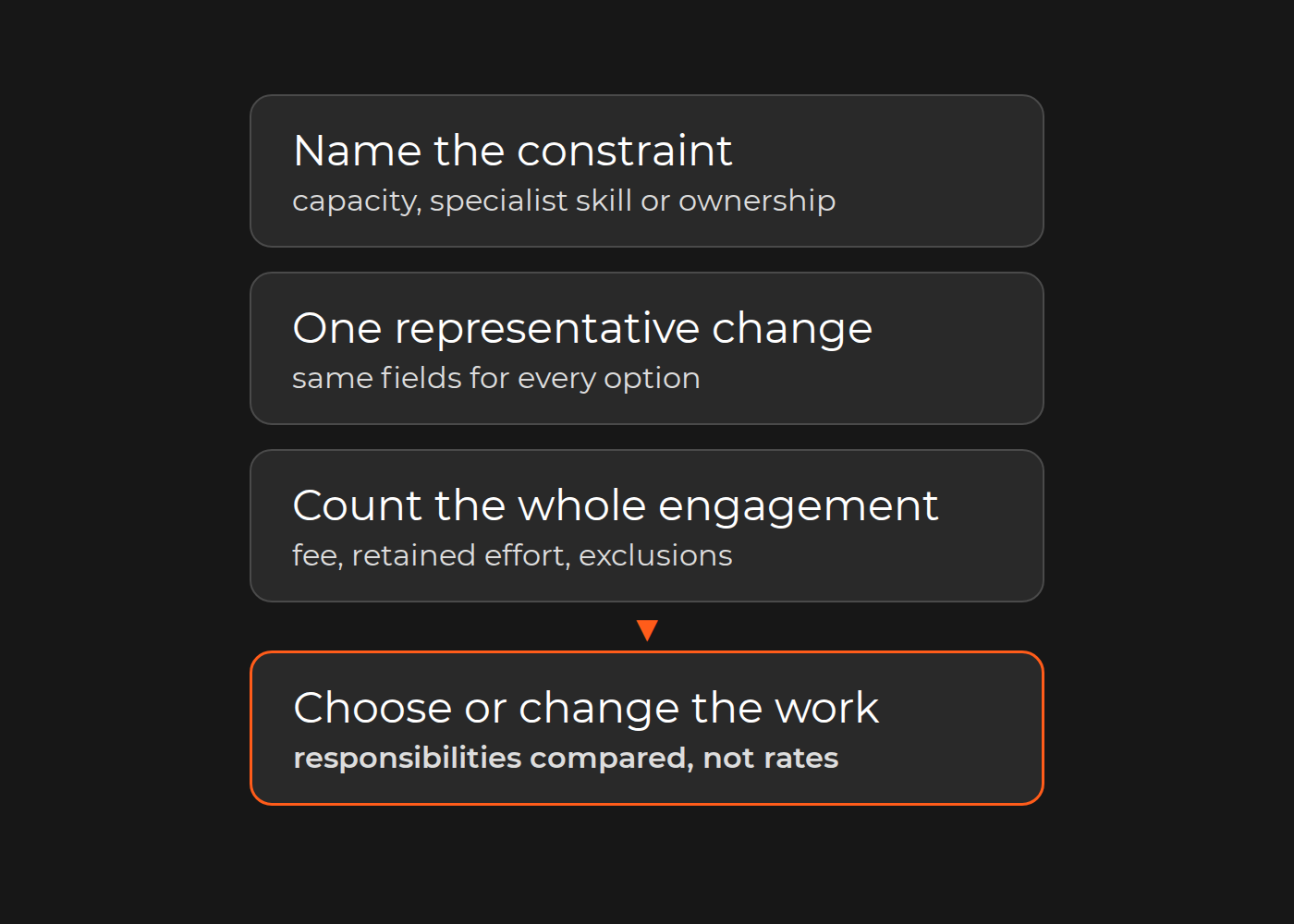
Before expanding, split the estimate into discovery, data remediation, implementation, usage, review, monitoring and change. Mark any line you cannot yet price as unavailable, not zero.
Keep or configure what already meets the need. Buy a suitable product when its supported workflow, permissions, and operating requirements fit. Build or integrate the remaining gap only when you can describe what the existing options cannot do. None of these choices automatically requires a new commerce platform or a custom-trained model.
For an initial business case, measure manual work removed after adding review and correction work back in. Treat sales improvement separately: faster preparation or better answers may support a sales hypothesis, but neither proves incremental revenue. There is no defensible universal AI sales-uplift percentage or payback period for these different workflows.
A transformation roadmap that starts with one accepted workflow
Locate the blockage. Name the recurring job, current workaround, owner, and observed baseline. If the issue is missing data or approval, fix that first.
Compare the simplest alternatives. Use the same representative inputs for manual work, native features or rules, and the AI candidate. Include difficult cases, not just clean examples.
Run a bounded offline test. Agree what constitutes a correct output and what must be rejected. Measure full preparation/review effort and errors by type. Do not turn generation speed into a time-to-publish claim.
Test the handoff before controlled use. If the result merits integration, verify draft writes, access controls, destination read-back, failure handling, and the ability to pause and recover. The authorized owner—not the model—permits live action.
Accept, revise, or stop. Expand only after the owner accepts quality, workload, operating cost, and support responsibility. Success in one product family does not validate every supplier format, language, or channel.
For a catalog launch, the ecommerce lead owns the business decision with the catalog owner. IT or the relevant system owner checks access and integration risk; the authorized budget owner decides whether broader rollout is justified. One enthusiastic user is not a substitute for those responsibilities.
AI fit checklist: choose one workflow
Copy this map into a working document. Complete it for one workflow with its owner. It is a decision record, not a score or an ROI calculator.
Field to complete
Write your answer
Recurring job and boundary
“Turn ___ into ___ for this product family/topic/channel: ___.”
Observed problem
Where does work wait or repeat? What evidence shows it? ___
Current native feature, rule, template, SaaS tool, or process change to compare: ___
Permitted inputs
Source/version: ___; required fields: ___; data owner and permitted processing environment: ___
AI’s limited role
Draft, extract, classify, rank, or predict: ___. Why might rules be insufficient? ___
Authority retained elsewhere
System/rule controlling facts or transactions: ___; person approving output: ___
Exception and stop path
What should be left unknown or escalated? ___; who resolves it? ___
Smallest test
One bounded sample: ___; correct reference answers: ___; separate evaluation cases: ___
Acceptance evidence
Required quality: ___; worthwhile operational improvement: ___; how review and costs will be counted: ___
Handoff and ownership
Test destination: ___; allowed actions: ___; operator and recovery owner: ___
Decision
Keep the simpler method / test AI offline / fix data or ownership first / stop. Reason: ___
Illustrative completed choice: “Classify desk organizers from one supplier spreadsheet into existing storefront categories.” The catalog owner supplies approved examples; AI suggests categories; rules reject nonexistent categories; ambiguous kits go to review. The test compares rules and AI on the same held-out records, with reviewer effort included. No descriptions, translation, prices, or live publishing are added to that test.
Illustrative no-AI choice: a feed has consistent columns, but editors repeatedly convert millimeters to centimeters and chase missing material values. Use a deterministic conversion and required-field validation; obtain missing facts from the supplier. Do not buy a model to conceal an incomplete source.
If the input rights, source of truth, or acceptance owner are unknown, choose fix the dependency first. If the current feature or a simple rule meets the need, keep it. If a specific gap remains and a safe comparison is possible, investigate that one AI workflow.
Common questions about using AI in ecommerce
How much can AI increase online store sales?
There is no general percentage you can apply to your store. Separate an operational result, such as less catalog rework, from a causal sales result. To assess incremental sales, define the change, comparison group, measurement period, and treatment of promotions, returns, and other influences. A controlled experiment can support that assessment when feasible; a before-and-after sales chart alone cannot isolate AI’s effect.
Can small online retailers use generative AI?
Yes, a bounded drafting task may be suitable without a custom system. First check tools already available in your platform or content workflow, using approved facts and human review. If the volume is small or review costs more than the work saved, a template or manual process may be the better choice.
How is AI changing online shopping?
Relevant applications include interpreting natural-language product needs, ranking candidates, and drafting answers from approved information. They do not remove the need for accurate product records, useful filters, current prices, and reliable order handling. Choose based on the customer or operational task you can improve—not a prediction that every store needs an autonomous agent.
Your next step: choose one workflow, not an AI program
Complete the checklist with the person who owns the work. Select one boundary, one simpler alternative, one exception, and one smallest test. The useful outcome is a clear decision: retain the current approach, fix a source or process gap, or test a bounded AI assistant. Choosing no AI is a valid result. First practical check: for the workflow you pick, write down today's baseline, including review and correction time. A pilot is worth running only if it can beat that baseline on useful accepted output with the retained human work visible. To discuss one bounded workflow and its AI fit, contact Dinarys or see Dinarys' ecommerce catalog processing services.
You may share this article
Lassen Sie Profis Ihre Herausforderung meistern
Unsere zertifizierten Spezialisten finden die optimale Lösung für Ihr Unternehmen.