Your ESG platform and adviser can both be doing their jobs while departments still reconcile source spreadsheets manually. The missing piece may be a controlled route from operational records to approved reporting inputs—not another reporting methodology.
A traceable ESG data pipeline preserves where a value came from, which version was used, how it changed, and who reviewed exceptions. Start with one adviser-approved input group. Compare controlled manual collection, your platform’s existing functions, and a bounded integration on that same group before commissioning a larger system.
Decide what engineering should change—and what it should not
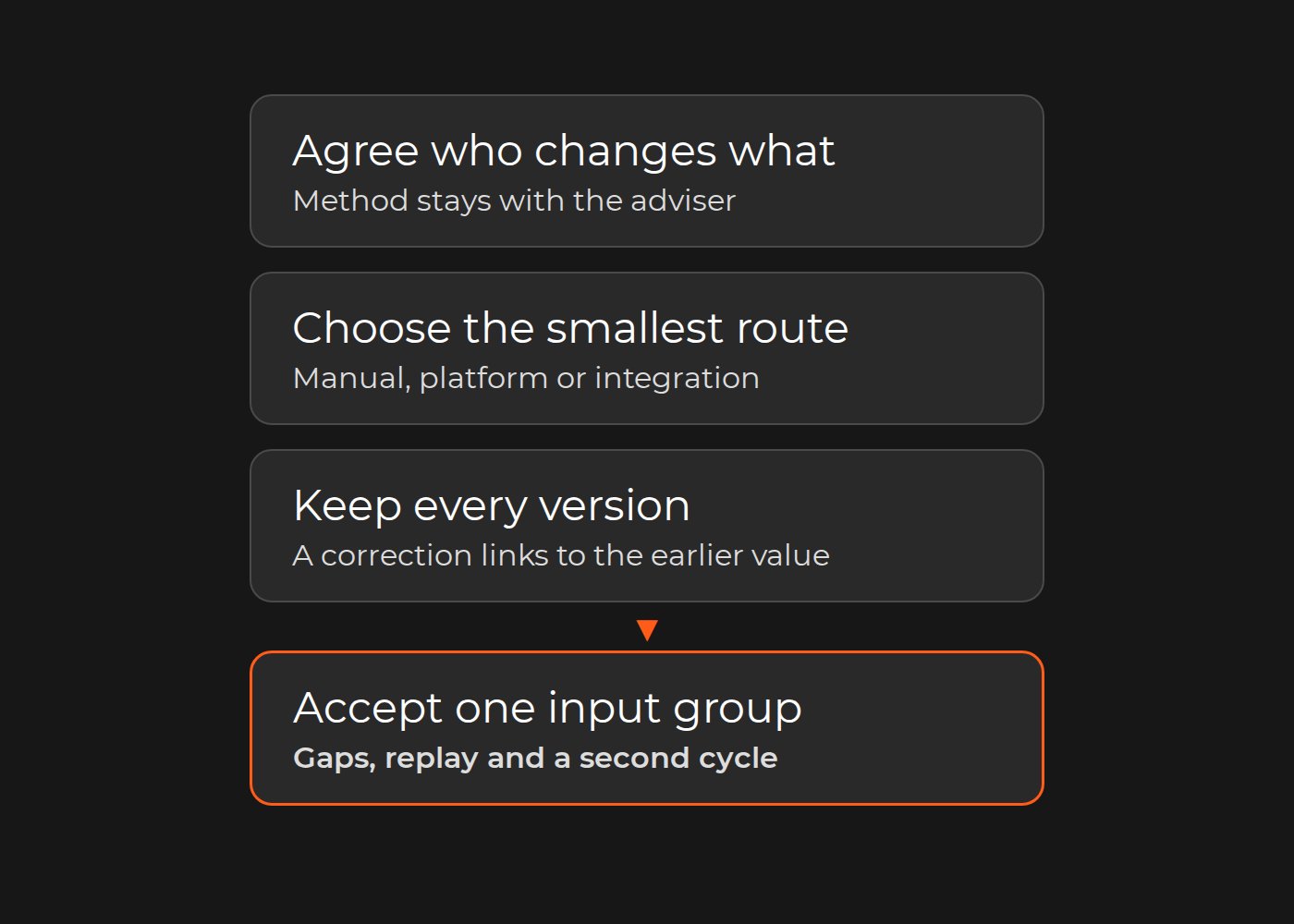
The sustainability owner and ESG adviser define the indicator, organizational boundary, reporting period, units, calculation method, and treatment of estimates. Engineering implements that approved specification and retains its version. A developer should not resolve an unclear reporting boundary by choosing whichever data is easiest to access.
Finance or BI identifies usable sources and reconciles the prepared values. Source owners confirm what their records mean. IT approves access and operating controls. The sponsor authorizes the pilot boundary and any later production work; the subject-matter reviewer accepts the dataset, including its exclusions.
This division makes a contract concrete: data engineering covers extraction, mappings, version history, checks, and reviewer handoff; the adviser retains methodology and interpretation. Technical traceability supports specialist review. It does not itself provide assurance or a legal conclusion.
Choose the smallest collection route that solves the recurring problem
Controlled manual collection can be sufficient for a limited request with accessible evidence. Use a stable template, named owners, explicit gaps, and retained source files. Examine recurring preparation and coordination work rather than assuming that every spreadsheet needs replacement.
Your existing ESG platform should be the first place to check for collection, evidence, review, and import functions. Test what your configured product actually supports. If it handles the workflow, use it; an integration may still be needed to obtain approved operational inputs.
A bounded custom integration makes sense when repeated extraction, inconsistent mappings, or unexplained corrections remain outside those functions. Keep the reporting platform where possible. Specify the output it must receive rather than rebuilding its reporting interface.
Repeated extraction from the same systems, combined with corrections that cannot be reconstructed from retained files, is a useful reason to investigate integration. It is not a numerical investment threshold. One clean monthly export may remain manageable manually.
A relevant engineering example: iSi Group
Dinarys’ public iSi Group ESG reporting PoC describes data-preparation pipelines in the sales department and “traceable data transformations.” The same PoC page also describes a pricing/margin report that was previously prepared manually in Excel. These are related scopes within one PoC for one client, not several ESG implementations.
The useful precedent is the component: source-to-report data preparation. The whole published case is a proof of concept, not a complete production ESG platform, an assurance engagement, or evidence of AI document extraction. Use that distinction when assessing a proposed pilot.
Preserve evidence before transforming it
The operational owner confirms the source and permission to use it; IT establishes authorized extraction. Retain the original evidence, its identifier, period, and version in an appropriate repository. A filename alone is not a reliable connection between a reporting value and a source row.
Create a source register for the selected input group: expected entities and periods, responsible owner, source location, units, extraction method, and known gaps. This prevents a technically valid dataset from silently omitting a facility or department.
For documents, first test the existing extraction or manual-review route. If AI-assisted extraction is worth evaluating, use authorized documents and a human-checked reference set. Retain document and page references, extracted fields, units, and corrections. Ambiguous fields go to review; missing values stay missing. Agree on error severity and acceptance criteria for this task rather than borrowing an accuracy claim from another project.
Make a correction explainable without deleting the earlier value
Lineage is the recorded path from source evidence to a prepared reporting value. In this fictional example, meter M-114 supplies a September input for one facility:
A supplier estimate produces D-SEP-v1. The record retains the estimate status, source file and row, facility, period, preparation-rule version, and processing run.
A later actual reading produces D-SEP-v2. It links to v1 and records “actual replaces estimate”; v1 remains retrievable.
The reviewer chooses the accepted version and records the date, unresolved gaps, and whether an earlier submission needs a correction note.
Keep source status separate from review status: an actual reading is not automatically an accepted reporting input. Also distinguish a corrected source value from a changed reporting method. A method change needs its own explicit version, not a hidden data-cleanup step.
For each prepared input, have your reviewer complete the same record that the fictional M-114 example illustrates. It is a lineage and checks record, not an ESG methodology template:
Input and approved definition version.
Expected entities and reporting period.
Source owner and authorized source location.
Source identifier, row/page, version, and source status.
Original unit and approved preparation rule/version.
Prepared dataset version and processing run.
Superseded version and correction reason, if applicable.
Coverage gaps and responsible owners.
Reviewer, decision, accepted version, and decision date.
Downstream submission affected and correction decision.
Accept gaps, replay behavior, and a second cycle—not just a total
Have the business reviewer and engineering team demonstrate the following on the selected input group:
Acceptance should name the dataset version, covered entities and periods, unresolved exclusions, reviewer, and decision date. A valid outcome can be “source not ready,” with an owner and a corrective action—not an invented value to make the report complete.
Commission one reproducible input group
A pilot should establish whether an agreed dataset can be reproduced from retained source versions and whether the reviewer can inspect gaps and corrections. Production is a separate decision about access, retention, monitoring, support, recovery, and broader coverage.
Dinarys’ sustainability data integration service is the direct service route for discussing the collection and integration layer. If inconsistent entity or source definitions are the underlying problem, master data management consulting is also relevant. Neither replaces ESG advice or makes an enterprise-wide data program necessary before testing one input group.
To discuss extraction, mappings, or version tracking, contact Dinarys with a sanitized indicator definition confirmed by your adviser, one source example, the expected entities and periods, a correction example, the reporting destination, and the named reviewer. Those inputs support a scoped discussion of what engineering must deliver and what stays with your ESG adviser.