Content
E-Commerce
Nov 18, 2026
AI Price Optimization for Retail: Constraints Before Recommendations
Time to read: 6 minutes

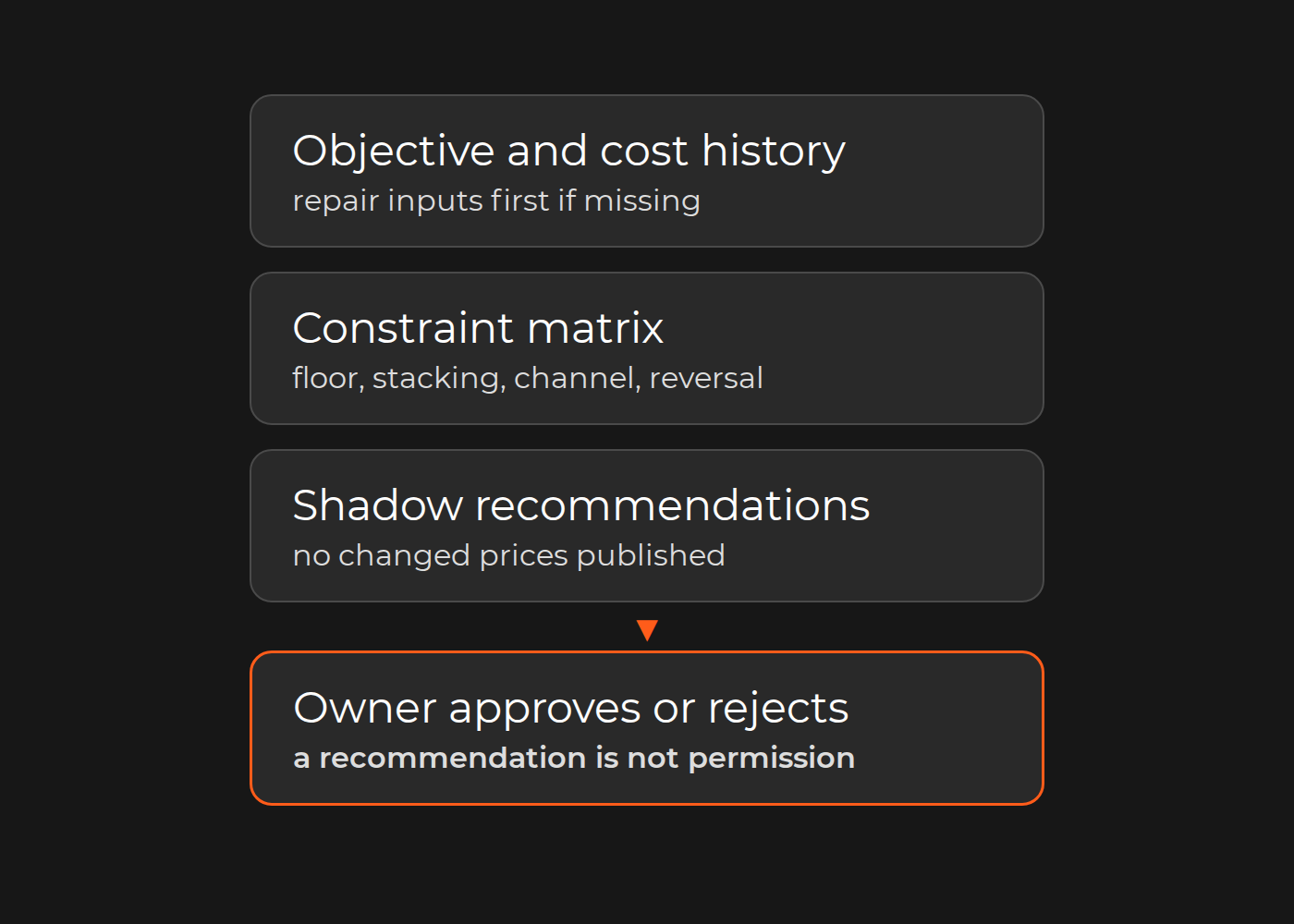
An AI price recommendation is not permission to change a price. Before comparing software, a retailer needs an agreed objective, reliable historical cost and price data, channel rules and a person who can reject the recommendation.
For a commercial leader or CFO, the useful decision is whether approved rules, the existing pricing workflow or a specialist product can support the category within those constraints. Change frequency is secondary. If the real question is why promotion revenue rose while contribution fell, diagnose the economics before selecting an optimizer.
Choose a route before comparing software
Use these four questions to locate the remaining gap. A data connection may support any route; it is not a substitute for a pricing method.
- Is the objective defined, with reliable cost and price history? If not, repair those inputs first. Have finance define contribution and the applicable cost basis; do not optimize an undefined result.
- Do approved margin and discount rules solve the problem? If so, maintain those rules. They fit inconsistent floors and blanket discounts, but cannot resolve a predictive gap simply by enforcing a minimum price. Test ownership, stacked discounts and exceptions.
- Do SKU, location and stock-age decisions exceed a manageable rules process? If not, inspect the existing commerce/POS workflow and approvals. If so, evaluate price optimization software with a qualified specialist. Software is a poor fit if your constraints cannot be represented or no pricing owner can accept its decisions.
- Can cost, stock, history and approvals reach the chosen workflow reliably? If not, scope the missing data/integration work. That work loses its value if the actual unresolved need is a pricing model, not a connection. Test time alignment, reconciliation and handover.
This comparison should include the ongoing work: data quality, model and policy maintenance, licenses where applicable, channel integration and operational support. Those are scope factors, not a published price estimate.
Dynamic pricing versus optimization
For this evaluation, “dynamic pricing” describes changing prices as conditions change; “optimization” describes choosing among prices against an objective and constraints. These are working distinctions, not mutually exclusive product labels. The objective could be contribution, clearance by a date or an agreed balance—not simply immediate revenue.
The AI part of an optimizer is mainly forecasting. A model learns from historical prices, sales, stock and seasonality how demand for each SKU and location is likely to respond to a price change. The optimizer then proposes prices that serve the agreed objective without breaking the constraints you set, and a pricing owner or merchandiser approves, adjusts or rejects each proposal. The forecast is only as reliable as that history: stockouts hide demand and past markdowns were chosen for slow sellers, which is why the evaluation below treats any model claim with caution.
Here, markdown optimization focuses on permanent clearance reductions for aging or seasonal stock. Retail usage also includes temporary markdowns. Revionics' markdown page describes decision support for end-of-life, end-of-season and other clearance types. That is vendor-stated scope, not verified margin improvement or a product recommendation.
The floor must survive the coupon
This fictional constraint test is not a recommended price or proven pricing algorithm. Assume USD, tax-exclusive prices and a finance-approved variable cost basis of $70/unit, including product and the variable costs selected for the test. The illustrative contribution-margin floor is 20% of net selling price. Exclude fixed costs, campaign cost, returns and supplier support.
The test requires (price − $70) ÷ price ≥ 20%, giving a minimum net price of $70 ÷ 0.80 = $87.50. At that floor, $17.50 contribution is 20% of $87.50. With a $100 reference price, the maximum reduction on this simplified basis is 12.5%. A different cost or margin definition changes the floor.
Candidate markdown: $90. Contribution is $20/unit and margin is $20 ÷ $90 = 22.22%, rounded. It clears the illustrative floor.
The same markdown with a further 10% coupon: $81. Contribution is $11/unit and margin is $11 ÷ $81 = 13.58%, rounded. It fails the same floor.
The coupon is applied to $90, not subtracted as another ten percentage points from the original discount. Passing the floor does not establish the best price, demand response or total profit. It establishes only that one constraint passed on the stated basis.
Bring a constraint matrix to the demo
Use one category decision, with an owner and expected exception behavior for each constraint:
- Finance/pricing — cost and floor: missing or stale cost creates an exception, not assumed compliance.
- Pricing and channel owner — stacking: test the final price after coupon, loyalty and basket reductions.
- Merchandising — stock age: identify the intended clearance cohort and remaining stock, not just total sales.
- Commercial/policy owners — channel and country: make tax, currency and channel differences explicit. Have qualified business and legal owners determine applicable promotion, reference-price and customer-data requirements.
- Pricing operations and IT — approval, pause and reversal: confirm that a changed recommendation cannot inherit an earlier approval and that an authorized operator can stop publication; the detailed walkthrough belongs in your interviews with markdown optimization partners.
A tool setting does not establish legal compliance. Recommendation, business approval and channel publication remain separate decisions.
What an evaluation can claim
Join historical SKU–price–cost–stock versions as they applied at the time, retaining discounts, returns, promotions and availability. Reserve a later-period holdout before tuning; compare current markdowns, simple rules and the candidate on time-appropriate inputs. Stockouts censor sales, and prices never offered have uncertain counterfactual demand. Selected discounts on slow sellers do not yield a clean causal elasticity estimate.
Run shadow recommendations for one category and season or campaign, without publishing changed prices. Merchandisers should record reasons and accepted/rejected exceptions. Shadow performance is not realized incremental margin. A separately authorized live comparison needs a measurement specialist to address substitution, shared advertising, cross-channel shopping, returns and post-promotion effects. Keep attributed and incremental sales apart: a sale credited to the campaign may have happened without it, so the comparison has to estimate what would have sold anyway.
Agree responsibility before integration scope
Dinarys' Prostor case shows where such data can flow. The case page describes real-time inventory sync across 427+ physical stores and the online storefront, ERP/CRM integrations through a custom ERP API layer, and 50,000+ SKUs. Those are the kind of paths an optimizer or rules engine would read cost, stock and price from—and the route an approved price would travel back to each channel. The page does not describe a delivered price optimizer or a causal price-response model.
Discuss that connection through ERP integration services, with a qualified pricing partner owning the specialist method. Whichever pricing partner you choose, require named responsibility for model validation, approvals, the price API and reversal—not an implied pricing capability inside an integration proposal.
Prepare the constraint matrix, a sanitized stacking example, historical-data limits and one category decision when you contact Dinarys. Agree floors, channel rules and the control test before estimating the remaining engineering gap. Any rollout needs authorized ownership and a rehearsed pause/reversal plan; this is not an executable automatic price-change procedure. No AI label guarantees better margins.


Lassen Sie Profis Ihre Herausforderung meistern
Unsere zertifizierten Spezialisten finden die optimale Lösung für Ihr Unternehmen.