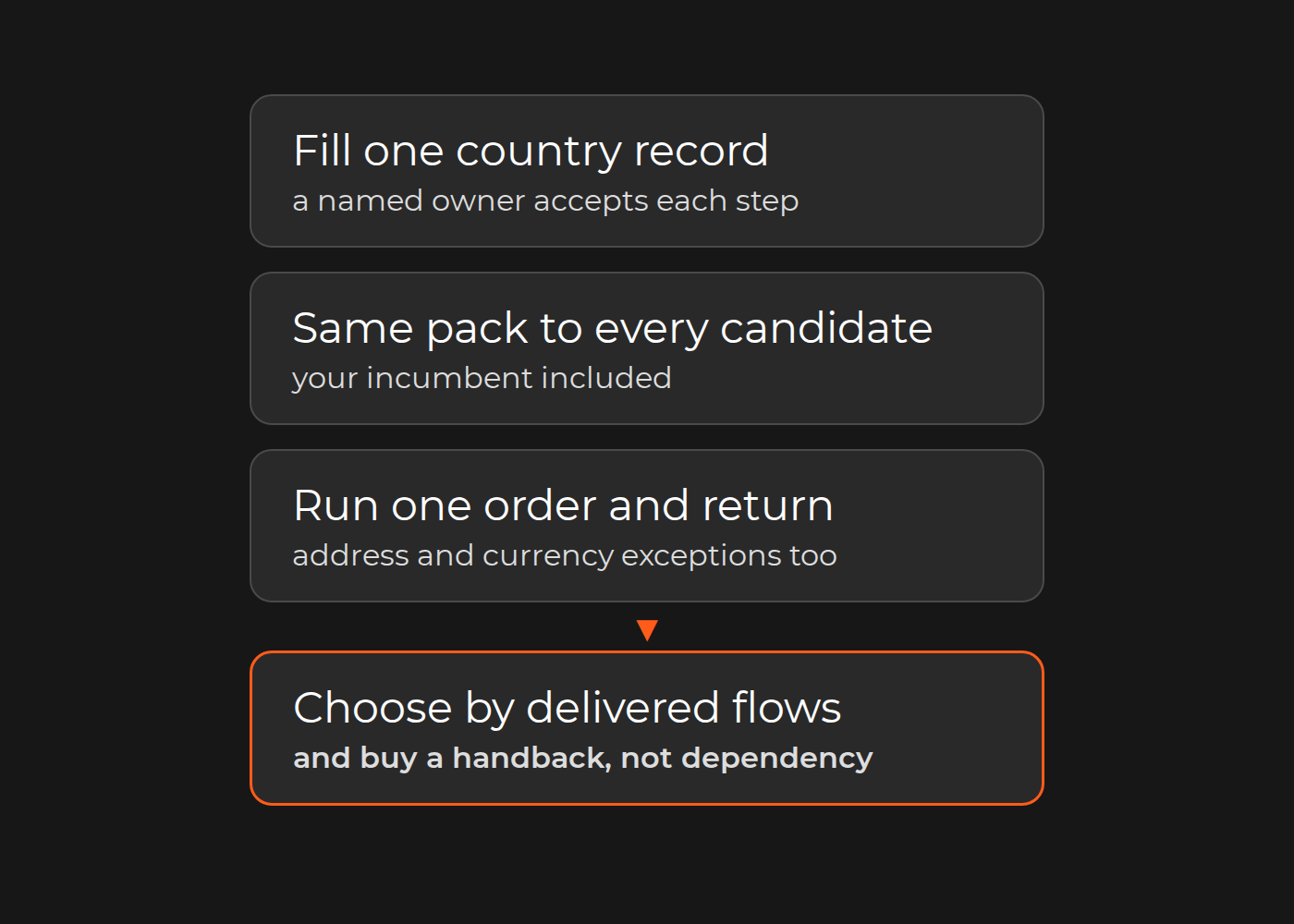
A recognized PDF is not a valid order in your ERP. Ask each candidate to show how a source line becomes an approved draft—and what stops it when the SKU, pack, revision, buyer price, or credit decision is uncertain.
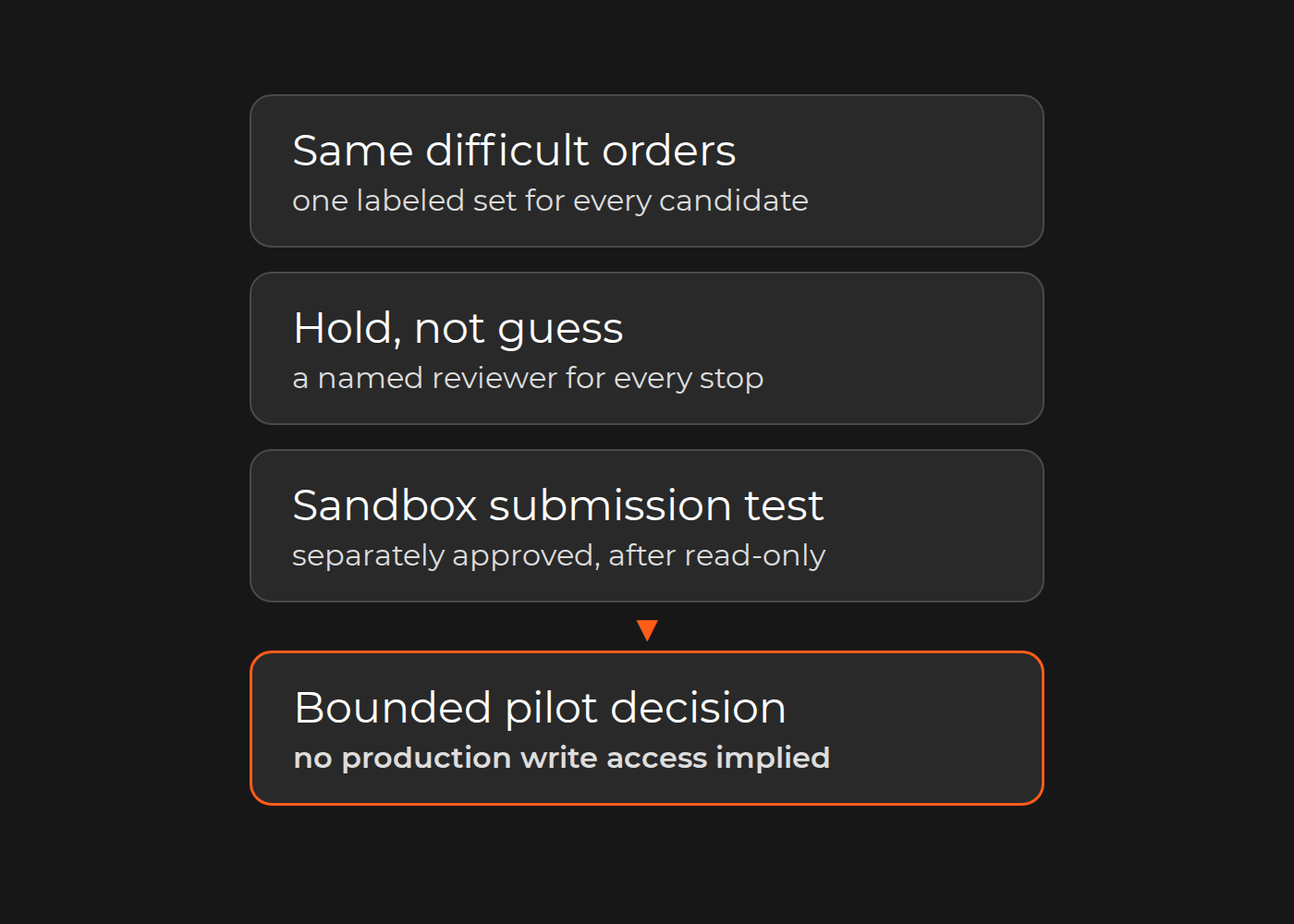
Shortlist partners that demonstrate a visible hold rather than a guessed answer, with a named reviewer and reproducible evidence. Test historical extraction read-only first. Demonstrate submission controls later in a separately approved sandbox before considering production access.
For Sales Operations and the ERP owner, this is a commercial-control and operational decision as well as an extraction test. Dinarys offers related engineering services and has a commercial interest in the selection; the criteria below should be applied to its proposed scope as well as other candidates.
Give every candidate the same difficult orders
Select permitted examples across customers, formats, document quality, and exception types. Link source emails and attachments to the correct revision and approved historical outcome. Minimize the data and approve access, transfer, retention, and provider use before sharing it.
Have the order-desk lead and ERP owner label expected results together. Keep disagreements unresolved rather than inventing a correct answer. Provide practice examples, retain buyer-owned cases unseen until testing, freeze mappings/rules per run, and record configuration changes.
Include clean repeats, customer aliases, look-alike variants, ambiguous units, pack conversions, currency/price differences, credit holds, duplicate messages, revisions, and incomplete documents. A clean-order demo cannot establish how exceptions behave.
Ask for seven demonstrations on one revised purchase order
Fictional example: PO-740 revision 1 requests 10 cartons of customer item C-12, blue. The approved mapping is internal SKU INT-BL, exact blue variant, 12 units per carton. Revision 2 changes the quantity to eight cartons before approval. These identifiers and rules are invented to illustrate the tests.
Show revision 1 alone. Require 120 proposed units linked to the source line and approved pack mapping. Retain mapping version and conversion; an unexplained quantity is not enough.
Introduce revision 2. Require explicit supersession and 96 proposed units, with both sources retained. Treating the revisions as independent new buyer orders fails. Keep the revision link and review decision.
Remove the approved units-per-carton rule from the test mapping. If an approved conversion exists, applying it is correct; if none exists, the line must be held for the master-data reviewer. Reusing 12 without an approved rule fails. Retain the hold reason and its owner.
Make “blue” match two variants. Require exact-variant clarification rather than automatic selection. Retain candidate mappings and unresolved choice.
Make document price differ from the ERP buyer price. Require a flagged discrepancy and an authorized commercial decision. A model override fails. Retain the price source and decision record.
Apply a credit hold. Require it to remain visible and reach the authorized role. Confidence in extracted fields cannot remove it. Retain the source and approval boundary.
Forward the same attachment again. Require duplicate-candidate identification linked to the existing request, not another independent order draft. Retain the source relationship and disposition.
the mapping, rule and configuration versions in use;
the actual output, with source and line references;
any critical defect or exception type;
the responsible reviewer and decision;
active review, correction and reconciliation time;
for unresolved cases, the reason, next action and owner.
Require joint line correctness, not mostly readable fields
A correct line must agree across every field required for the task: customer, PO/revision, internal SKU, exact variant, quantity, unit, pack conversion, price, and currency. Whole-order correctness also requires the right line count, no invented lines, and the correct commercial disposition.
A missing critical field must stop the draft with a reason and reviewer. Reading most fields correctly does not make a wrong-pack line acceptable. Approved master data and ERP rules establish mappings and commercial controls; extraction proposes values against them.
What adjacent integration evidence can tell you
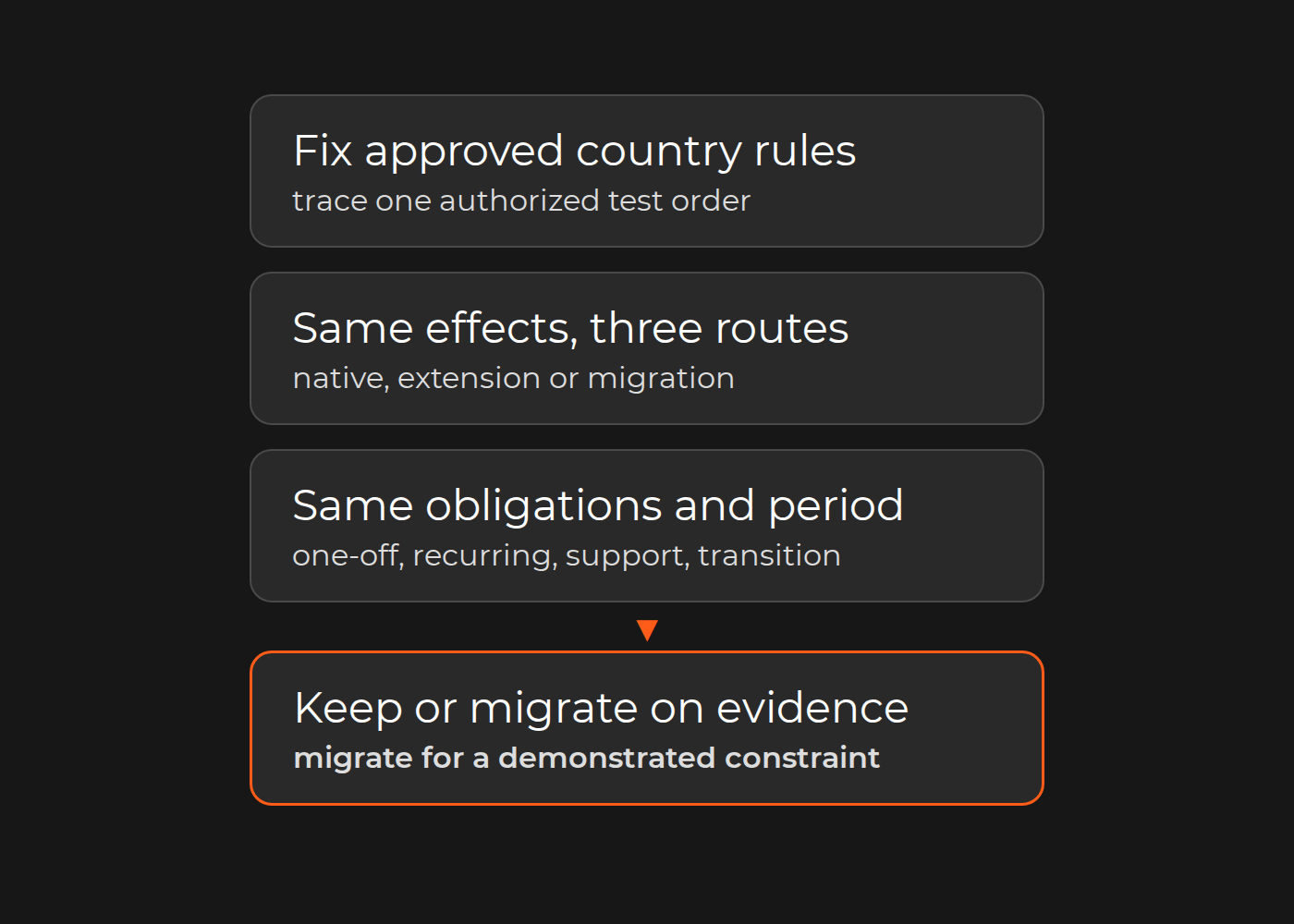
Dinarys’ SanMar case describes a custom API connector that converts a legacy ERP data format for Magento B2B/B2C commerce. The engagement also included documenting B2B functionality and moving the B2C site from Magento 1 to Magento 2.
For PO-740, that is relevant to translating and documenting an interface once its business meaning is agreed. It does not demonstrate customer-SKU extraction, a 12-unit carton rule, revision supersession, human review, or duplicate-safe AI order submission. The published case is not a completed AI sales-order extraction reference. Evaluate those behaviors separately; ERP integration services cover the adjacent system connection.
Inspect duplicate actions and unknown submission outcomes
In a separately authorized sandbox, ask the candidate to repeat a source document, repeat a review action, and simulate a timeout around submission. Observe the actual integration—not just a UI status—and distinguish:
Not sent: evidence shows no submission occurred.
Outcome unknown: the request may have reached the ERP, but acceptance or rejection is unconfirmed. Reconcile status rather than blindly resubmitting.
Confirmed accepted: actual ERP acceptance evidence is linked to the buyer request.
Known rejection: the rejection reason and next action are retained.
A transport acknowledgment may confirm receipt without confirming ERP order acceptance. Have the ERP owner identify the accepted-order evidence. “Idempotent” is not evidence by itself: show how one buyer request stays linked across attempts and revisions and how the reviewer sees its current state.
Replay of the same approved draft/submission intent, including an authorized retry after reconciliation, must not create another independent ERP order. Require actual resulting ERP records and references. Two accepted orders for the same intent fail even if both are linked correctly to the buyer request. Test legitimate revisions or amendments as separately identified changes—not as replays of the original intent.
Score severity and operating effort separately
Agree on business-specific thresholds before testing. Count jointly correct lines, correct whole orders, critical defects by type, correctly routed exceptions, unresolved cases, duplicate dispositions, and total human effort. Report denominators and case coverage. Wrong packs, lost revisions, and unauthorized price/credit decisions are not minor errors to average away among readable fields.
Correctly stopping an incomplete document is useful. Also inspect unnecessary holds on cases the process should resolve. Finite tests do not establish future error-free operation.
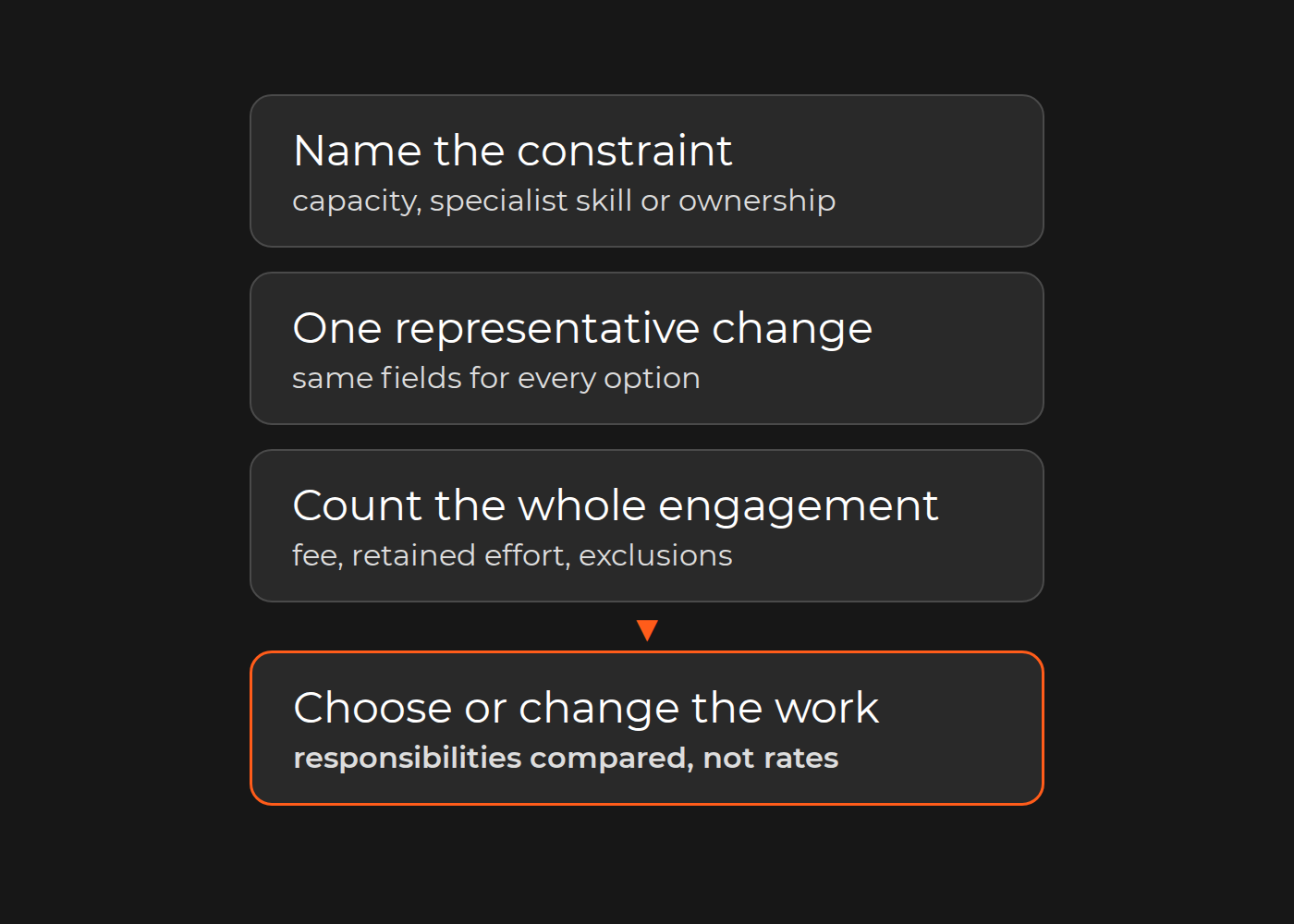
Compare preparation through review, correction, and reconciliation with the current process on the same order mix. Keep elapsed waiting separate. Finance should approve the cost-per-accepted-order definition, with setup and operating costs separated and pending/rejected work visible. Do not let a lower time result waive a critical defect.
Select a team that can hand over the operating process
Ask who owns labeling, alias/pack maintenance, ERP-rule validation, review queues, reconciliation, monitoring, and acceptance sign-off. Sales Operations should accept the desk workflow; the ERP owner should accept integration behavior; commercial/finance owners retain price/credit authority; the sponsor decides whether the bounded scope can advance.
Require the corpus and results, mapping/configuration versions, known gaps, access boundaries, monitoring instructions, escalation, and a way to disable the new route while preserving manual intake. Have the receiving team perform a stopped-draft and unknown-outcome walkthrough.
Do not select a candidate that guesses a missing pack or variant, cannot name the reviewer for a hold, cannot reproduce a result on frozen mappings, or presents only clean orders after being asked for exceptions. These are evaluation criteria, not findings about a named supplier. Repair and retest demonstrated defects before reconsidering the scope.
Discuss acceptance before sharing customer documents
Discuss acceptance with Dinarys using a non-sensitive description of one channel and ERP, current handling baseline, accountable owners, critical stop conditions, and intended review responsibilities. Agree on an approved transfer route and data-use rights before providing a minimized sample with approved outcomes and mappings.
Acceptance applies to the documented scope. It does not grant production write access or authorize a broader rollout. The useful next decision is whether the proposed people and evidence can support a bounded pilot under those conditions.