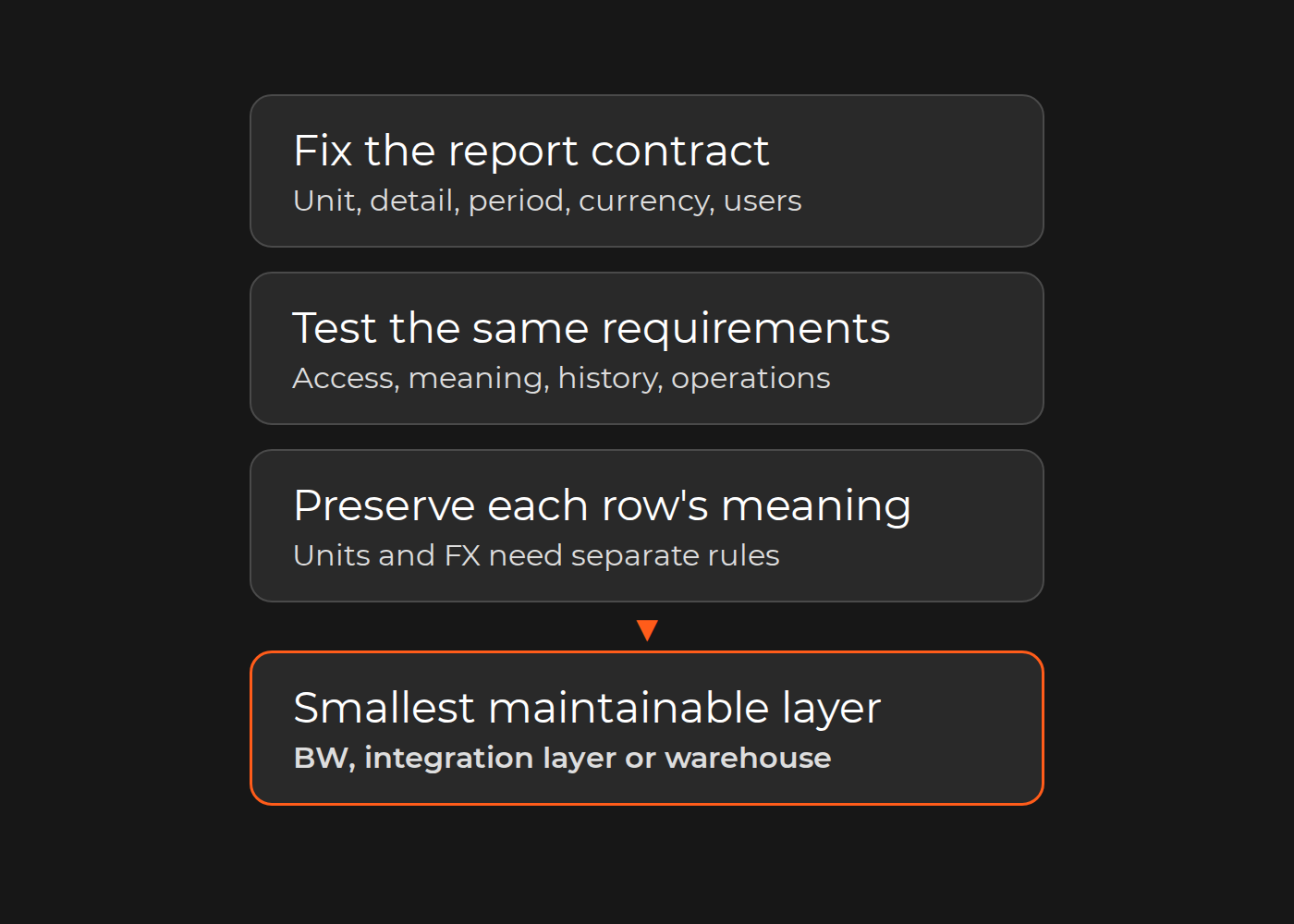
Another dashboard will not resolve different units, cost bases, and posting periods in your ERP extracts. Choose the smallest maintainable data layer that can reproduce the agreed report, explain exceptions, and support the next reporting cycle.
Extend existing BW when its trusted finance models, history, and operating team can accommodate the source.
Add an integration layer when the gap is repeatable extraction and normalization into a suitable existing reporting destination.
Evaluate a separate warehouse when justified history/model requirements cannot be met economically by the retained environment.
These are overlapping choices, not an automatic selection algorithm. SAP Business Warehouse (BW) is itself a data-warehousing application; here, a “separate warehouse” means an analytical store outside existing BW. An integration layer can feed either. A second ERP or multi-year scenarios alone do not require another warehouse.
Fix the report contract before comparing platforms
Define the business unit, level of detail, period, currencies, units, included revenue/cost, actual-versus-plan separation, and authorized users. Finance owns the metric; source owners confirm extracts; the data team implements and reconciles them.
“One source of truth” is not precise enough. ERP may own invoices, a controlled finance process may own allocations, and an approved rate table may supply FX. The report must explain how those authorities combine, not pretend they are one original source.
Compare every candidate against the same requirements: source access, metric meaning, history/corrections, reconciliation, access control, workload, and operating ownership. That prevents a low storage estimate for one option being compared with a complete reporting service for another.
Extend BW when the trusted model can carry the change
SAP's data-warehousing introduction describes BW as an integrated warehouse application. Existing financial models, history, controls, and operators are assets worth testing before adding another analytical store.
Demonstrate ingestion of the actual source, identity/unit mapping, historical treatment, and reconciliation without breaking retained reports. Validate the installed BW version, interfaces, capacity, access, and support—not a product-family description. This option loses its advantage when verified ingestion or modeling constraints make the bounded report disproportionately difficult to build or operate.
Dinarys' SAP BW/BI support and S/4HANA transition analysis for iSi Group shows the kind of evidence this test needs. The case page describes a review of BW/analytics data flows, integrations, and reporting dependencies, and an assessment of which components are ready for S/4HANA and which need redesign. That work was analysis, not a completed S/4HANA migration, and the public case page does not describe adding a second ERP source to BW.
Add an integration layer when the destination already fits
This route addresses repeatable extraction, normalization, and delivery into BW or another retained reporting environment. Prove source-to-target traceability, correction/replay behavior, monitoring, and where durable history lives. A maintained connector may reduce interface work without solving customer or product identity.
It is a poor fit if the destination cannot support the required report or history. Also reconsider a design in which the “integration layer” quietly becomes an undocumented analytical store with calculations and exceptions no one is assigned to maintain. Name the metric owner and the operator of every durable component.
Evaluate a separate warehouse when requirements exceed the retained environment
Cross-source history and reusable analytical models can justify another store when evidence shows the current environment cannot meet those needs at acceptable operating cost. Compare implementation and recurring effort, migration, security, reconciliation, source impact, and a named operating team—not storage alone.
This option loses when retained BW or another analytical store already meets the contract with less change. Stop expansion if the proposed enterprise scope grows before the first report has a viable model and acceptance route. A new warehouse adds another data lifecycle to operate; it does not remove responsibility for definitions or corrections.
Choose none of these changes when the problem is elsewhere
A warehouse cannot approve a cost allocation. A connector cannot decide whether “customer 123” denotes the same business in two entities. Resolve definitions and source ownership first. Reuse an existing report or vendor capability if it meets the requirement with less operational change. If one interface remains uncertain, investigate that dependency rather than reopening the whole enterprise architecture.
What every option must do: preserve the meaning of each row
Fictional manufacturing illustration: Entity A supplies invoice lines in EUR and individual units; Entity B supplies USD and packs. The target is one row per entity + invoice + line, with approved product/customer mappings attached. Retain original keys and batch IDs; invoice numbers may repeat across entities. Preserve posting period, invoice date, and extraction time.
Field
Entity A
Entity B
Target/control
Quantity
12 each
2 packs of 6
12 each; dated conversion
Product
Local A-77
Local B-04
Approved P-7 mapping
Revenue
€120
$132
Original amount + FX rule
Actual cost
€72
$85.80
Comparable cost inclusions
Suppose finance approves €0.90 per $1 for this illustrative October management report, from fictional table FX-OCT-v1. B becomes €118.80 revenue and €77.22 cost. A contributes €48 margin; B contributes €41.58. Total margin is €89.58 on €238.80 revenue: 37.51%, rounded to two decimal places, using (revenue − included cost) / revenue × 100.
Rebates, freight, and allocations are excluded by assumption. Real definitions, rate sources, effective dates, rounding, and approval must replace these teaching inputs. Quantity conversion does not multiply line revenue; currency conversion does not change quantity.
Skip FX and the report could add $132 to €120, then label “252” as euros instead of the approved €238.80. The addition succeeds while its meaning is wrong. Neither BW nor another warehouse prevents that without the correct transformation.
Apply the comparison to the same example
Suppose existing BW already meets the report's history, calculation, and access requirements, and a maintained team can operate it. The remaining gap is Entity B extraction plus the pack/FX mappings. Test an integration path into retained BW—not a new analytical store merely because B is a second ERP.
If required cross-source history or reusable models cannot be supported economically in BW or another retained destination, evaluate a separate warehouse. The arithmetic does not choose the architecture; demonstrated requirements, constraints, and operating cost do.
Test the candidates and record the decision
Use a control sample with pack conversion, credit note, unknown product, late correction, and repeated batch where applicable. Require source-to-target or rejection traceability and separate source-currency/reporting-currency totals. Identify where retained inputs, history, and correction evidence will live.
For each viable option, record its sources, business unit, row detail, history, users, retained assets, excluded work, operator, and recurring-cost assumptions. Attach the reconciled sample, verified interface constraints, unresolved exceptions, correction/reload evidence, and the conditions that would change the choice.
For the fictional example, a useful decision entry is: “Candidate: integration into retained BW. Evidence needed: Entity B extraction, dated pack/FX mapping, repeat-batch test, and retained-report regression. Reconsider if required history or operating cost fails the report contract.” This is a proposed test decision, not a proven implementation.
The controller approves metric rules, the commercial director validates decision usefulness, and BI demonstrates mapping and operations. IT/security approves access and source impact; the authorized sponsor funds the selected boundary. If two options fit, compare recurring effort, effect on retained reports, and availability of a named operator.
What Dinarys' iSi Group PoC does and does not show
The iSi Group ESG reporting PoC is a proof of concept, and that framing applies to the whole case page, including its pricing/margin work. Within the PoC, the page describes data-preparation pipelines in the sales department, a pricing/margin report previously prepared manually in Excel, and a “data simulation mode” on historical data. That makes it relevant to the report-contract and control-sample steps above—not proof of a production reporting platform or a delivered multi-ERP warehouse.
The public case pages do not describe enough technical topology to classify any component as a BW extension, middleware, or separate warehouse. Your additional ERP sources, history requirements, and warehouse choice need their own assessment.
Discuss the bounded reporting problem
For source-system connectivity, ERP integration services is a relevant starting point. To discuss a profitability data flow, share the report boundary with Dinarys: an approved metric definition, system/version list, sanitized mapping sample, control totals, history/correction needs, and unresolved interface questions. Use a redacted description first; exchange extracts only through an agreed authorized route.