Content
E-Commerce
Nov 18, 2026
Selecting a Markdown Optimization Partner Without Losing Price Control
Time to read: 5 minutes

A markdown partner should help you make and review category decisions without gaining an undefined right to change prices. The buying question is who owns the pricing method, who maintains the integration and who can approve, pause or reverse a change when a channel does not match the accepted plan.
For a commercial leader or CFO, the useful demonstration is not a predicted margin chart. It is an acceptance walkthrough: an invalid recommendation is stopped, an approved version is traceable, channel discrepancies are visible and your own operators can manage the exception.
Interview script for a markdown optimization partner
The script covers both the pricing specialist who owns the method and the engineering team that integrates it; one provider may answer for both, or two may split the roles. Use one category and one season or campaign as the test perimeter. Ask every candidate the same questions and record the named provider owner, buyer approver and evidence behind each answer.
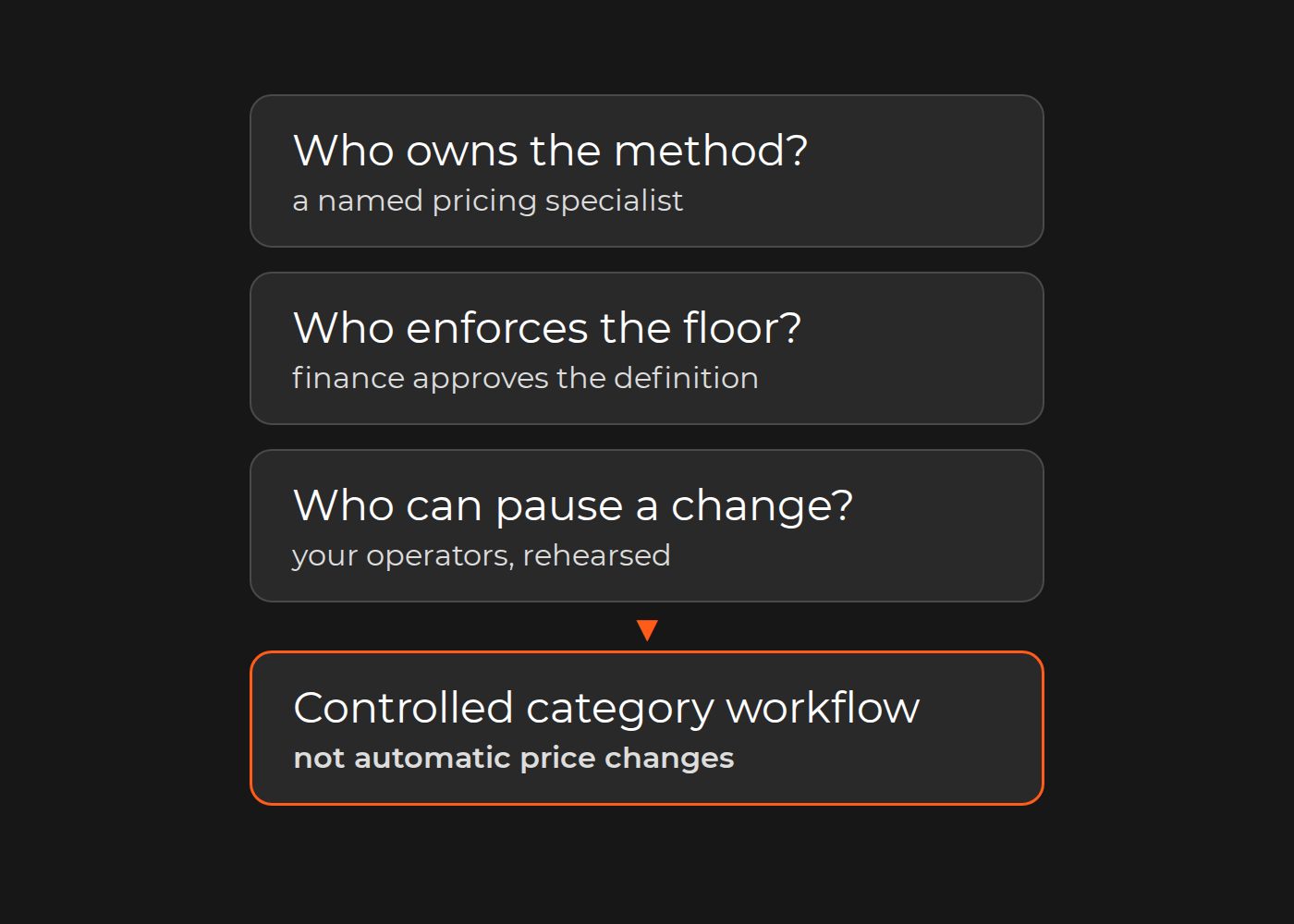
1. Who owns the pricing method? A strong answer identifies responsibility for demand-response assumptions, category objectives, cost definitions and evaluation. A weak answer substitutes an “AI team” or commerce integration case for pricing competence.
2. Who sets and enforces the floor? Finance/pricing should approve the definition; the specialist explains the method and engineering demonstrates enforcement using time-specific costs and discounts. A floor with no agreed cost/tax basis is not an acceptance criterion.
3. What happens when cost is missing or stale? Require an explicit exception and an owner. Treating unknown cost as evidence of margin compliance is a red flag.
4. What invalidates an approval? Demonstrate a changed recommendation, effective period and coupon/loyalty combination. A strong workflow checks the final customer price and requires review of the changed version, rather than inheriting stale approval. For example, in a fictional USD test with an $85 floor, either 5% reduction on $90 gives $85.50; both applied sequentially give $81.225, about $81.23. Individually acceptable reductions can fail together. Actual rounding rules must be part of the test.
5. What happens when the price interface times out or repeats a request? Require a visible outcome and reconciliation against the receiving system. “Request sent” is not proof that the intended price is displayed; an unknown outcome must not become false completion.
6. Who sees the price actually shown in each channel? The IT/commerce/POS owner should reconcile the accepted version, customer-visible price and effective period. A candidate should show how a mismatch is assigned and why it prevents scope expansion.
7. Who can pause, and who authorizes recovery? Name the operator and escalation owner. Require a rehearsal your team can run without provider intervention, preserving current channel state and history. Blindly resending an old value is not a recovery plan.
Ask for evidence that matches each responsibility
Request permitted examples of a pricing-method review, constraint test, explained merchandiser override and reconciled handover. A commerce integration case does not prove causal elasticity estimation; a product's marketing promise does not validate its model on your assortment.
Evaluate maintained pricing products and your existing provider first. Revionics describes markdown decision support across clearance types; this illustrates a product category to evaluate, not a verified benefit or Dinarys partnership. If consistent margin rules and approval routing meet the need, simpler controls may be sufficient.
Dinarys is a potential provider of the engineering work discussed here, so this is not an independent vendor ranking. Its Prostor case describes a custom loyalty/bonus program with a unified loyalty balance across online and in-store, checkout work, ERP/CRM integrations and real-time inventory sync across 427+ physical stores and the online storefront. Those are the points where a markdown meets loyalty reductions and channel stock, so ask any integrator—Dinarys included—to show how a price change, a loyalty reduction and a stock state are reconciled in a setup like that. The case is adjacent engineering evidence, not proof of a delivered markdown optimizer or price-elasticity model. ERP integration services are the relevant engineering route; confirm the pricing specialist and method scope separately.
Fictional markdown incident: approval is not channel confirmation
Use this fictional incident as a demo prompt. One SKU has a business-approved test floor of $85 and approved markdown version 7 at $90. Two test channels must show the same tax-exclusive USD price for the same unit and effective period. Prior approved version 6 was $95; no coupons or taxes complicate this incident.
A separate $82 candidate should fail the floor check. Version 7 clears that particular check, but does not establish profitability or authorize publication. In the simulated handoff, the store shows $90 while the web still shows $95—a $5 discrepancy.
The acceptance record should say “channel mismatch,” not “version 7 complete.” The operator must be able to pause further changes, inspect the actual versions and route the incident to its owner. Any authorized recovery uses current state and policy rather than blindly resending an old value.
Reversing a displayed price does not erase completed transactions, customer communications or commercial obligations. Those require their own authorized handling. Retain incident history rather than implying rollback makes every consequence disappear.
Define acceptance without promising a positive result
Treat any forbidden price or unauthorized release in the agreed tests as a failed acceptance case, not a warning to waive. Finite tests cannot guarantee every future failure is impossible. Name the owner of ongoing cost, constraint and software-behavior changes.
Finance should accept the baseline, contribution, campaign cost and sell-through denominator. Backtests and shadow advice demonstrate decisions and operator control, not realized profit; a separately approved live evaluation needs a pricing/measurement specialist. Agree the pricing constraints and the evaluation method before that live test. If you still cannot explain why promotion revenue rose while contribution fell, diagnose those economics first. An inconclusive or negative result must remain visible.
Confirm budget authority and vetoes for the engagement. Legal and policy owners should determine applicable reference-price, promotion, customer-data and commercial requirements.
Buy a handover your team can operate
Before acceptance, have the merchandiser review an exception, IT reconcile a failed handoff and operations rehearse a pause. Agree who maintains constraints, which configuration and artifacts transfer to your team, and when another category needs a new scope.
Take the interview answers and version-7 incident to your shortlisted providers. If Dinarys is one of them, send your recorded interview answers together with the version-7 incident results, a sanitized channel mismatch, your systems list and the proposed category/season. Settle who owns the pricing method and who can pause a change before estimating delivery. The purchase should be a controlled category workflow with an accepted economic method—not automatic price changes or a promised margin gain.


Lassen Sie Profis Ihre Herausforderung meistern
Unsere zertifizierten Spezialisten finden die optimale Lösung für Ihr Unternehmen.