A customer wants a different size. The portal offers an exchange, the warehouse records a receipt, and support sees a refund button. Which action should happen next—and which system is allowed to trigger it?
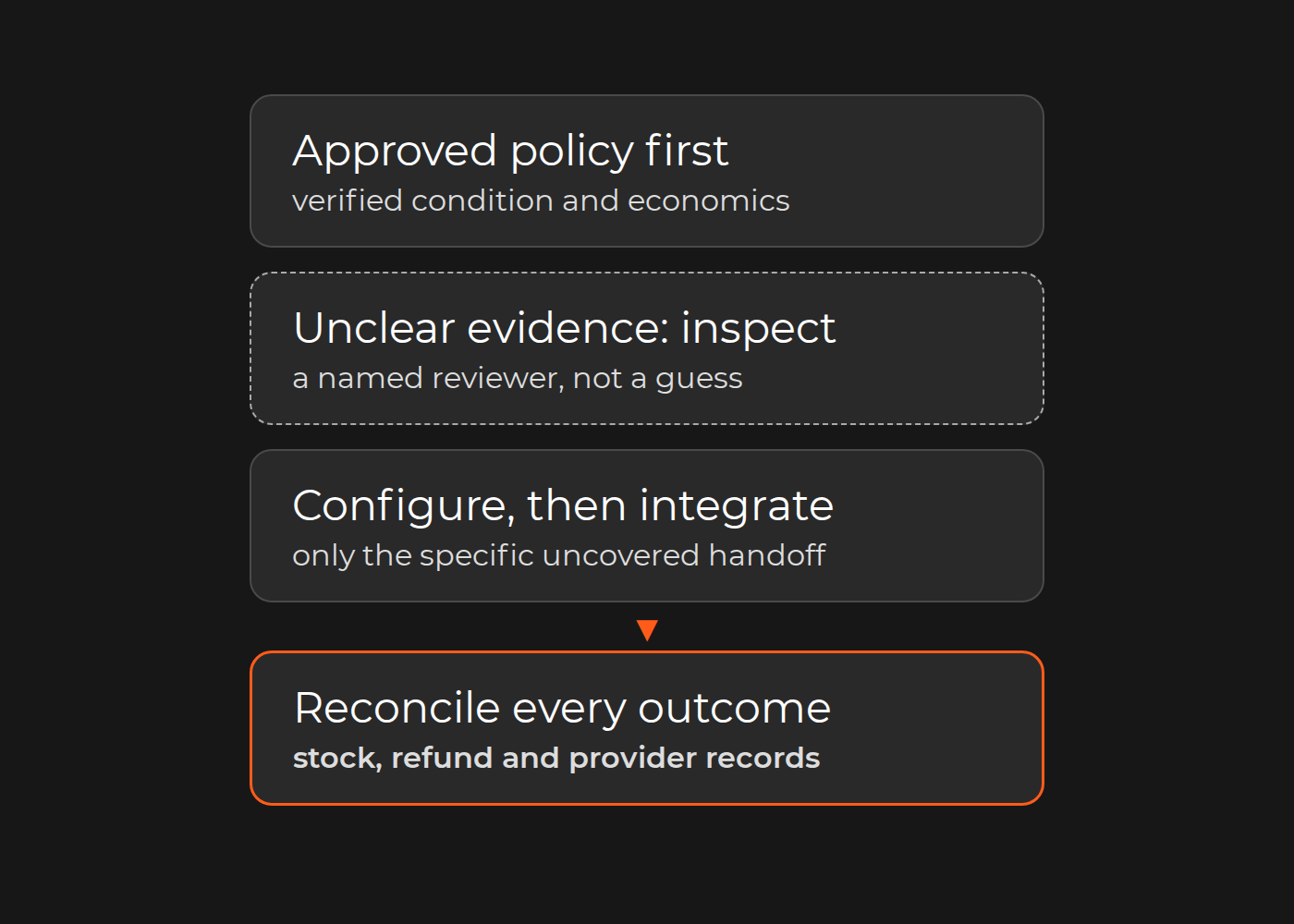
Choose exchange, refund or inspection by three things: the item's verified condition, the approved policy and the economics of the resolution. Automate the decisions your rules can settle from reliable records. When the evidence is uncertain—an unclear customer photo, a mismatched item, a risk flag—hold the case for human inspection instead of letting automation record a guess as fact. Automating every decision turns uncertain evidence into expensive mistakes: refunds that should not be paid, damaged stock counted as saleable, and disputes you cannot answer.
For a returns or operations lead comparing ecommerce returns solutions, the answer is rarely “automate everything” or “build a new platform.” Configure the existing flow when it covers the policy; integrate the specific gaps between systems; use AI only for bounded assistance that people can check. Keep disputed eligibility, policy exceptions, and uncertain evidence with authorized reviewers.
Exchange and refund are resolution choices. Inspection is an evidence-gathering step that may precede either one. Treating all three as interchangeable options is how a convenient portal can become an inconsistent operational process.
A return with an inconclusive photo: decide, then trace
The following return is illustrative. It shows the decision path with an honest inspection step and the records each later outcome should leave.
Field
Illustrative value
Order/line ID
Order 5012, line 2: one jacket, $120 paid
Return reason
“Arrived damaged” (customer's own words kept)
Item condition source
Customer photo; the damaged area is not visible
Policy decision
Damage claims are eligible, but condition must be confirmed: hold for inspection, with no automatic refund or refusal
Inspection
Warehouse grades the received jacket: seam damage confirmed, not saleable
Refund ID
One $120 refund submitted against the original payment and confirmed by the provider
Stock disposition
Quarantine; not added back to saleable stock
Dispute deadline
None open. Had the customer opened a chargeback, the refund would follow the payment provider's dispute process and finance would own the response deadline
Owner
Returns reviewer decides; warehouse lead inspects; finance/payment owner handles the refund and any dispute
If the inspection had found the jacket undamaged, the reviewer would apply the ordinary return rules instead, and the stock record would show a saleable item. The photo decided neither outcome. It only showed that inspection was needed.
Accept a returns flow for this kind of case only if it passes two checks: a return or refund event received twice still ends in one authorized refund, and a partial return or a later chargeback leaves each line's paid, refunded and disputed amounts correct. The detailed acceptance tests are covered in accepting a returns automation project without duplicate refunds.
Illustrative decision path: uncertain condition evidence leads to a named human inspection step, and every outcome ends in one reconciled refund or replacement.
Choose the smallest solution that covers the whole return
Start with the approved policy and a few representative exceptions, not a software shortlist. Operations owns the process, finance confirms compensation authority, the warehouse owns physical condition and disposition, and the systems owner confirms what each integration can actually do. Have the appropriate policy or legal owner resolve applicable customer-rights requirements; a workflow diagram is not legal advice.
Option
Prefer it when
What it does not solve by itself
Ongoing burden to compare
Operating owner
Existing native flow or installed returns SaaS configuration
Available settings and connectors cover the required item rules, review gates, exchange choices, and reconciliation records
Missing inspection evidence, an unsupported warehouse event, or unclear decision authority
Rule maintenance, subscriptions where applicable, permissions, operator training, and exception handling
Returns operations, with the systems owner for settings and connectors
Targeted custom policy/refund/WMS integration
A documented gap remains between the returns product, commerce platform, warehouse management system (WMS), and payment service provider (PSP)
An unsettled policy, poor source data, or warehouse work that is not recorded
Development, monitoring, API changes, recovery procedures, reconciliation, and ownership after handover
Systems owner, with a named owner after handover
Human-reviewed AI assistance alongside either option
Unstructured notes or permitted images create a specific classification or summarization task that simpler rules cannot adequately cover
Refund authority, reliable physical inspection, stock truth, or proof of fraud
Evaluation, privacy controls, reviewer effort, incorrect suggestions, and model changes
Returns reviewer, with the data and privacy owner
These options can coexist. A returns product might own the portal and standard rules, a small integration might synchronize inspected condition, and a reviewer might use an AI-generated case summary. There is no need to replace the portal to repair one missing handoff.
A supplier-reported example shows the first option in practice. Loop's Tortuga case study describes a backpack brand that moved from returns started through support agents to a self-service refund-or-exchange workflow, and then used customers' return reasons in product development. The case does not report a return-rate reduction, and it says nothing about warehouse inspection or payment reconciliation; those still have to be checked in your own flow.
What existing products can already cover
Check the installed product before commissioning custom rules. For example, Loop's Workflows documentation describes product-level conditions such as SKU and return reason, plus actions including manual review, return destination, processing event, and letting the customer keep an item. It also documents rule-priority behavior. That is a reason to inspect configuration—not evidence that every warehouse or payment requirement is covered.
Likewise, Shopify's return-management API guide separates requesting and approving a return from processing its refund and disposition. Platform capabilities may already provide part of the required lifecycle. An API capability, however, is not proof that your installed app, staff permissions, or connector exposes it correctly.
Product behavior also changes. Shopify's exchange guide distinguishes its return-processing workflow from legacy exchange behavior. Verify the deployed API version and actual processing actions before relying on assumptions about when replacement fulfillment is created or held. Do not infer those controls from the word “exchange.”
Follow the return from portal to reconciled resolution
One order status is not enough. Keep the commercial decision, physical item, replacement fulfillment, and payment outcome distinguishable even if a product displays them on one screen.
Portal: capture the request. Identify the original order line, SKU/variant, requested quantity, customer-stated reason, and preferred resolution. Preserve the original reason even when adding a normalized category. A request is not approval or proof of condition.
Approval: establish the permitted route. Apply the relevant policy version, product and market rules, prior resolutions, and delegated authority. Record whether the request is approved, needs review, or requires more evidence. Authorization to send goods back is not necessarily authorization to refund immediately.
Receipt and inspection: establish what arrived. Where goods are expected, match the return line, received quantity, item identity, warehouse, and inspected condition. Record disposition separately: saleable, reconditioning, quarantine, or another approved route. A carrier scan is not a physical grade.
Exchange or refund: execute the authorized resolution. For an exchange, link the replacement variant, stock reservation, release condition, and any price difference. For a refund, link the approved amount, currency, components, and original payment reference. A mixed return can contain both outcomes on different lines.
Reconciliation: verify both sides. Match warehouse disposition and stock movements to the physical lines; match submitted compensation to provider outcomes and finance records. Track pending, failed, or unlinked actions instead of treating “request processed” as case completion.
One return, five records that should stay distinguishable.
These are logical gates, not a mandatory waiting sequence for every policy. If approved rules authorize a refund or replacement before inspection, record that early authorization and keep the expected goods and later inspection open. Early compensation does not make returned stock saleable. Any later discrepancy needs review, not an automatic clawback. This is different from an approved no-return resolution, where no goods are expected at all.
Three distinctions the flow must preserve
A partial return concerns selected quantities or lines from an order. It must not reverse the items the customer keeps. Discounts, shipping, tax, prior compensation, and any applicable charges need the approved calculation for those lines—not an invented percentage of the order total.
No-return compensation means the agreed resolution requires no goods back. A price correction or authorized keep-item refund has no receipt, inspection, or recovered stock. Mark those physical fields not applicable, rather than leaving them looking overdue. The compensation can be partial or full; it is not a partial physical return merely because the amount is small.
An exchange creates a replacement obligation. An even exchange may require no new customer payment, but still needs the correct replacement SKU, availability, fulfillment, and treatment of the original item. A higher- or lower-priced replacement can add a collection or refund leg. Do not silently substitute store credit for a refund or ship a replacement that the customer has not agreed to receive.
Build a policy × condition × action matrix
Use the following as an illustrative design worksheet, not a recommended return policy or an executable rules engine. Replace its scenarios with your approved rules. “Hold” means stop the specified automated action and assign a review task—not suspend the customer's rights indefinitely. Set an owner, due time, customer update, and escalation route for every hold.
For each row, identify the policy version and effective-date basis, market, SKU/category, source channel, and receiving warehouse. State how overlapping rules are resolved. A warehouse's inability to grade a product should change its routing or review requirement, not silently rewrite the customer's entitlement.
For example, a fictional retailer could route apparel to Warehouse A for grading and serialized devices to Warehouse B for identity and condition checks. A device arriving at A remains non-saleable until the required checks are completed through the approved route. The apparel rule must not turn A's generic “received” event into device refund authority; compare whether configuration already handles that distinction before adding integration logic.
Scenario
Decision
Warehouse or fulfillment
Payment (PSP)
Hold owner and release
Standard eligible line; inspection confirms identity, quantity, and saleable condition
Customer-selected refund within the approved line entitlement
Record the inspected disposition; restock once at the confirmed location
Submit the authorized refund once; keep the provider reference and outcome
Returns operations resolves missing evidence; finance reviews any amount mismatch before submission
Approved early resolution; goods still expected, inspection pending
Refund or release a replacement only within explicit delegated authority
Keep receipt and inspection open; no saleable stock before the required grade
Submit only the authorized early amount
Returns owner reviews later discrepancies; missing authority or conflicting compensation blocks the early action
Exchange allowed for this SKU; original accepted; replacement available
Confirm the agreed replacement and any calculated difference
Record the original's disposition; reserve the replacement under the approved gate
No refund for an even exchange; collect or refund only an authorized difference
Fulfillment owner holds release if reservation or payment is unconfirmed; returns owner gets the customer's choice if unavailable
Partial return: one of several units passes inspection
Resolve only that unit; keep other lines unchanged
Apply disposition to received units only
Refund the approved remaining entitlement for that line and quantity
Finance/payment owner reviews prior compensation or quantity conflicts
Approved no-return correction
Issue only the agreed compensation
No receipt, restock, or recovered stock; physical fields not applicable
Submit the authorized amount against the linked payment
Support/finance owner records the exception and checks existing compensation
Goods expected, but identity, quantity, or condition differs
Inspection review; no automatic approval or refusal
Quarantine the disputed units; no saleable-stock increase
Hold the disputed amount; do not automatically reverse a completed refund
Warehouse lead records evidence; returns reviewer applies policy and customer-rights requirements
Reason is unsupported, ambiguous, or inconsistent with evidence
Keep the original text; route to review
Continue only independently authorized receiving; do not invent a grade
No payment instruction from an AI classification
Returns reviewer maps the reason or asks for proportionate clarification
Risk signal on an otherwise ordinary eligible return
Risk review, not a fraud finding or automatic denial
Inspect or hold only under approved rules
No refund or refusal decision from the score alone
Reviewer checks source evidence, records overrides, and offers an escalation route
Repeated event, conflicting state, or uncertain payment result
Keep the existing resolution pending; create no new outcome
Do not repeat stock or replacement movements
Reconcile the existing operation before any new submission
Systems owner investigates with warehouse or finance; release once the authoritative state is known
Replace the fictional rows with your approved rules, then use the table to compare your existing setup with a targeted integration.
What should be automated—and what stays reviewer-led?
What rules, integrations, reviewers, AI, and risk flags may each do in a return.
Automate known rules and authorized actions
Good candidates include validating required identifiers, checking remaining quantities, selecting an approved warehouse route, calculating compensation from authoritative records, and executing a permitted transition once its prerequisites are confirmed. Straightforward cases need not all wait for a human click if the business has explicitly delegated that authority to tested deterministic rules.
Keep disputed condition, unclear eligibility, policy exceptions, and conflicting compensation with the authorized reviewer. That person needs the original evidence, applicable rule, previous decisions, and a way to correct the proposed outcome—not just an “approve” button beside a score. Separate permissions for policy editing, exception approval, refund execution, and stock adjustment where the operating model requires it.
Integrate the missing handoff, not a second source of truth
A custom integration is justified by a specific uncovered transition. For example: the returns product can wait for inspection, but the installed warehouse connector sends only “received,” not the approved grade and quantity. First check whether the connector can be configured or extended. If not, scope that evidence handoff rather than rebuilding all returns management.
Name the authoritative source for policy, inspection, available stock, approval, and provider outcome. Carry linked order-line, return-line, replacement, approval, and payment-operation references across systems. Maintain a resolution record that accounts for prior refunds, credits, and replacements before issuing more compensation.
Dinarys' nearest published work is in these order, refund, and stock handoffs. The Authentic T-Shirt Company case describes a new Magento 2 retail store for a branded apparel distributor, connected to its ERP for orders, refunds, and stock. The Mon Tresor Bebe case describes order editing, invoice editing and totals recalculation, and shipment editing for a children's wear wholesale site on Magento 2. The public case pages do not describe a returns-portal integration. The related service is ERP integration services.
Repeated messages are normal integration conditions, not new business instructions. Stripe explicitly documents duplicate webhook deliveries and does not guarantee event ordering. Design the flow to verify event authenticity, recognize processed events and operations, and fetch authoritative state when messages arrive late or conflict. A late “received” message must not undo an inspected disposition or trigger another replacement.
For outgoing payment requests, use the provider's supported retry controls. Stripe's idempotency documentation explains how a key identifies retries of the same operation, with retention and parameter constraints. That does not create a permanent cross-system guarantee: two different keys, two operator channels, or a later retry can still require business-level duplicate protection. Coordinate automated and manual actions against the same resolution record.
A chargeback needs its own place in the same resolution record—dispute ID, disputed amount and response deadline—because a refund does not close it and, at Stripe, cannot be issued outside the dispute process while the dispute is open.
Keep “authorized,” “submitted,” and “provider-confirmed” distinct. Stripe permits multiple partial refunds up to the original charge amount, but that payment ceiling is not proof of the correct item-level entitlement. Its documentation also describes pending and failed refunds. A timeout is not permission to submit a fresh refund, and an API response is not a universal customer-receipt guarantee.
Use AI to prepare evidence, not to grant authority
Bounded tasks to evaluate include proposing a reason category from a note, summarizing a case for a reviewer, or identifying missing information against a checklist. Keep the source text, the suggestion, and the reviewer correction separate. Allow “unknown” and “unsupported reason”; do not force every unfamiliar description into the nearest confident label.
Limit inputs to data the team is permitted to use. A support summary does not need payment credentials or an unrestricted customer profile. Treat customer text and attachments as evidence, never as instructions that can change policy or call payment tools. Give the AI no authority to submit refunds, alter eligibility, or release stock.
Risk tooling needs the same boundary even when it is built into the returns product. Loop's Fraud Tools documentation describes risk flags, manual-review workflows, and “Mark safe” feedback. As of October 2026, it also describes critical-risk outcome holds with exceptions; labels are not held by that protection. Check the actual store settings and return route rather than assuming a flag stops every action. A risk flag is not proof of fraud, including when the vendor describes it as high confidence.
Start proposed AI or risk assistance in shadow mode: record what it would suggest without changing the customer's outcome. Then compare reviewed suggestions with the underlying evidence. Count incorrect flags on legitimate cases, missed problems, unsupported classifications, overrides, complaints, and review time. Sample unflagged cases too; the flagged queue cannot reveal all misses. If review work or customer friction outweighs the demonstrated benefit, keep the simpler flow.
Work through the exceptions before choosing the option
The following examples are fictional. They show how the matrix changes the solution choice, not how any particular product will behave by default.
Exception 1: a partial exchange loses its replacement stock
An order contains two shirts at an agreed discounted value of $40 each. The customer returns one for a different size. For this example, there are no tax, shipping, or other price adjustments, and the approved policy requires inspection before exchange release.
The warehouse accepts one shirt, but the requested replacement is no longer available at the designated fulfillment location. Hold replacement release, not the whole order. The fulfillment owner confirms availability; the returns owner asks the customer to choose an available permitted alternative or the eligible refund route. Keep the retained shirt unchanged. If the customer chooses a refund, close or cancel the unreleased replacement obligation in the linked resolution before submitting it. The authorized merchandise amount for this returned unit is $40, subject to checking prior compensation—not $80.
Record the original item's disposition independently. An accepted original does not prove a replacement exists. If the installed flow already supports this availability check and customer choice, configure it. If the gap is a missing reservation response from the warehouse, investigate that integration. AI does not fix the stock record.
Exception 2: a no-return correction is followed by a payment timeout
Support is authorized to grant a $12 correction on an $80 line, with the customer keeping the item. The operation is submitted, but the response times out. Another operator opens the same case.
Hold a second submission. The payment owner checks the stored operation reference and provider state, using supported retry behavior for that same operation where appropriate. Once the actual outcome is established, record or resolve it under the approved procedure. Do not create a warehouse receipt, a stock increase, or a new refund merely because the first screen never showed success.
An installed workflow may already cover this recovery. Custom work is warranted only if the resolution reference or cross-channel coordination is missing—not because a timeout occurred.
Exception 3: a damage claim gets a risk flag
A customer reports damage, submits an unclear photo, and receives a risk flag. Neither the image nor the flag establishes intent. The authorized returns reviewer owns the disputed decision. The warehouse owns inspection if goods must return; the policy owner resolves an uncovered warranty or customer-rights question.
An AI summary may identify that the image does not show the relevant area. It must not turn that observation into “fraud confirmed.” Request only evidence needed for the permitted route, record the review due time and customer update, and escalate an aging case to the named backup. A legitimate case wrongly delayed is a false-positive cost, not a fraud saving.
Compare coverage and operating cost on your own exceptions
Use one category, market, and defined warehouse route for the comparison, and run the two acceptance checks from the jacket example against every option. For each representative case, record whether the existing setup covers it by configuration, needs a connector change, or requires an authorized manual decision. Compare an AI-assisted variant only where there is a real evidence-handling task.
Look beyond portal completion speed. Compare correct compensation, correct stock disposition, replacement availability, unresolved payment cases, customer contacts, and total handling work—including review and reconciliation. In the cost comparison, include product charges under your actual contract, integration maintenance, inspection work, and exception handling. Do not treat issued store credit as profit or time released as an automatic payroll saving.
How to reduce returns in ecommerce with reason data
Faster processing does not by itself reduce the number of returns. To reduce them, send reason data to the teams that can remove the cause: product content and photos when items differ from expectations, sizing guidance when fit is the reason, quality checks for defects, and fulfillment when wrong or damaged items ship. Keep the customer's original reason next to the normalized category so those teams see what actually happened. Your ecommerce return policy states what customers may choose; rewording it does not fix the cause. Nor does steering more customers toward exchanges prove better margin once replacement fulfillment and recovered-item value are considered.
Decide what to configure, integrate, automate, and review
The useful decision is a short allocation of responsibilities: configure these rules, integrate this missing event, automate these authorized actions, and retain these exceptions for review. If the current product and incumbent team cover the matrix adequately, use them.
Bring the completed matrix and a few anonymized exceptions to a joint operations, finance, warehouse, and systems discussion. Test the exceptions first; choose the implementation from what remains uncovered—not from a universal AI pitch.