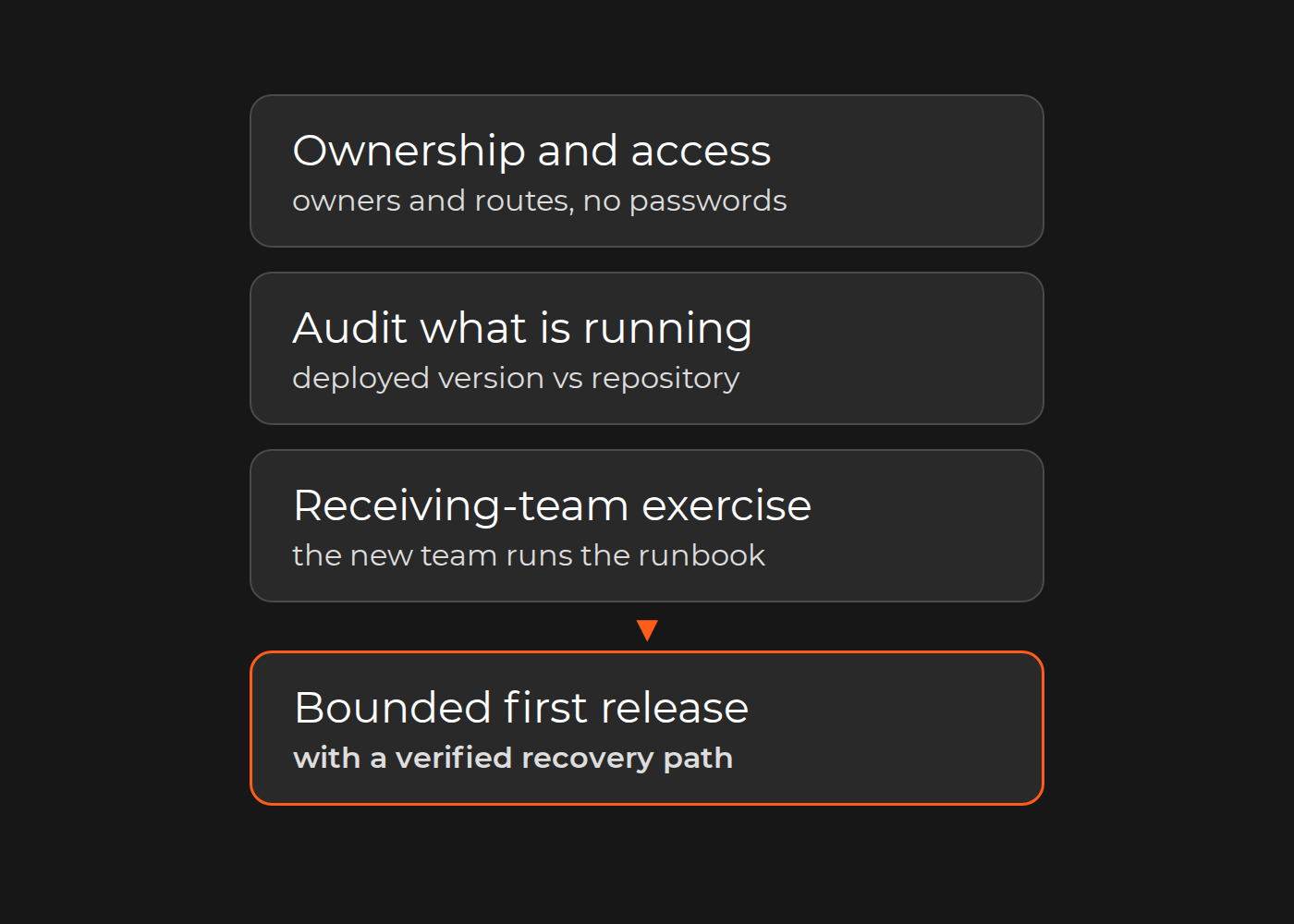
A repository transfer does not mean the new team can run the store. The deployed version may differ from the main branch. A payment callback may depend on an account nobody can administer. The only recovery procedure may be something the outgoing developer remembers.
For a retailer's CTO—or a CEO working with a named technical owner—the takeover is complete only when the receiving team can operate the agreed scope, release a bounded change and recover it using verified instructions. That does not require rewriting the platform. It requires ownership, evidence and a first release small enough to understand.
Use this ecommerce project handover checklist to separate access transfer, technical assessment, knowledge transfer and operational acceptance. A planned supplier change can use it without becoming a rescue project; an active outage needs its incident response first.
Agree who remains responsible during the transition
Name the business sponsor who approves investment and residual risk, the technical owner who accepts the engineering handover, and the release approver who makes the go/no-go decision. The ecommerce or operations lead supplies the critical customer and back-office scenarios. A delivery lead coordinates outgoing, receiving and third-party teams.
Then define the overlap: who answers incidents before the transfer, during the first release and afterward? Which supplier still owns ERP, hosting, payment or platform support? Agree escalation contacts, coverage, response commitments and the end of each responsibility in writing. Do not assume a new development contract replaces all existing support agreements.
A dispute over code ownership or account rights is not solved by copying credentials. Confirm contractual rights, licenses and authorized access with the appropriate owners. Legal or procurement help may be needed for a contested exit. Keep the affected work blocked rather than finding an unauthorized technical route around it.
Inventory access and ownership—not passwords
Build a register with each asset, its company or delegated owner, required receiving role, permitted action and evidence of access. Store secret values only in the organization's approved secret-management system. The handover document needs the authorized access route and owner, not a password appendix.
Asset group
What to establish
Evidence of control
Code and delivery
Repos, branches, artifacts, CI/CD
Receiver can build the identified release
Hosting and domains
Cloud, DNS, CDN, certificates, billing
Authorized admin and recovery contacts verified
Commerce and apps
Store admin, modules, themes, licenses
Required roles work on agreed environments
Integrations and data
ERP/CRM, PSP, feeds, webhooks, backups
Owners, endpoints and approved test routes known
Include scheduled jobs, queues, search indexes, media storage, email delivery, monitoring and analytics/tag management. For a hosted commerce platform, record the boundaries the platform controls and the theme/app/integration changes your team controls. Do not demand infrastructure access the platform does not expose.
Have authorized owners provision receiving access and test the needed activities. Plan credential rotation and outgoing-access removal around dependencies, incident coverage and verified replacement access. Abruptly revoking a shared service identity can break a live integration; leaving personal access indefinitely is not a completed transition either. The security owner should approve the sequence and any temporary exception.
An inaccessible service is a specific blocker, not a reason to stop every read-only assessment. Document what cannot be verified, what it affects and who can resolve it.
Audit code, infrastructure and data around business risk
Start by identifying what is actually running: deployed artifact or theme/app version, commit/tag where applicable, configuration, platform/module versions and relevant infrastructure definitions. Compare that with the repository and last release record. Uncommitted production changes are a reconciliation task, not something to overwrite during onboarding.
Trace the critical flow from storefront to its business result. A payment authorization, a commerce order and an ERP order are different records. For imports, distinguish source records accepted by a job from products correctly available in the storefront. For loyalty, identify where balances and eligibility rules are authoritative.
The initial audit should answer practical questions:
Can the receiving team build and deploy the known version in an authorized nonproduction environment?
Which tests exist, what do they cover, and which critical paths remain untested?
Which integrations, jobs and configuration are absent from the diagram or runbook?
Are backup scope, restoration access and recovery checks documented and exercised appropriately?
Which dependencies have verified support or update constraints, and who owns them?
Which data mappings, open orders, queues and manual exceptions could be damaged by a change?
Are critical landing URLs, checkout events and business reports understood well enough to detect a regression?
Keep an audit finding tied to evidence, consequence and a next decision. “Poor code quality” is not a release blocker until the team identifies the affected behavior or maintainability risk. Reuse recent valid findings and isolate uncertainty instead of charging through the same investigation again.
The SpieleMax case, which names the client as Spiele Max, starts where many takeovers start: an existing Magento 2 store with bugs from previous vendors. Dinarys took on optimization and support of that store, built a separate loyalty service integrated with Magento 2, and added CSV product import/export and layered navigation. The takeover lesson is that inherited defects are a starting condition to work through on the running platform, not on their own a reason to replace it. The case page does not say which handover checklist was used, and it does not imply reference availability.
Transfer knowledge through a receiving-team exercise
Ask the outgoing team to walk through architecture, one normal order, one failure, the last release and an incident recovery. Capture the decisions and operational steps in maintained documentation. A recording can supplement that record; it should not be the only place the receiving team can find an essential action.
Next, reverse the roles. The receiving team follows the runbook in a suitable environment while the outgoing team observes. Record missing steps, unexpected permissions, version differences and assistance needed. Close each gap by updating the instructions and demonstrating the affected step again.
The exercise should include more than deployment:
Find the logs and trace a sanitized order across the relevant systems.
Interpret an alert and identify the responsible system owner.
Locate the approved procedure for a failed import or uncertain transaction.
Demonstrate the agreed release and recovery checks without an undocumented supplier-only action.
If the outgoing team is unavailable, do not pretend knowledge transfer occurred. Reconstruct the necessary behavior from authorized code, configuration, records and controlled tests. Label inference as inference until verified; price the unresolved investigation separately. You may still take over a bounded area while an unrelated component remains with its current owner.
Dinarys' Untamed engineering case names the same pieces of work this checklist separates: a technical audit of third-party integrations, a new back end built under the direction of the client's CTO, migration of existing customers to the new environment, CI/CD, documentation and back-end support after deployment. The practical lesson is to audit the integrations before changing them and to plan support for the period after the first release instead of ending the engagement at deployment. It is one engagement, not a template for your timeline.
Choose the first release to test control
Select a useful change with a known boundary, an observable outcome and a recovery path. It might be a reproduced import defect or a contained checkout correction. It should not be a meaningless commit made solely to claim progress, or a platform migration attached to a supplier change.
Hypothetical example: a retailer's CSV import maps two supplier pack codes incorrectly. The storefront and ERP remain in place. The receiving team proposes a mapping correction, checks the two known values plus missing and unsupported values, and verifies the resulting product units and filters. It does not bundle a catalog redesign or a new import platform into that release.
Before approval, the release record needs the following:
Decision
Required evidence
Decision owner
What changes?
Scope, versions and excluded work
Technical + business owners
Does it work?
Expected/observed flow and regression results
QA + operations
Can it be released?
Rehearsed procedure, alerts, stop conditions
Release approver
Can it be recovered?
Code/data/external-state recovery boundaries
Technical + system owners
GitHub's deployment-review documentation illustrates one tool-level control: jobs configured to require review can be approved or rejected before proceeding. That is not evidence that your repository has the control enabled, or that approving a job accepts the business result. Verify the actual pipeline configuration and keep technical authorization distinct from operational acceptance. Other delivery tools can implement the agreed control.
If there is an active material incident, contain it under the authorized incident process before pursuing a demonstration release. If an existing release already proves the required control, do not manufacture a new production change just to complete a checklist.
Rollback is not the same as undoing business activity
Restoring a previous application version can leave changed catalog values, accepted payments, ERP orders or fulfillment actions behind. A database restore can also discard legitimate activity created after the backup. The release plan must specify what can be reversed, what must be reconciled and who can authorize corrective business actions.
In the hypothetical import release, reverting code alone will not necessarily restore product records already updated by the import. Agree the affected-record inventory, approved correction source and validation with the catalog/data owner. Preserve legitimate concurrent changes. This is a planning requirement, not an instruction to restore or replay production data.
For checkout, trace payment and order states before retrying or compensating. An uncertain transaction remains an owned exception until its outcome is established. A successful redeployment is not evidence that money, orders and stock agree.
Define release stop conditions from the agreed baseline: a critical flow fails, reconciliation cannot account for affected records, or required monitoring/recovery access is unavailable. The authorized release owner decides whether to stop, recover or continue within approved risk limits. Do not replace that judgment with a generic “all tests green” banner.
Keep a risk register that produces action
Use a short record: risk or actual issue, affected flow, evidence, owner, next action and closure condition. Avoid multiplying likelihood scores when the underlying facts are unknown.
For example, “only the outgoing supplier can run the scheduled import” is an issue requiring proof of receiving-team control. “A future ERP change may alter the mapping” is a risk requiring interface ownership and regression planning. They should not share the same vague status of “medium.”
Decide which unresolved items block a particular release, which block overall handover and which can remain accepted with a named owner and review date. Acceptance of a residual risk does not mean the defect disappeared. A fixed bug does not close an entire recovery program when release access or support remains unverified.
Keep the inventory, exercise evidence, risk register and release decision in one editable handover record that both teams work from. It needs seven parts:
Transition boundary: critical flows, receiving technical owner, business acceptance owner, contract signer, release approver, retained suppliers and incident coverage before, during and after the transition.
Asset inventory: owner, receiving role, approved access route (no secret values), the activity demonstrated with its evidence, and the approved rotation and removal sequence.
Current release and audit: deployed version and matching source revision, observed drift, build result in an authorized environment, untested essentials and open-order or queue implications.
Receiving-team exercise: scenario, runbook version, operator and observer, expected versus observed result, assistance required and the owner of each gap.
Risk and issue register: type, affected flow, evidence, owner, next action, what it blocks, closure condition and the approver of any accepted residual risk.
First-release decision: bounded change and exclusions, tested versions, regression results, stop conditions, software rollback and data-correction boundaries, reconciliation owner and the go/no-go decision.
Handover acceptance: demonstrated capabilities, retained dependencies, open items, accepted support responsibilities and access-removal status, with technical and business acceptance recorded separately.
An unchecked field stays unverified; a completed template is not evidence that a test was run.
How quickly can a team take over?
There is no universal timeframe: it depends on access, how reproducible the environment is, third-party owners and the transfer of support. Track it as four milestones: “can start reading,” “can deploy in a test environment,” “can support the critical flow” and “has accepted operational ownership.” Available accounts and staff do not prove all four.
Estimate effort and elapsed dependencies for access, reconstruction, critical remediation, rehearsal and support transfer. The limiting factor may be a third-party owner, missing data rights or an unreproducible environment—not developer capacity. A complete, current runbook may allow direct verification rather than a broad new audit. For one reference point, the Untamed case page reports that its team was staffed in less than three weeks; that figure covers staffing for that engagement, not the moment operational ownership was accepted.
Close the handover with the receiving technical owner and business acceptance owner: accepted scope, demonstrated capabilities, retained suppliers, open issues, support/escalation responsibilities and approved access-removal actions. The signer approves the contract and risk boundary; the engineers demonstrate control. One signature should not silently stand in for both.
Start with the latest release and the incidents that matter
Prepare a sanitized access/ownership map, last release record, recent production incidents, critical flows and current support commitments. Include the people who can authorize access and accept the first result. Do not send passwords, customer records or repository contents through an inquiry form.
The Dinarys Rescue Team service page is the relevant route when repeated failures or blocked releases require recovery implementation. For a planned takeover or a specific remaining gap, discuss the handover scope with Dinarys. Ask for an accepted transition boundary and first useful release—not a promise to rewrite everything before anyone has verified what you already own.
You may share this article
Lassen Sie Profis Ihre Herausforderung meistern
Unsere zertifizierten Spezialisten finden die optimale Lösung für Ihr Unternehmen.