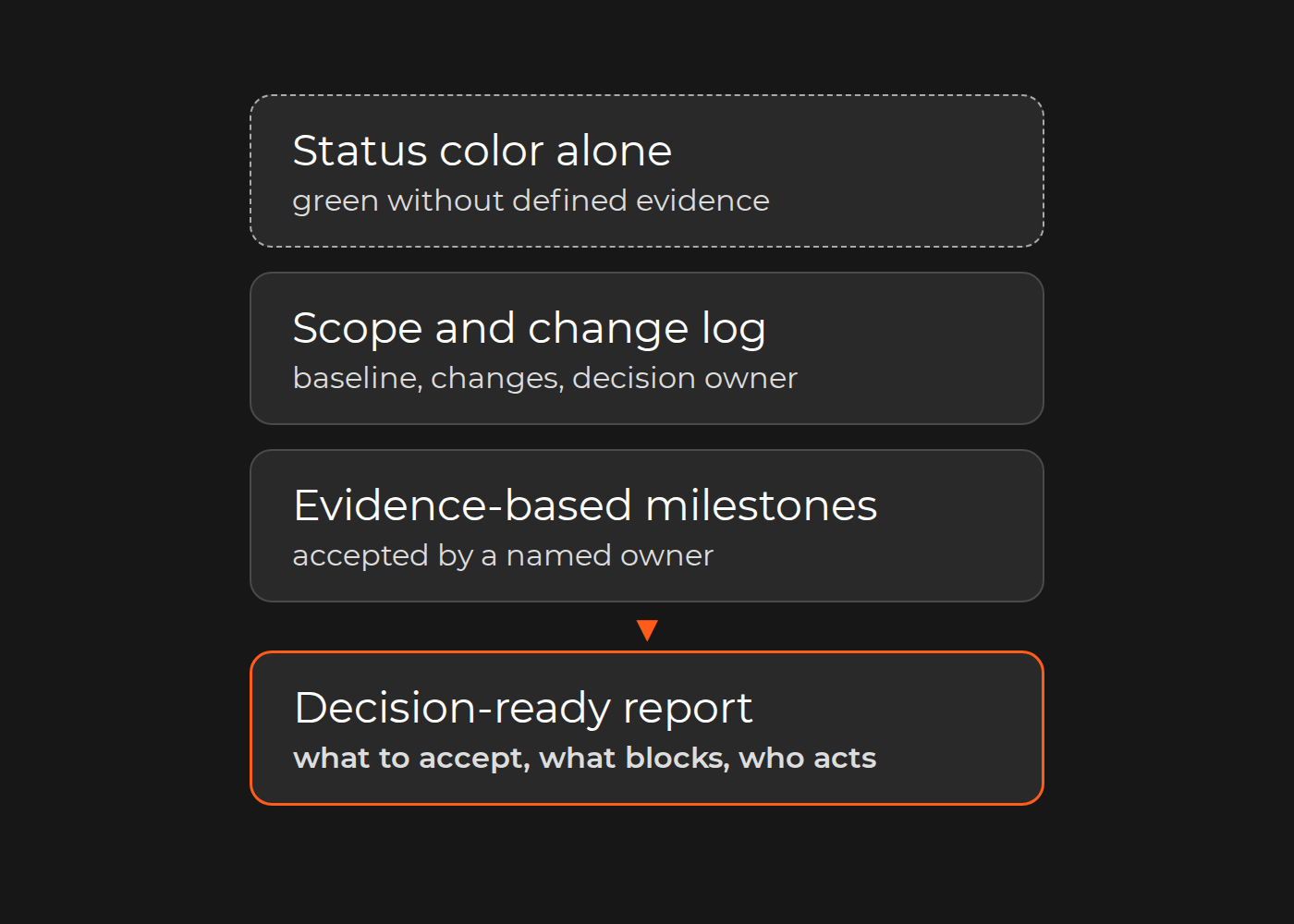
“Development is green” tells a CEO very little if operations cannot accept the release. The interface may be built while its price mapping fails. The demonstration may work while the warehouse owner has not tested shortages. The budget may look unchanged because nobody recorded the extra requirement.
Ecommerce delivery governance makes those differences visible. It connects the agreed business outcome, the work authorized to deliver it, the evidence of progress and the people allowed to make the next decision.
The aim is not another reporting layer. A COO or CTO should be able to answer: What can be accepted now? What is blocking the next release? What changed in scope or forecast? Who needs to decide? This guide provides a practical delivery report, change log and acceptance record to adapt—not a claim that paperwork guarantees an on-time launch.
Start with a business-flow boundary
“Build the new B2B channel” is a goal, not an acceptably bounded release. Define which buyers, products and operations the first release includes. Name retained systems, changes and exclusions. Follow one order through price, availability, payment or credit terms, ERP acceptance, fulfillment and support as relevant.
For made-to-order products, the boundary may instead run from permitted selections through approved price to production specification. For a recovery project, it includes the affected critical flow, controlled releases and receiving-team ownership. A list of completed screens does not describe any of those outcomes.
Write acceptance examples while defining scope. The business supplies the approved rule; engineering and QA specify how to observe it. Include a normal case, material exceptions and required operational behavior. The purpose is to avoid discovering at sign-off that “order sent” meant an API response to one team and a usable ERP order to another.
Use existing platform tools, supported products and deterministic rules where they fit. Governance should help stop unnecessary custom work, not just organize it. AI is an option to evaluate for a particular task; it is not a default milestone or a substitute for authoritative pricing, permission or transaction rules.
Assign decision rights, not just task owners
The ecommerce lead champions and prioritizes the customer outcome. Operations accepts the process staff will run. The technical owner approves architecture, interfaces and technical risk. QA supplies test evidence. The delivery lead maintains the connected plan and escalates dependencies.
The authorized sponsor—CEO, COO, CFO or a delegated owner—approves investment and material scope/risk decisions. The named release approver makes the go/no-go decision within that authority. These can be overlapping roles in a smaller business, but the decisions still need to be distinct.
For cross-vendor work, name who owns each interface and who coordinates the complete flow. “Waiting for ERP” is not an actionable responsibility. Identify the ERP owner, the needed operation or decision, the effect on the milestone and the escalation route.
Do not turn the delivery lead into the person who can invent product rules, approve tax treatment or accept security exceptions. Qualified business, domain and security owners retain those decisions. Availability of each accepting owner is a planning dependency, not an assumption that a vendor team can fill the role.
Keep scope and change control in the same record
Preserve the agreed baseline and record changes against it. Each material request needs a description, reason, affected flows, implementation and test impact, dependency, effort/cost effect and decision owner. Update the acceptance criteria when the business behavior changes.
Distinguish a defect against an agreed requirement from a new requirement and from an unresolved interpretation. Do not label every correction “new scope,” or quietly absorb a new warehouse into a ticket called “stock sync.” Contract terms govern commercial treatment; the record makes the disagreement inspectable.
Give the sponsor a choice rather than an unexplained revised total: approve added scope and resources, exchange a lower-priority item, stage the request or defer it. A rejected request stays visible as rejected; a backlog entry is not approval to implement it.
In a fictional effort example, the original baseline is 36 hours. A separately approved eight-hour change makes the current authorized baseline 44 hours. At a reporting cut, 28 hours are spent and the latest estimate to complete is 20 hours: the forecast is 48 hours, four above the current baseline. The eight-hour change explains baseline growth; it does not also explain away that four-hour forecast variance. These are illustrative effort inputs, not a Dinarys quote or schedule.
Keep effort, money and elapsed time separate. Translate hours into cost only using actual agreed commercial terms; show vendor waits and release windows separately. Do not add incompatible story points, hours and currency to produce one progress number.
Make milestones evidence-based
A milestone should state what can be reviewed or accepted, the dependency needed to reach it and the person who accepts it. “Integration 90% complete” is less useful than “normal order reconciles; customer price fails; timeout scenario is untested pending ERP access.”
An evidence-based sequence could include approved rules/mapping, demonstrated difficult flow, end-to-end acceptance, release readiness and operational handover. These are planning boundaries, not mandatory sequential phases. Run independent work in parallel where the dependencies allow it.
The Flash Style case shows milestones named by function. Its public account describes Magento/PrintQ delivery in nine sprints grouped as foundation, payment and documentation, advanced features, and integration and refinement. Each sprint included testing of new features, integration testing with existing systems, document generation verification, payment processing validation and multi-language content verification, and the final sprint included final acceptance testing. For a sponsor, the lesson is that each milestone names the function being delivered and the checks that prove it. Do not borrow that engagement's sprint count or its result percentages for another project.
A small supported configuration change may need one reviewable increment and a concise release record. A cross-vendor checkout or ERP change needs a wider set of acceptance owners. Scale the controls to the consequence and uncertainty, not to a universal document quota.
A delivery report should expose the decision
The following is a wholly hypothetical report, not an anonymized client record. A distributor is preparing one channel's order-to-ERP release. Six agreed checks are tracked; four have passed, one has failed and one has not been run.
Check
Current evidence
Next decision/owner
Account mapping
Passed on agreed buyer fixture
Retain evidence / IT
Customer price
Failed: wrong list applied
Resolve mapping / price owner + IT
Availability
Passed within agreed age
Retain evidence / operations
Order identity
Passed normal and agreed repeat case
Retain evidence / ERP owner
Returned status
Passed agreed state mapping
Retain evidence / operations
Unavailable receiver
Untested: environment unavailable
Arrange test / ERP owner
The report's release recommendation is hold, because a required price check failed and an essential exception check is untested. Four of six passed is approximately 66.7%, but that percentage cannot establish release readiness. One failed essential rule can outweigh many passed minor checks. The agreed-repeat result also does not prove every possible outage outcome.
Add the current scope revision, baseline/forecast, evidence references and changes since the previous report. Put the sponsor decision first, with the consequence of delay and the next agreed decision point. Keep code completion, business acceptance and production release as separate states.
This makes a “green” status useful only if its meaning is defined. It must not turn missing evidence into success or conceal a forecast variance behind a changed baseline. A genuine blocked state with a clear next action is more useful than a confident color with no inspectable basis.
Separate risks, issues and unanswered questions
A risk is a future event that could affect delivery. An issue has already happened. An unknown needs evidence before its effect can be established. Their treatment differs.
For example, a planned ERP update may change an interface: assign compatibility review and regression ownership. An unavailable ERP test environment is an existing issue: assign restoration/access and show which tests it blocks. An undocumented reservation rule is an unknown: have the authorized business owner resolve it before engineers assume a behavior.
For each record, include the affected flow, evidence or uncertainty, consequence, owner, response, trigger for escalation and closure condition. Describe likelihood and impact where there is a defensible basis, but do not manufacture numerical precision. Multiplying arbitrary scores does not turn unknown compatibility into an accepted release.
Review the register when a dependency, rule or release condition changes. Do not keep a risk green after its trigger has occurred. If a sponsor accepts residual exposure, preserve what was accepted, by whom and under which conditions; acceptance of risk is not evidence of technical correction.
Keep acceptance, deployment and operation distinct
Technical acceptance verifies the implemented behavior against the agreed scope. Business acceptance confirms it meets the approved operational rules. Release authorization permits deployment under the stated conditions. Operational acceptance confirms the receiving team can run and support the result. They may be recorded together, but one does not silently replace the others.
Before release, require:
Identified versions, configuration and approved scope, with changes traceable to decisions.
Expected-versus-observed results for critical normal and exception scenarios, with essential unknowns visible.
An explicit disposition for remaining defects: blocking, fixed/retested or accepted by an authorized owner within agreed limits.
A release procedure, monitoring, stop conditions and recovery responsibilities.
Operations' reconciliation method, runbook, access, training and support/escalation coverage.
A deployment-approval step in the pipeline authorizes a release; it cannot establish that the correct customer price reached ERP. Recovery must also cover business events: reverting software does not reverse an accepted order, payment or shipment, so assign reconciliation and corrective business actions separately from technical rollback.
Communication and escalation must change something
Agree a reporting rhythm suited to the work and a faster escalation route for material blockers or incidents. A routine status meeting is not the right place to wait with an active critical incident. The incident process remains separate, with its own authority and communication.
Use a concise escalation format: fact → affected outcome → options → recommendation → decision owner and needed decision point. Include what the team can continue safely while the blocked area waits. This avoids turning every dependency into either total paralysis or an unauthorized workaround.
In the fictional report, the delivery lead asks the price owner to confirm the correct list and IT to resolve the mapping, while the ERP owner arranges the unavailable-receiver test. The sponsor sees the release hold and forecast variance. The sponsor cannot make an untested flow tested by approving more budget; the team cannot approve extra investment by updating a ticket.
Dinarys' Untamed case shows what this coordination role can cover in practice. A project coordinator was assigned as the team expanded, with responsibility for resource management, time tracking and reporting—monthly hours in the client's system aligned with Dinarys' internal tracking—invoicing, communication, scheduling and resource planning. The engineering work alongside it included CI/CD and documentation for a back end built under the direction of the client's CTO. The useful detail for a sponsor is that hours were aligned between the client's system and the supplier's own tracking rather than reported from one side only. It is one staffing arrangement, not a model that fits every retailer.
Handover is an operating result, not an attachment
For an ERP scope, the SanMar case adds a documentation example. Before the project, the client's ERP relied on poorly built APIs that could not exchange or update catalog and order data in real time. Dinarys documented the B2B site's functionality and built a custom API connector for the ERP's legacy data format. The lesson: when an integration depends on an older system, recording what the existing site does is part of the delivery, because it gives the acceptance owners something concrete to test against.
Judge whether governance is helping
Look for fewer unresolved decisions carried into release, earlier visibility of dependencies, clearer forecast changes and accepted operational outcomes. Establish your own baseline for blocked decision time, rework, release failures or manual exceptions where records support it. Interpret changes alongside scope, staffing and platform changes; do not attribute every improvement to governance.
If reports consume effort but no one uses them to decide, remove duplication. If a small fix already has clear ownership and acceptance, a large steering structure may add delay. If vendors each report their component as complete while the order still fails, a shared end-to-end acceptance record may be the missing control. More meetings are not the objective.
To keep the record usable, hold the report, change log, risk register and acceptance record together so each decision can be traced:
Report: current recommendation and reason, the decision needed with its owner and decision point, changes since the previous report, accepted outcomes with evidence, failed checks and essential unknowns, baseline and forecast, and work that can continue within existing authority.
Change log, per request: reason, classification (agreed-scope defect, new requirement or unresolved interpretation), affected flows and tests, effort, cost and dependency impact, the options (add, exchange, stage or defer) and the authorized decision.
Risk, issue or unknown, per item: affected flow, evidence or missing fact, consequence and trigger, owner and escalation route, closure condition, and any accepted residual exposure with its approver.
Acceptance and release record: tested version, approved rule and observed result, technical and business acceptance owners, disposition of remaining defects, stop conditions and go/no-go approver, and the recovery and reconciliation owners.
Do not mark unperformed checks as passed.
Compare your current report with the decisions it must support
Dinarys' public How We Work page covers discovery and scope; plans, milestones and acceptance criteria; release, risk and change control; and handover and support. Use those topics to ask concrete questions about the proposed engagement, then confirm the deliverables and decision rights in its written scope.
To discuss your ecommerce delivery controls with Dinarys, bring a redacted status report, current scope, one unresolved change and the acceptance evidence for the next release. Leave credentials and customer records out. The first useful comparison is simple: does the report explain what operations can accept, what remains uncertain and who must act next?