An AI ecommerce implementation costs more than the model calls. The budget has to cover access to reliable data, integration, exceptions, evaluation and the people who will operate the workflow. The timeline depends on when those pieces become usable—not when a demo generates its first answer.
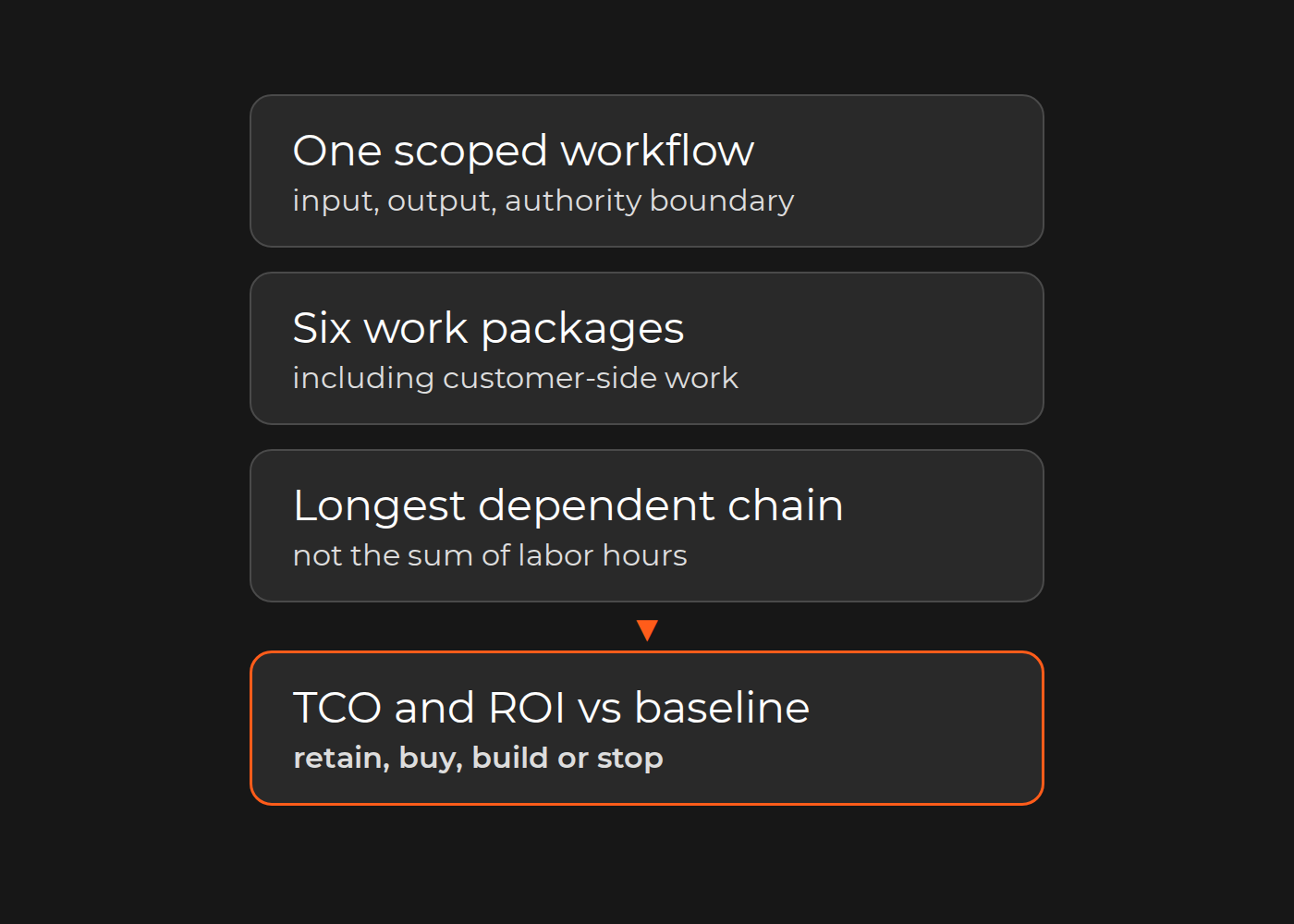
For a COO or Head of Ecommerce, the useful starting question is: Which single workflow can justify the whole cost of changing it? Compare a process fix, native automation, specialist software and custom AI on the same workload before asking for a company-wide transformation estimate.
This guide provides a work breakdown, a dependency-based schedule and a TCO/ROI model you can rebuild in your own spreadsheet. The numbers below are hypothetical internal planning inputs, not Dinarys prices or a delivery forecast.
Define the purchase before requesting a price
Write one sentence that names the input, output and authority boundary. For example: “Prepare a reviewable order draft from selected customer PDFs; validate SKU and pack data against the ERP; retain human approval before submission.” That is estimable. “Add AI to operations” is not.
The process owner supplies volumes, handling effort and exception examples. IT and the ERP/commerce owner check interfaces, permissions and recovery. Finance agrees which benefits are cash savings versus released capacity. The CEO, CFO or authorized P&L owner signs the budget; the workflow owner and technical owner accept their respective results.
Keep the first scope narrow enough to measure: one channel, one backend and named transaction types. If an existing specification or failed pilot contains usable mappings and tests, retain them. Investigate only the unresolved parts rather than buying discovery again by default.
What belongs in the implementation budget?
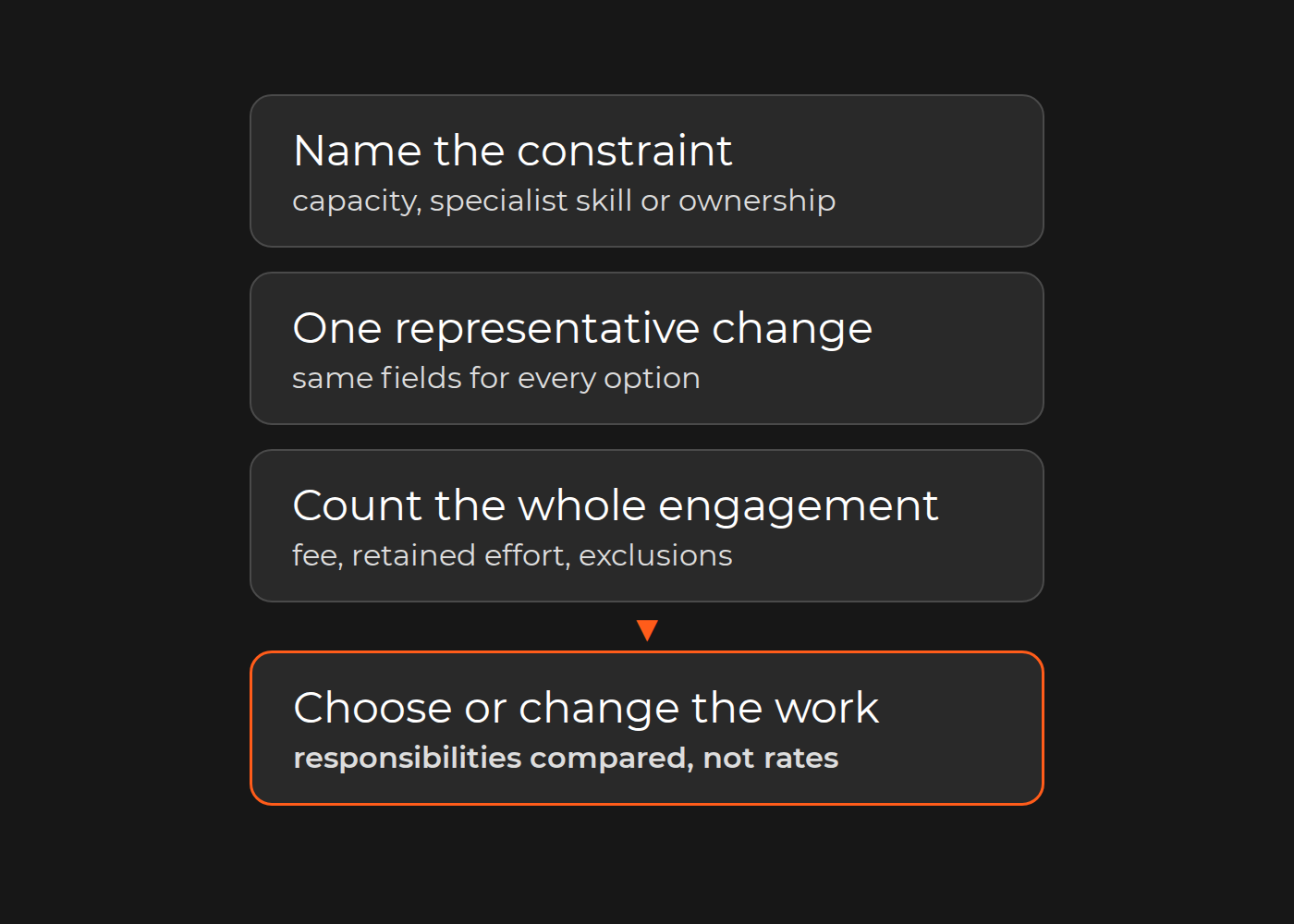
Ask every bidder to use the same boundaries. An app subscription, an API prototype and a supported production workflow are different purchases.
Work package
Inspectable output
Main effort driver
Discovery and fit-gap
Workflow, baseline, retained tools, exclusions
Unknown rules and fragmented ownership
Data preparation
Approved mappings, samples, source rights
Missing IDs, units, labels and permissions
Integration
Tested reads/writes, recovery, audit
Legacy APIs and transaction exceptions
Evaluation
Baseline comparison and defect report
Risk, test diversity and reviewer effort
Release and handover
Limited rollout, fallback, runbook
Operational dependencies and training
Ongoing operation
Monitoring, review, maintenance
Volume, change rate and exception load
Include customer-side work. Preparing test orders, securing vendor access and reviewing results consume real capacity even when they never appear on an agency invoice. Separate reusable platform costs from the incremental cost of this workflow, and document the allocation rather than charging the same setup to several business cases.
Most of these packages exist even when the AI step itself is small. In adjacent lending work, Dinarys' Oze case describes a bank-statement processing pipeline built with the client's internal team: secure document upload, asynchronous AI analysis, background polling for processing status, retry flows on failure, a manual template fallback for edge cases, and structured error remediation with errors grouped by type. Only one of those six steps is the AI analysis; the other five are integration, exception and operating work. It is a lending project, not an ecommerce price reference, but it shows which lines an estimate should not leave out.
Checkout: fix the failure before adding intelligence
If customers cannot complete a payment because an integration fails, repairing that path may be the entire project. An AI assistant will not repair a missing payment webhook. Budget for tracing checkout attempts through payment authorization, order creation and fulfillment, and compare completed, nonduplicate orders—not chatbot engagement. Do not give a model authority over payment or eligibility rules simply to call the result AI-enabled.
Order routing: decide whether rules are enough
A stable routing table based on warehouse, carrier and cutoff may be sufficient. AI becomes a candidate when unstructured requests require interpretation. Estimate classification separately from the deterministic routing and order-state checks. Include the cost of ambiguous requests, manual review and reconciliation after a timeout.
Product discovery: separate data work from ranking
Search may need better attributes, synonyms or filters before a new model. Budget for a judged query set and catalog corrections as well as retrieval and latency testing. Measure successful selection and purchases under valid price/availability conditions; a more fluent answer alone is not the promised result.
The BigCommerce catalog case documents inconsistent source fields, normalization workarounds, AI-assisted categorization and separate theme/checkout changes. Those components explain why data preparation belongs in the estimate. The published total catalog size is not a count of AI-processed products, and the combined project's reported conversion change does not isolate AI's contribution.
Build the timeline from dependencies, not a generic range
There is no defensible universal duration for “adding AI to a shop.” A read-only comparison and an integration authorized to change orders have different release requirements. Request a dated schedule only after the work packages, available people and external dependencies are checked.
Use this sequence to establish what can run in parallel and what cannot:
Ready to compare: usable historical samples, permitted data use, a baseline and named reviewers. Missing access is a dependency, not completed discovery.
Ready to integrate: native fit-gap resolved, source ownership and API behavior agreed, sandbox usable. Data cleanup and interface work may overlap where their contracts are stable.
Ready to evaluate end to end: connected test workflow, expected outcomes, exception queue and recovery behavior. A model-only score does not close this milestone.
Ready for limited release: defects assessed, business/security approval, fallback and operating owner in place.
Ready to expand: evidence from the limited cohort, manageable review load and a new scope decision.
For each package, record owner, effort estimate, available capacity, earliest usable input, predecessor and approval wait. Calendar duration follows the longest dependent chain, including vendor waits and release windows; it is not the sum of everyone's labor hours. Do not add a separate risk buffer for a known access delay already included in that chain.
What tends to extend the chain? An undocumented ERP, absent pack mappings, unavailable test environments, unresolved return policy, a changing product taxonomy or a reviewer who cannot accept results. Record who can resolve each blocker and the evidence needed to close it. A read-only pilot can proceed while write permissions are pending, but it must not be presented as production completion.
Calculate total cost of ownership over an agreed period
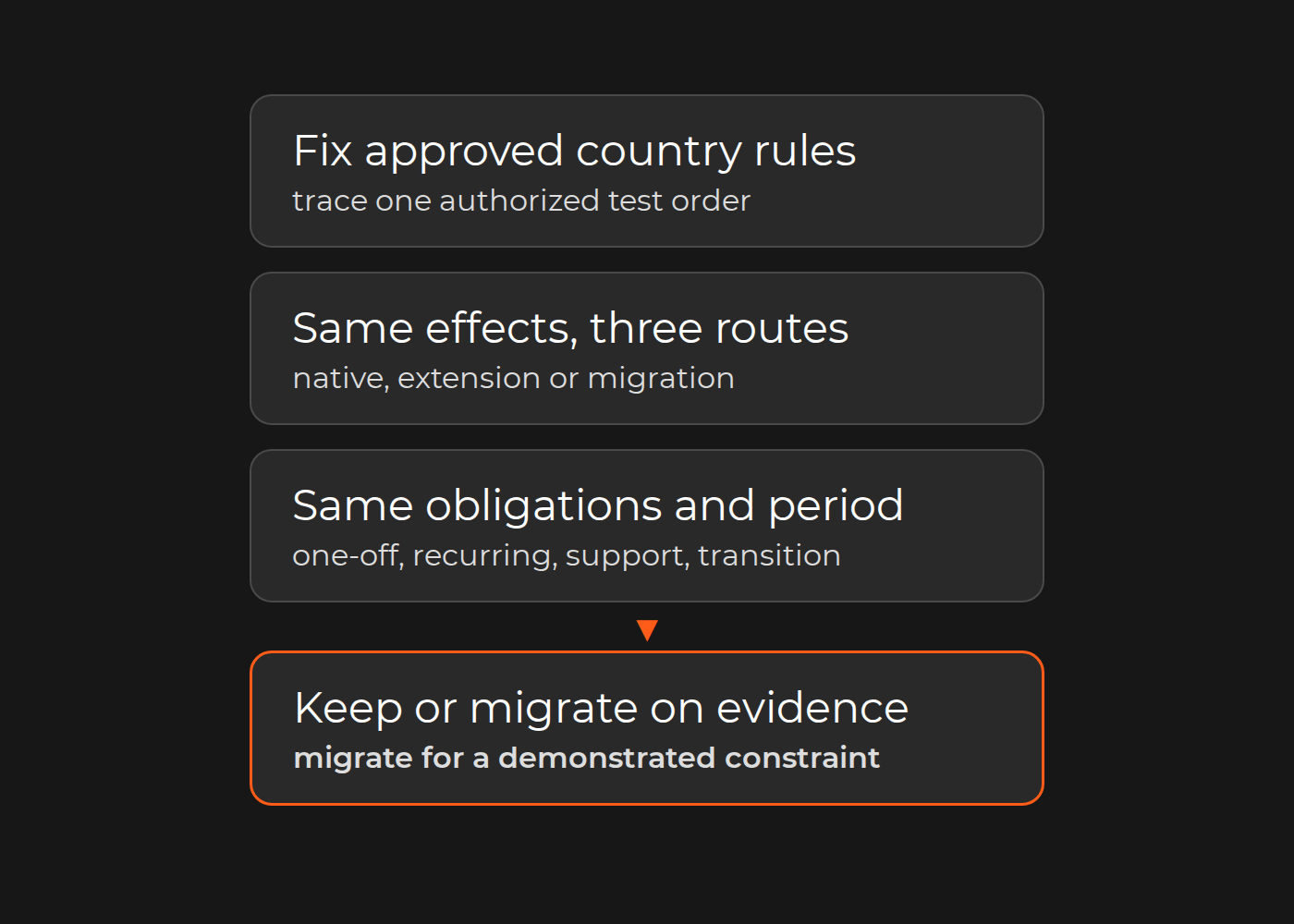
Use a common period and volume for every option:
TCO = one-time implementation + recurring software/infrastructure + human operation + maintenance/change + retirement or exit costs.
Human operation includes review, rejected work, corrections and reconciliation—not only accepted outputs. Usage estimates should include retries, document/page volume, retrieval/indexing and peak demand where applicable. Obtain current vendor terms for actual products rather than treating today's trial allowance as a permanent entitlement.
Keep contingency visible with its rationale. Also list excluded costs, tax/currency assumptions, retained licenses and the effect of volume changes. “Cheaper per API call” can lose once more exceptions reach people.
An editable ROI example—and the case where it loses
Replace every fictional input below with approved figures. This simplified example assumes a full 12 months at steady volume after setup, no ramp, no discounting and no incremental revenue claim.
Hypothetical input
Value
Meaning
Eligible orders per month
3,000
Excludes unsupported formats
Human effort, before → after
8 → 3 minutes/order
After includes review and correction
Loaded internal labor value
$24/hour
Not an agency rate
Cash-realizable share of released time
50%
Assumption for finance to validate
One-time implementation
$24,000
Fictional budget input, not a quote
Recurring cost
$1,200/month
Excludes labor already in handling time
Released time is 3,000 × 5 ÷ 60 = 250 hours/month, valued at $6,000. With only half assumed cash-realizable, count $3,000/month as cash benefit. Recurring costs leave $1,800/month net benefit before recovering setup.
The incremental investment cost is $24,000 + 12 × $1,200 = $38,400. Cash benefit is 12 × $3,000 = $36,000. Investment ROI is ($36,000 − $38,400) ÷ $38,400 = −6.25%. Simple payback is $24,000 ÷ $1,800 ≈ 13.3 operating months, excluding implementation time. A positive monthly contribution does not mean positive first-year ROI.
Full workflow TCO answers a different question: what does the whole process cost to run, compared with today? Remaining handling effort is 3,000 × 3 ÷ 60 = 150 hours/month, allocated at $3,600. With no other costs in this simplified example, the new workflow's 12-month activity-cost TCO is $24,000 + 12 × ($1,200 + $3,600) = $81,600. The comparator is the current process over the same 12 months: 3,000 × 8 ÷ 60 = 400 hours/month at $24, or 12 × $9,600 = $115,200. Both figures value labor used, not payroll cash, so the $33,600 gap is a capacity view. Add retained platform and other allocated costs to both sides for a complete comparison, and do not add this gap to the cash-based ROI above, which already reflects the before/after effort difference.
Countercase: at 1,500 eligible orders/month with all other inputs unchanged, released time is 125 hours; cash benefit is $1,500/month and net benefit only $300/month. Payback becomes 80 operating months. At 1,200 orders/month, the cash benefit merely covers recurring cost; it never recovers setup under these assumptions.
If nobody's paid hours, overtime or external spend actually falls, the cash-realizable share may be zero. Released time can still be valuable for capacity, service or growth, but report that separately. Do not add a capacity valuation and cash savings for the same hours, or count the same recovered sale under checkout, search and support.
Rebuild the model in your own spreadsheet
Use one sheet per option, with the same horizon and volume for each. The variables and formulas behind the example:
V eligible volume per month; B and A human minutes per item before and after (after includes review, correction and reconciliation); L loaded labor value per hour; F cash-realizable share from 0 to 1; I one-time cost; R incremental recurring cost per month; N operating months.
Released hours H = V × (B − A) ÷ 60; cash benefit C = H × L × F.
Investment ROI = (N × C − (I + N × R)) ÷ (I + N × R).
Simple payback = I ÷ (C − R), only when C is greater than R; otherwise there is no payback under constant assumptions.
Full workflow TCO = I + N × (R + V × A ÷ 60 × L + other allocated cost) + exit cost.
Put internal setup, integration, testing, training and migration in I. Put software, model usage and retries, hosting, maintenance and support in R, but not the handling labor already counted in A. For ramp-up or seasonality, use month-specific values and find the first month in which cumulative net benefit covers setup; add rollout months to calendar payback. Recalculate for higher review time, lower volume, higher vendor cost and a delayed rollout. If B is not greater than A, there is no time-saving case.
Beside the numbers, record the scope and owners (workflow, included channel, backend and transaction types, exclusions, comparator, process and technical owners, budget signer), the dependency inputs for each work package above, and the final retain, buy, build or stop decision with its evidence and known limits.
Measure ROI against a baseline and a control
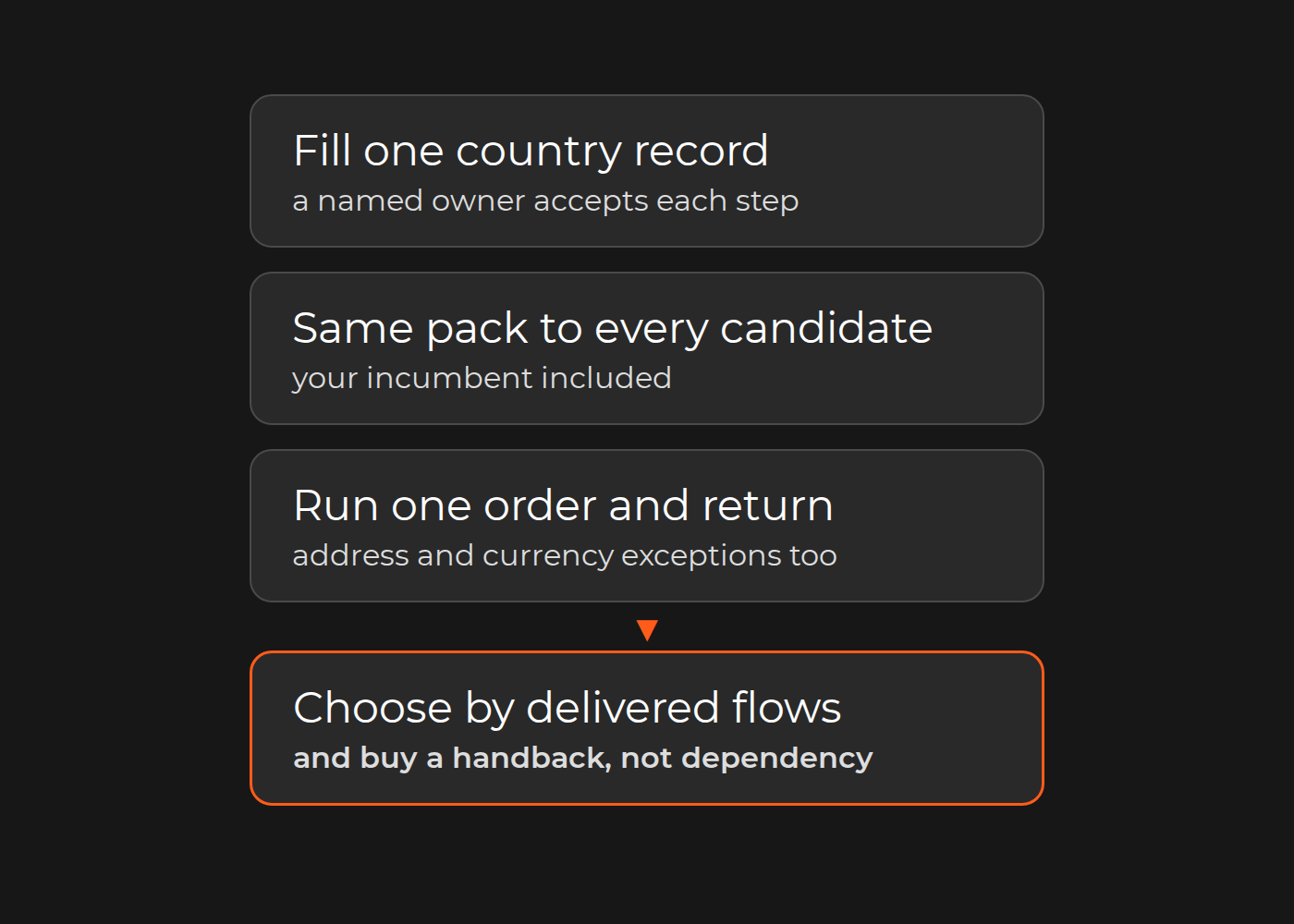
Historical replay tests correctness and handling effort. It cannot establish incremental conversion or revenue. For a live comparison, define eligible traffic/orders, assignment method, observation period, primary measure and guardrails before launch. Where practical, compare contemporaneous randomly assigned groups; account for users who return or cross channels. Shared queues or warehouse capacity can contaminate the comparison and may require assignment at a different level.
Finance and the analyst should distinguish revenue from contribution after discounts, returns, fulfillment and payment costs. Include unresolved cases and delayed returns in the observation plan. A before/after increase during a promotion is not automatically AI ROI.
Stop expansion when correctness worsens, unauthorized actions occur, review queues grow beyond capacity or the measured economics no longer justify operation. The cheapest valid decision may be to retain rules or buy a supported product.
Bring one workflow and its baseline
Discuss a scoped implementation estimate with Dinarys. Start with a non-sensitive workflow description, volumes, current handling effort, systems/versions, exceptions and the business and technical owners. Keep customer records out of the first exchange until a sharing route is approved.
Ask for a work-package estimate with assumptions, exclusions, dependency dates, acceptance evidence and operating responsibilities. That gives the budget signer something more useful than an unsupported price or an optimistic launch date. If the largest package turns out to be commerce-to-ERP exchange, Dinarys' ERP integration services describe that connector and middleware work.
You may share this article
Lassen Sie Profis Ihre Herausforderung meistern
Unsere zertifizierten Spezialisten finden die optimale Lösung für Ihr Unternehmen.