Don't ask whether your development partner uses AI. Ask what evidence each change carries before it reaches your checkout.
If your ecommerce vendor uses AI coding assistants, require four things. First, every AI-assisted change passes the same pull-request review, automated tests and security scanning as any other code, with a named human reviewer. Second, credentials never reach an AI tool, and customer data and production database extracts reach one only inside an approved, contracted setup. Third, matches with public code are checked and their licenses handled. Fourth, the contract names the tools in use and states that code ownership and responsibility for defects do not change because a tool drafted the code. Then accept the work on test results and review records, not on claimed productivity.
NIST's secure development profile for generative AI takes the same line: its practices "do not distinguish between human-written and AI-generated source code, because it is assumed that all source code should be evaluated for vulnerabilities and other issues before use." That profile (SP 800-218A) is written for AI model developers, so this guide uses the base framework, SP 800-218.
This guide is for CTOs buying Magento, Shopware, Shopify or custom development, and agency leads buying white-label ecommerce engineering capacity.
The vendor AI-use control checklist
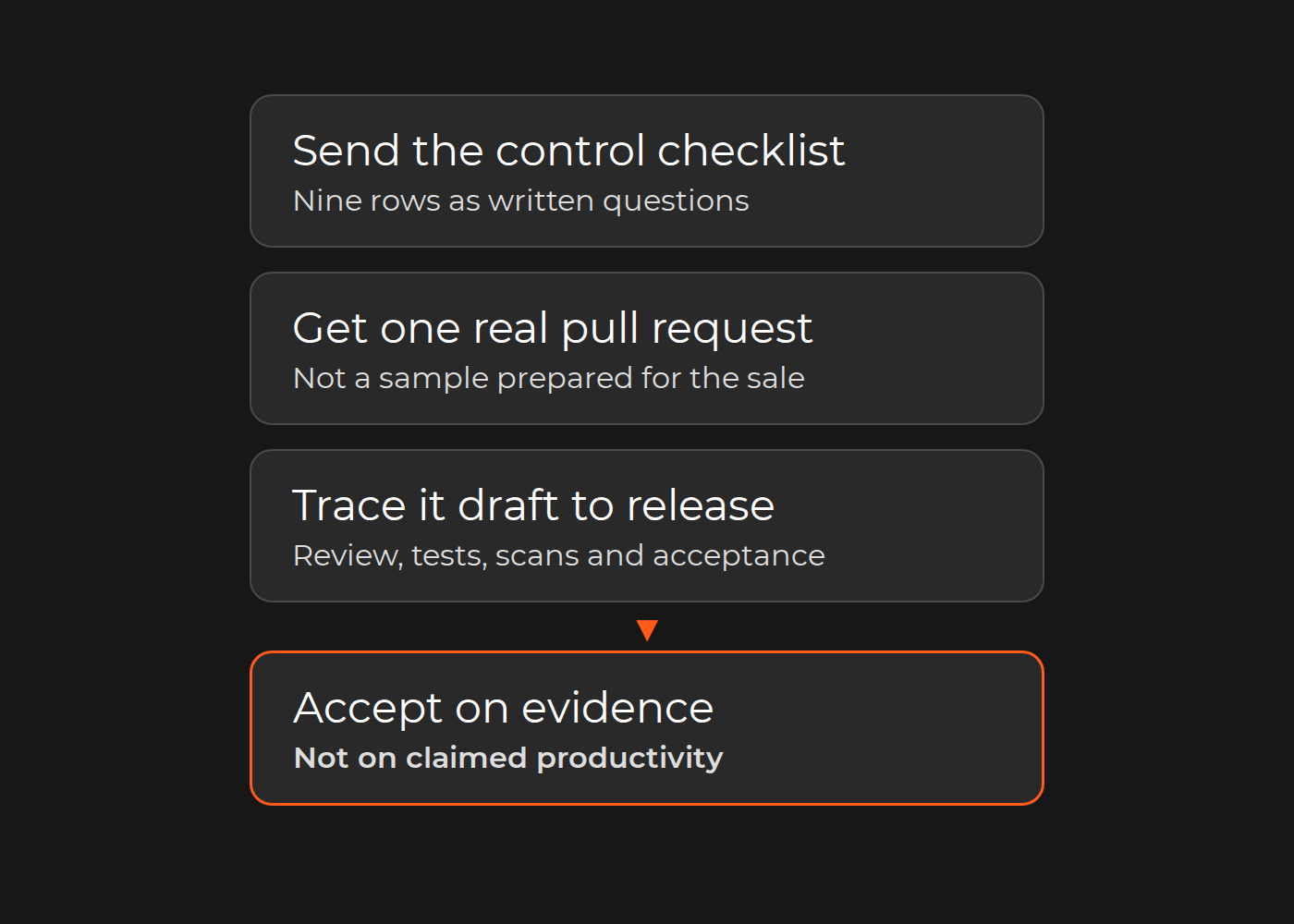
Send the "What to ask for" column to each shortlisted vendor as written questions. Ask for the evidence from one real, recent pull request (redacted if needed), not a sample prepared for the sale. Mark each row shown, promised or missing. A missing answer on data handling, review or accountability should hold the signature until it is fixed.
Control
What to ask for
Evidence in delivery
Red flag
1. Approved tools and data settings
Which AI tools touch your code, on which plan, with which training and retention settings
Written policy naming the tools; admin settings or contract terms for business accounts
Developers pick tools freely, on personal accounts
2. Data handling
A rule that personal data, secrets and production database extracts never go into prompts; which AI providers could receive your data
Policy text; sub-processor list; synthetic test data in the repository
A production dump shared "to give the AI context"
3. Review gate
A named human reviewer on every pull request; no self-approval
Branch protection settings; a merged pull request with the reviewer's name and comments
Authors merge their own changes, or "the AI reviewed it"
4. Tests
Tests for changed checkout, pricing, tax and order code; a regression suite before merge
CI run log; a test that failed before the fix and passes after it
"QA will check it manually later"
5. Security scanning
Static analysis, dependency and secret scanning on every pull request; an SBOM per release
Scan results linked from the pull request; the SBOM file
Scans only before release, or findings closed without triage
6. License and public-code matching
The tool setting for public-code matches, and what the team does when one appears
The setting; a record of a match removed or attributed
"The tool takes care of licenses"
7. AI-drafted migrations and scripts
Data migrations, import scripts and infrastructure changes reviewed and dry-run like other code
Dry-run output on a staging copy; a rollback note
A script from a chat window run straight on production
8. Accountability
The vendor owns defects, whatever tool drafted the code
Contract clause; unchanged warranty terms
"The AI made that mistake"
9. Reported measures
Change lead time, change fail rate, deployment rework rate, defects found in acceptance
A monthly trend against a baseline
"Lines generated" or "% of code written by AI"
A filled example: two Shopware agencies
Fictional and illustrative, not a client case. A fashion retailer asks two Shopware agencies how they use AI. Agency A says it "uses AI to move faster" and shares no process: every row is missing, so the retailer stops there. Agency B answers in writing:
Row
Agency B's evidence
Status
1. Tools
One assistant, business plan, no-training setting
Shown
2. Data
Prompts exclude customer data; test fixtures are synthetic
Shown
3. Review
A real pull request: an AI-drafted plugin change approved by a named reviewer, with a note on a rejected suggestion
Shown
4. Tests
Same pull request: a test failing before the change, passing after
Shown
5. Scanning
Dependency scan; no secret scanning or SBOM yet
Partly shown
6. Public code
Not covered
Missing
7. Scripts
No migration this sprint
Not applicable
8. Accountability
Standard warranty clause
Promised
9. Measures
Change fail rate from sprint three
Promised
The retailer adds two contract clauses, tool disclosure and data handling, asks for secret scanning and a public-code rule before sprint two, and accepts Agency B's first sprint on test and review evidence, not on a velocity claim.
What AI coding assistants change in delivery, and what they don't
Assistants change how fast drafts appear and how much code one developer can propose. They do not change who answers for a pricing bug, what a reviewer must understand, or what your acceptance tests must prove.
Google Cloud's DORA 2024 report found that "AI adoption significantly increases individual productivity, flow, and job satisfaction. However, it also negatively impacts software delivery stability and throughput, reminding teams that fundamentals like small batch sizes and robust testing remain crucial." Its 2025 report, State of AI-assisted Software Development, describes AI's primary role as "an amplifier, magnifying an organization's existing strengths and weaknesses." For a buyer, that means a vendor with weak review will produce unreviewed code faster.
In ecommerce, the risk sits where a small change moves money or orders: checkout, prices and promotions, tax, payment callbacks, order export to the ERP, and customer data migrations. Whatever drafted it, every change should take the same five-stage path.
Illustrative path for every change. The data boundary applies while the developer works with the assistant.
Data and secrets: what must never reach an AI tool
Never paste into an AI tool, or leave where one can read it, API keys and other credentials, payment data, or other clients' code. Customer personal data and production database extracts stay out too, unless your contract approves a specific setup for them.
Settings depend on the plan; GitHub Copilot is one example, not a recommendation. GitHub's documentation states: "GitHub does not use Copilot Business or Copilot Enterprise customer data to train AI models." For Copilot Free, Pro, Pro+ and Max plans, it says that starting April 24, 2026, GitHub "may use your interactions with GitHub features and services—including inputs, outputs, code snippets, and associated context—to train and improve AI models," with an opt-out in personal settings. So ask which plan covers every account that touches your code, and check other tools' terms.
GitHub also says its content exclusion "is not a filesystem security boundary," so secrets belong in a secrets manager, outside the repository and the developer's workspace.
If personal data from your store could reach an AI provider through your vendor, that provider may become another processor in the chain. As the European Data Protection Board summarizes GDPR Article 28(2), "the processor shall not engage another processor without prior specific or general written authorisation of the controller." So either you authorize the provider in writing as a sub-processor (often by approving the vendor's sub-processor list), or a written rule keeps personal data out of prompts. Your DPO should decide which applies.
Review and test gates: one bar for every change
NIST says purchasers can use its Secure Software Development Framework (SSDF, SP 800-218 version 1.1) "to foster communications with suppliers in acquisition processes." Two of its tasks and one implementation example fit AI-assisted work directly:
PW.7.2: "Perform the code review and/or code analysis based on the organization's secure coding standards, and record and triage all discovered issues and recommended remediations …"
PW.8.2: "Scope the testing, design the tests, perform the testing, and document the results …"
PS.1.1, Example 4: "Have the code owner review and approve all changes made to the code by others."
In practice, a named person who can explain the change approves each pull request, and authors cannot approve their own. An AI review tool may comment; it is not the approval. Tests must check business rules, not just run: a promotion that should not stack with a B2B price, a tax rule by country, an order that reaches the ERP exactly once. A test the assistant wrote after the code, restating what the code does, proves little, so ask for one that failed before the change. Checkout, payment and order flows are where ecommerce testing and QA effort should go first.
Security and supply chain: scanning, dependencies and SBOM
A library an assistant suggests is a new dependency like any other. SSDF task PW.4.4 is to "verify that acquired commercial, open-source, and all other third-party software components comply with the requirements, as defined by the organization, throughout their life cycles"; one example is to "build into the toolchain automatic detection of known vulnerabilities in software components." Task PS.3.2 is to "collect, safeguard, maintain, and share provenance data for all components of each software release (e.g., in a software bill of materials [SBOM])."
Licensing, ownership and the contract clauses to add
Assistants can reproduce public code. GitHub's documentation says that when suggestions matching public code are blocked, in most Copilot products Copilot "checks code suggestions with their surrounding code of about 150 characters against public code on GitHub" and hides a match or near match. When matches are allowed, code references "help you review the source and licensing of matching code so you can decide whether to use, attribute, or remove it." The index "does not include private repositories or code hosted outside GitHub," so a setting narrows the license question rather than settling it.
Clauses to discuss with your lawyer (this is not legal advice):
Tool disclosure: the AI tools and account types used on your code; notice before adding one.
Data handling: no personal data, secrets or production extracts in prompts; AI providers that may process your personal data authorized by you as sub-processors.
Same gates: AI-assisted work passes the same review, test and scanning gates; evidence on request.
Ownership: assignment and warranty clauses cover all delivered code, however drafted; known public-code matches disclosed.
Accountability: the vendor fixes defects on the agreed terms, whichever tool produced the code.
Measuring the effect honestly: delivery stability, not lines of code
Lines generated and the share of code written by AI measure volume, not whether changes hold up in production. Ask for DORA's measures instead, one for throughput and two for instability:
Change lead time: "The amount of time it takes for a change to go from committed to version control to deployed in production."
Change fail rate: "The ratio of deployments that require immediate intervention following a deployment."
Deployment rework rate: "The ratio of deployments that are unplanned but happen as a result of an incident in production."
Add defects found in acceptance and compare all four with a pre-change baseline: a vendor claiming speed should show lead time falling while the other three hold steady.
The honest limit: research on AI's effect on delivery is mixed, and no checklist proves code is defect-free; it shows whether the controls exist and run.
What Dinarys' own case pages show
Our Lappu case page (a Shopify store with a custom Laravel and React sticker configurator; the page places the client at the last stage of pre-launch) states that GenAI was used across the software development life cycle to save resources. The team of five included QA and a project manager. The page gives no figure for the saving, and we claim none.
Other case pages show the gates rather than the tools. On the Flash Style project, each of nine sprints included testing of new features, integration testing and payment processing validation, and the final sprint included final acceptance testing. The Untamed engagement page lists CI/CD and DevOps automation, documentation, and a project coordinator responsible for time tracking and reporting. Neither page is evidence about AI use.
When lighter or stricter AI rules apply
Low-risk work. Boilerplate, test scaffolding and documentation may get lighter review; agree which paths qualify. Checkout, pricing and order code never do.
Regulated environments. Some security policies ban cloud AI tools outright; then row 1's answer is "none," and you check that it holds.
License findings. Open-source obligations depend on the code actually matched; treat each match on its facts.
Your own team. In-house developers need the same rules.
Send the checklist and get the evidence for at least one real pull request. Trace the change from draft to release: which tool and account drafted it, who reviewed it, which tests ran and whether one failed first, which scans ran, and who accepted it on staging. Any step you cannot trace is a missing control; agree the fix before signing. For the wider evaluation, see how to choose an ecommerce development partner.
FAQ
Should we ban our vendor from using AI coding tools?
Usually not: a ban is hard to verify and gives up the drafting gains. Require the controls, and ban cloud tools only where your security policy or regulator requires it, with evidence that the ban holds.
Does a no-training setting mean customer data can go into prompts?
No. Retention, access and sub-processing still apply. Keep personal data and secrets out of prompts.
Who owns code that an AI assistant helped write?
Make the contract's assignment and warranty clauses cover all delivered code, however drafted. Whether and how AI-assisted output is protected under your governing law is a question for your lawyer.
What should a vendor report to show AI is helping?
Change lead time falling while change fail rate, deployment rework rate and defects found in acceptance hold steady against a baseline. Not lines of code.