Content
E-Commerce
Jul 08, 2022

AI-Assisted Product Catalog Optimization and Categorization
Time to read: 7 minutes

PIM, mapping rules, or AI: which will remove your catalog queue without introducing incorrect product facts? Use rules where supplier codes and units are explicit and stable. Use PIM workflow where the gap is ownership, approval, or channel versions. Test AI suggestions where descriptions vary and a reviewer can check proposals against supplier evidence. Missing supplier facts still require clarification, not generation.
Compare approaches on the same supplier records, taxonomy, and acceptance rules, including human checking and correction time. The goal is approved, usable product data—not the largest number of generated descriptions. If you have not yet located the delay, start by mapping product launch blockers and waiting time.
What is a category, an attribute, a tag, and a supported claim?
Product catalog optimization organizes facts, categories, media, and channel-ready content so buyers can find and evaluate an item. Four distinctions define what your method must do:
- Category: a place in an agreed classification, such as Furniture → Seating → Dining chairs. Define what belongs in the final, or leaf, category and what does not.
- Attribute: a product fact such as seat material, finish, dimensions, or pack quantity. It may drive a filter without becoming a category.
- Tag: a label with an agreed purpose. A promotional “summer” tag must not silently become a factual “outdoor suitable” attribute.
- Supported claim: a statement traceable to an authorized source for that product and version. A plausible description is not evidence for its own claims.
Keep field ownership, product/media relationships, and channel updates explicit. A PIM is not automatically the authoritative stock or pricing ledger.
How to classify furniture and clothing
Start with what the item is, not its strongest keyword. A chair cover is an accessory, not a chair. A house taxonomy might distinguish dining chairs from bar stools using intended use and a defined seat-height range from supplier specifications. The catalog owner must set those definitions; “seating” alone may not distinguish the leaves.
For clothing, garment type can define Clothing → Tops → T-shirts, while size, fabric, and sleeve length remain attributes. Decide whether audience is a branch or filter according to shoppers' navigation. Do not infer audience from an image or discard a documented unisex classification to force a binary choice.
These are design choices, not taxonomy laws. One store may organize furniture by outdoor use; another may use a filter. Define inclusion, exclusion, and ambiguous-item examples, then version the rules. If two leaves fit, resolve the rule or allow an explicit cross-link. Hold classification when a required distinguishing fact is missing.
Product categorization methods: choose by the work they perform
These approaches can work together. Check the existing setup before adding another system, and identify where each alternative would fail.
- Manual preparation fits small volumes, exception-heavy work, or a one-off task. Compare full effort, consistency, and whether the queue is acceptable—not automation for its own sake.
- Existing PIM or native workflow fits unclear approvals, ownership, or channel versions. Test permissions, required fields, version control, and publication decisions. It cannot supply a fact absent from the source.
- Deterministic mapping and rules fit stable source codes, units, and category relationships. Test unknown codes, conflicts, conversions, and safe rejection. Brittle keyword rules may misclassify products sharing the same word.
- AI-assisted classification or extraction is a candidate for variable descriptions or selected document layouts. Test category errors, unsupported attributes, abstentions, and review workload. A fluent proposal is not publication approval.
- Custom integration addresses a verified nonstandard source or cross-system publication gap. Establish why native functions are insufficient and who will maintain the change as feeds evolve.
Combining methods is reasonable: rules normalize units, AI proposes a permitted category, and PIM manages approval. Missing media links or an unowned approval queue need workflow repair, not more generated copy. For document intake, evaluate the source type you actually have and require field-level source locations; categorization experience does not prove automatic intake across every PDF layout.
For B2B catalogs, keep request-to-quote separate. A categorized item may still need customer-specific visibility, quote fields, and routing to the responsible seller. A classification model does not implement that commercial workflow or establish a price.
One supplier record: check category and description separately
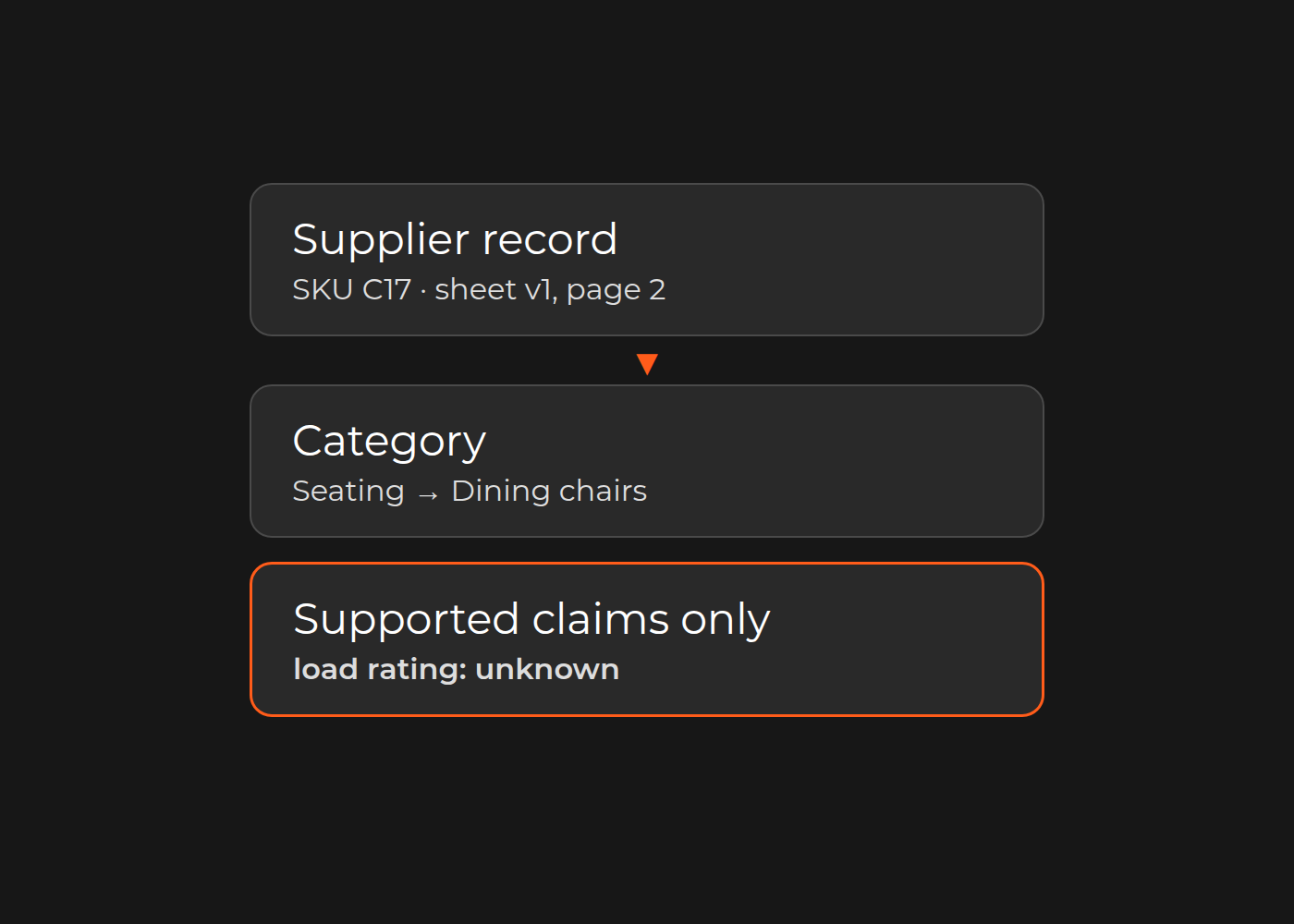
Consider fictional SKU C17. This is an editorial example, not client data.
| Field | Approved value | Supplier-sheet location |
|---|---|---|
| Product type | Dining chair | v1, page 2, heading |
| Seat material | Plywood | v1, page 2, materials |
| Seat finish | Oak-effect | v1, page 2, finish |
| Leg material | Steel | v1, page 2, materials |
| Seat height | 45 cm | v1, page 2, dimensions |
| Load rating / outdoor suitability | Unknown | Not supplied |
Category check: compare type, use, and seat height with the approved dining-chair definition. Assign the leaf only if its required distinctions are supported.
Description check: a supported draft is “Dining chair with an oak-effect plywood seat and steel legs. Seat height: 45 cm.” Reject “solid oak,” “weatherproof,” “ergonomic,” or a load rating unless an applicable source supports it and your claims policy permits it.
Description and category approval are separate. If load rating is mandatory for the target channel, C17 stays blocked until an authorized source supplies it. If optional, omit it. A factual tag needs the same source check as a sentence.
Held records require correction and rechecking. Approval belongs to a version; channel verification and correction history remain part of the process.
Test categorization quality on your own records
Use one family, one source type, and one target channel. The catalog owner approves expected categories and attributes before comparing methods. Include difficult cases: a chair cover sharing the word “chair,” a bar stool described only as “seating,” a variant with dimensions conflicting with its parent, and a missing required field that must prevent publication.
Resolve reviewer disagreement about taxonomy or source first. Keep tuning examples separate from final evaluation records. Save taxonomy, mapping, prompt/model configuration, and source versions. Ask the classifier to select from permitted categories with source-grounded support or flag the record for review. Calibrate a confidence score against reviewed examples before using it to route work.
For every method, retain the original proposal, normalized fields, source references, missing/invalid values, reviewer decision, correction effort, and publication status. Review must not erase the original error. Give each route the same evidence and timing fields: source version and location, taxonomy version, expected category and required fields, method and original proposal, unsupported claims and missing fields, review decision and accepted category, preparation, review and correction minutes, exception owner, channel-ready and verified-live status, and an evidence reference.
Report category agreement with an explicit denominator, abstentions, and coverage across all evaluated records. Also report required-field errors, unsupported claims, subgroup errors, review/rework time, unresolved exceptions, and verified-live outcomes. There is no universal AI accuracy percentage that makes every product claim safe. Agree category-specific risk thresholds before testing.
Count full processing time and cost
In a fictional timing comparison, manual preparation takes six minutes. AI generation takes one minute, review four, and correction two: seven active minutes total. This does not prove AI is generally slower; it shows why comparing one minute with six is incomplete. Apply the same quality and channel checks to both routes.
Budget for schema/taxonomy preparation, integration and evaluation, recurring software/model usage, human checking, exceptions, publishing checks, and maintenance as sources change. Divide relevant operating cost by accepted, channel-ready records, not generated outputs. State the volume and horizon used to allocate setup costs; keep blocked records visible.
What Dinarys's public BigCommerce example establishes
The BigCommerce Theme Design and Catalog Update case describes work for an unnamed office supplies product wholesaler. Dinarys updated product names, SKUs, and images, normalized inconsistent source fields, and performed AI-assisted categorization alongside theme, checkout, and request-to-quote work. Checkout and request-to-quote are separate commerce components, not classification outputs.
The case supports that contribution within a broader commerce project—not classifier accuracy, an AI-processed product count, automatic supplier-PDF intake, or uplift caused by AI. Use it to ask about the relevant component, then evaluate your own records.
Compare quality and complete processing time before choosing the implementation. The catalog owner should own labels and exceptions, IT should verify mappings and destination behavior, and finance or the budget sponsor should include review and maintenance. Retain the existing method if it meets the requirement better.
Dinarys's PIM services and catalog management services are relevant next steps for a verified mapping, review, or controlled-publication gap. Contact Dinarys with a sanitized supplier sample, approved taxonomy, expected SKU answers, channel rules, and completed comparison records. These inputs help define a bounded implementation and its acceptance criteria.


Lassen Sie Profis Ihre Herausforderung meistern
Unsere zertifizierten Spezialisten finden die optimale Lösung für Ihr Unternehmen.