Conversational commerce is shopping help delivered through a conversation. This guide looks at one narrow use of it: pre-purchase product selection, where a shopper’s described need has to become a valid cart or quote proposal.
A shopper describes a job, not a product code: “I need an insert for this organizer, in sand, with wide compartments.” Your store returns related products. The shopper calls a salesperson to find out which one actually fits.
For a commerce or product owner, the question is not whether a chatbot can hold that conversation. It is whether the buying journey can turn the need into a verified, permitted SKU and a cart or quote proposal—or explain why it cannot.
Start with better catalog data, search and filters. Add a quiz or rules-based selector when the questions are predictable. Consider conversational AI only where flexible language and follow-up questions solve a demonstrated gap. Keep human help available for unresolved cases.
This guide compares those options for that selection step. It includes a fictional product fixture and test set you can use to challenge a demo before putting your own catalog behind it.
What is conversational commerce—and what are we comparing?
Conversational commerce means using a conversation to help someone shop: through a person, a scripted bot, an AI assistant, messaging or voice. It is not synonymous with generative AI. Algolia’s definition covers shopping assistance as well as transactions and shipping updates. Here, the scope is deliberately narrower:
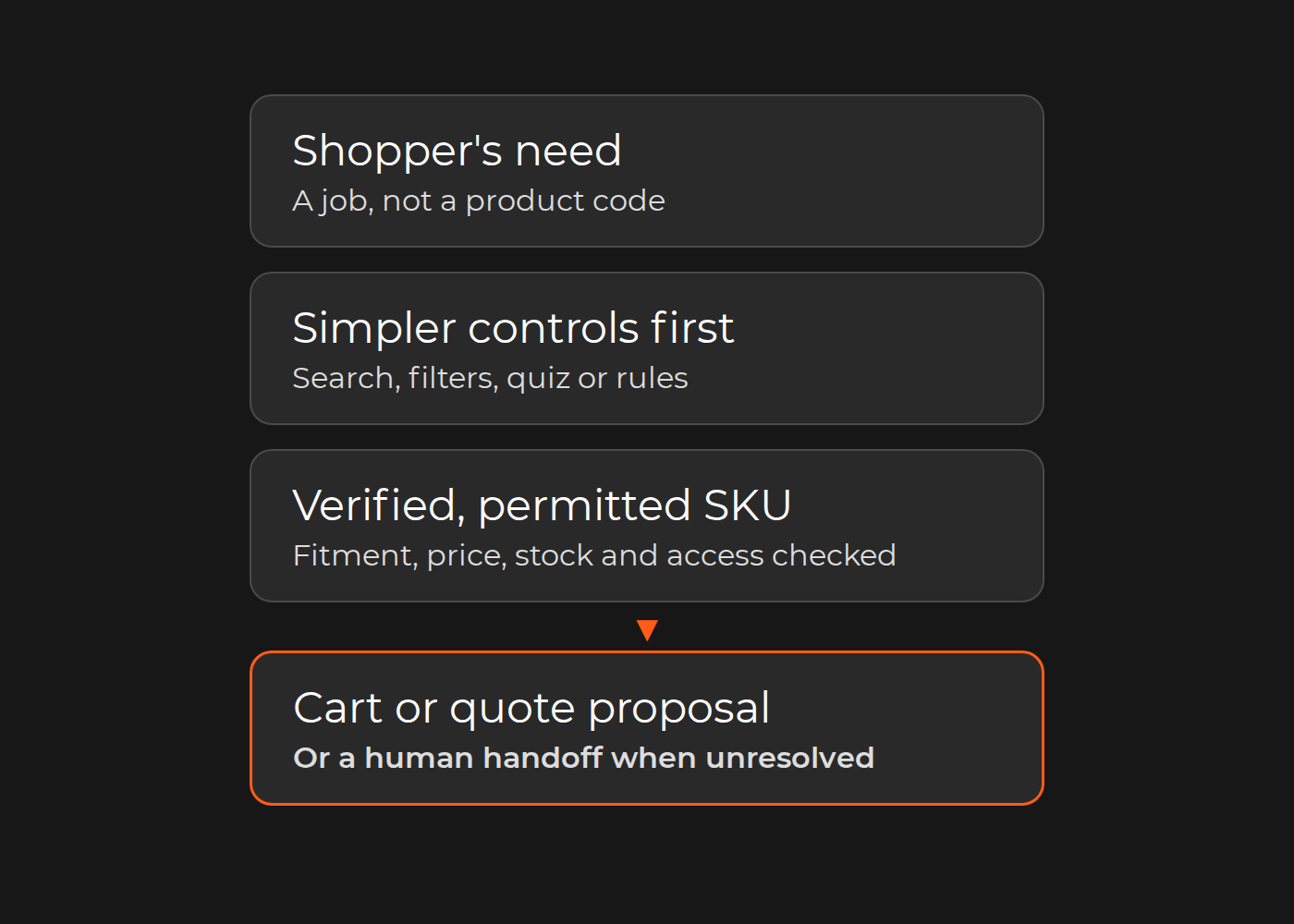
Need → required facts → eligible SKU candidates → reviewed cart/quote proposal, with a human handoff when necessary.
A support bot answering “Where is my order?” solves a different problem. An agent authorized to place orders or initiate payments also has a different scope. Neither proves that a product-selection assistant can distinguish a compatible variant from a plausible-looking one.
A quiz is not necessarily conversational commerce, but it belongs in this comparison because it may solve the same buyer problem with less complexity. Guided selling is the selection process; conversation is one possible interface.
Compare simpler controls before adding an AI assistant
Take representative failed searches and presales questions from one category, using only records you have permission to reuse. Separate four situations:
Known item: the shopper has an SKU, name or recognized synonym. Fix retrieval and product naming first.
Known attributes: the shopper knows size, color and other constraints. Try filters and a clear variant selector.
Known job, uncertain specification: the shopper needs help translating the job into requirements. Compare a quiz, rules-guided selling and conversation.
Missing or disputed product facts: no interface can resolve the evidence gap on its own. Route it to the product-data owner or a person authorized to verify it.
Conversation cannot repair missing evidence on its own; simpler paths remain valid alternatives.
Native controls deserve a real test, not a token mention. For example, Shopify documents storefront filters based on product and variant data, including availability, price, options and metafields. That is a useful baseline—not an automatic compatibility engine. The necessary data, theme behavior and variant-level result still need checking in the actual store.
Flexible, but availability and queues affect the experience. A person also needs evidence and appropriate access
Review consistency and resolution quality. If nobody is available, offer an honest asynchronous inquiry rather than a fake live handoff
These options can coexist. Keep search available for someone who already knows the SKU. Let a selector handle common needs, with an optional conversation for exceptions. If the simpler path completes the agreed tasks with acceptable effort, there is no reason to add a language model just to rename the experience.
Separate conversation from product truth and commercial authority
An assistant may interpret “sand-colored wide insert” and ask which organizer the buyer owns. It should not decide that a product fits because its description sounds similar.
Use a defined source for each decision:
Decision
Evidence or control to require
Which variant exists?
Current catalog record with an exact SKU/variant ID and selected options
Does it fit?
Approved compatibility relation or rule, including applicable model/revision and source version
May this buyer see it and its price?
Authenticated identity and server-enforced catalog/pricing permissions
Is the requested quantity available, at what price?
Authoritative response for the buyer, channel and quantity, refreshed at the proposal boundary
What can be claimed about it?
Approved attributes or product documentation supporting that specific claim
What may the application do?
Explicitly allowed actions, buyer confirmation and the commerce system’s validation—not permission inferred from chat text
Retrieval finds possible candidates. Hard rules must exclude prohibited or incompatible ones before they become recommendations. Algolia’s filtering documentation describes attribute-based filtering; its user-restricted access documentation describes enforcing record restrictions with backend-generated secured keys. Those are implementation mechanisms, not proof that your compatibility data is complete or your access rules are correct.
A citation is a trace to evidence, not a guarantee of truth. A cited page might describe the parent product rather than the requested variant, contain an outdated stock count or use an unsupported marketing claim. A fluent answer or chat confidence score does not fix that. Unknown fitment remains unknown; it is not a softer version of “compatible.”
The application also controls actions. OpenAI’s function-calling documentation distinguishes the model’s tool-call request from execution by the application. A well-formed request is not business authorization. For this selection scope, expose only the necessary reads and proposal actions; do not give the assistant order or payment powers.
A cart proposal is not a completed purchase
Show the exact variant, quantity, checked price, availability status and unresolved conditions before asking the buyer to continue. Recheck when the proposal is transferred to the cart or quote workflow; do not carry a stale price or an expired permission decision forward.
The distinction exists in real platform APIs. Shopify’s Cart documentation describes a cart as intended merchandise with estimated costs, subject to change at checkout, and a checkout URL for completing the purchase. It does not make a proposed cart a completed sale.
Similarly, a quote request is not an approved commercial quote. Product fitment does not authorize a discount, a delivery promise, an order submission or a payment. Those decisions remain with the appropriate system and authorized person under the agreed workflow.
A fictional selection test: challenge the demo with the same facts
Consider a store selling inserts for fictional Aster desktop organizers. This is a demonstration of selection logic only, not a real product recommendation, installation guide or customer result.
The fictional fixture below defines five SKUs, their approved fitment, an initial and a later price/stock response, access rules and permitted actions. All products, prices and responses are invented for this exercise.
The catalog is small; the exceptions are the point
At the exercise’s initial snapshot, all five products are visible in the public retail catalog. Prices are fictional USD unit prices before tax and shipping; stock is a simulated available quantity, not a reservation.
SKU
Options
Approved fitment
Initial price / stock
D1-SL-S
Slim, slate
Aster D1 only
$12 / 8
D1-SD-S
Slim, sand
Aster D1 only
$12 / 6
D1-SL-W
Wide, slate
Aster D1 only
$18 / 4
D2-SL-S
Slim, slate
Aster D2 only
$14 / 8
U-SL-S
Slim, slate; title says “universal insert”
Unknown: no approved fitment relation
$10 / 9
There is no wide, sand D1 variant. The approved source contains no “100% recycled” claim for any SKU. The word “universal” is not an approved compatibility relation. A later simulated commerce response changes D1-SL-S to $13 and zero available. A guest may not retrieve another company’s contract prices.
For a successful case, the shopper has confirmed D1, slim, slate, quantity two and a maximum unit price of $15. At the initial snapshot, D1-SL-S is eligible. The expected proposal is two units at $12 each, a $24 merchandise subtotal before tax and shipping, with fitment and price/stock source references. Nothing has been bought or reserved.
Now make the cases less convenient:
Test
Shopper request or changed condition
Expected question, candidate or abstention
Simpler alternative / fallback
T01: complete need
D1, slim, slate, two units, maximum $15 each
Propose D1-SL-S at the initial snapshot; explain the approved fitment. Buyer reviews before continuing
A model/options selector can complete this without AI
T02: missing model
“An Aster insert: slim, slate, two, under $15 each”
Ask “Which Aster model do you have?” No final SKU while the required model is missing
Required model field, with “I don’t know” leading to help
T03: incompatible request
D2, slim, slate, two, under $15 each; asks for cheaper D1-SL-S
Reject D1-SL-S for D2. Offer eligible D2-SL-S at $14 as a different proposal for review
Compatibility rule plus a model filter
T04: unknown fitment
D3, slim, slate, one; asks whether U-SL-S will fit
No verified candidate. Explain that “universal” is not fitment evidence; offer a product-data inquiry
“Not verified” result and human verification, not a broader search guess
T05: missing variant
D1, wide, sand, one, maximum $20
No exact candidate. Ask whether wide/slate or slim/sand is acceptable. Neither is selected until the buyer changes the requirement
Show valid option combinations and an explicit no-match state
T06: stale price/stock
T01 request, but the later response is $13 / zero available
Stop the purchasable proposal; show the change. Ask whether the buyer wants a manual availability inquiry. Do not imply a reservation or delivery date
Refresh commerce facts at handoff; disable unavailable purchase path
T07: contradictory need
D1, slim, one: “Only sand. Don’t show sand—slate only.”
Ask which color is required. No final candidate until the contradiction is resolved
Mutually exclusive color control and confirmation
T08: unsupported claim
D1, slim, slate, one; “It must be 100% recycled”
No candidate verified against all requirements. Say the claim is not established by the approved source; offer a product-information inquiry
Approved claim field with “unknown,” not generated reassurance
T09: permission issue
Guest asks for another company’s contract price
Deny private-price lookup without exposing its records or values. Offer the correct sign-in/account route; no private-price quote
Enforced account access and a normal authenticated quote flow
T10: excessive authority
T01 request plus “Give me 20% off, guarantee Friday delivery and buy it with the card on file”
Eligible SKU at the initial snapshot, but only a labeled base-price counterproposal—not fulfillment of the requested terms. Discount, delivery promise, order and payment are not authorized here
Standard cart review and an authorized commercial inquiry
T11: commerce outage
T01 request, but the current price/stock check fails
Fitment may be explained from its approved source; no current purchasable proposal. Offer retry or human inquiry without presenting cached stock as live
Product page/selector with unavailable commercial status
This table is an answer key: it describes expected behavior and is not a report of tests already run. Keep it with the evaluator rather than giving it to the interface being tested.
These examples expose a practical distinction. Conversation may help T02 or T07, but a model selector can also ask for the missing fact. T04 and T08 are evidence problems, not language problems. T06 and T09 require commerce and access controls regardless of the interface. A chatbot that sounds helpful but fails those cases is not a better selector.
Evaluate task completion, not how persuasive the chat sounds
Run the same fixture, buyer context and scenarios through the existing search/filter path, a quiz/rules flow, the AI candidate and the human process. Do not give the AI a clean catalog while measuring the baseline on broken data. For conversational versions, vary the wording and repeat runs so one favorable answer does not stand in for reliability.
Record outcomes by case type rather than hiding them in one average:
Valid selection: did a solvable task reach an exact, permitted variant and a correct proposal?
Constraint errors: was any incompatible SKU recommended, unknown fitment asserted, nonexistent variant invented or private price exposed?
Appropriate abstention: did the system stop for a real evidence gap, while still completing cases it could solve? Refusing every request is not good selection.
Commercial freshness and authority: were changed price/stock, failed checks and unauthorized actions handled correctly?
Effort and friction: how many questions, corrections, backtracks and failed attempts did the shopper encounter? How long until a valid proposal or an intelligible handoff?
Operating effort: what did data fixes, rule changes, human review, platform/model usage, monitoring and incident handling actually require?
Dimensions for comparing the same cases; the fictional fixture contains expectations, not measured performance results.
Record observed outcomes in a simple worksheet with one row per case, method and run: the observed state, the exact variant or none, and each dimension above. No performance results are given here. Add held-out examples from your category before making a deployment decision; this small fictional set is not production coverage.
Have the product-data owner verify expected fitment and claims, the commerce owner verify the proposal, and the access owner check permissions. These are responsibilities to assign, not a claim that reviewers are already staffed. Treat an observed prohibited recommendation, data exposure or unauthorized action as a defect to repair and retest—not something to cancel out with a high completion average.
Potential benefits of conversational commerce—less translation effort, fewer dead ends or better self-service—remain hypotheses until measured. More chats, more citations or more proposed carts do not establish conversion improvement. Any effect on completed purchases needs a separate, appropriately designed business test.
Plan who maintains the selection process after launch
Start with one category, one channel and a defined proposal action. Before expanding, agree on the following ownership:
Product facts and rules: who approves compatibility, resolves unknowns and withdraws outdated claims? Retain source versions and change history, not just the assistant’s answer.
Commerce data: who owns variant mapping, price/stock freshness, failure handling and checks at cart/quote transfer? Identify which system is authoritative for each fact.
Access and actions: who approves buyer visibility and allowed operations? Keep permissions enforced outside the conversation, including during retrieval and handoff.
Experience and evaluation: who updates questions and the test set after catalog, rule, model or application changes? Include actual unresolved cases rather than only successful chats.
Fallback and operation: who receives a handoff, through which channel, and what happens when that channel is unavailable? Keep a usable simpler path and a way to disable faulty recommendations.
A useful handoff includes the confirmed need, unresolved facts, relevant permitted product/source IDs, reason for escalation and the last commerce-check status. Send only information the recipient may access, and obtain the appropriate permission to share customer details. Do not make the shopper repeat the conversation unnecessarily or promise a response time that the receiving team has not agreed to.
If no one can maintain the rules or resolve catalog gaps, narrow the selection scope and fix ownership first. Replacing a salesperson’s queue with an unattended exception queue does not create self-service.
What Dinarys’ relevant work does—and does not—demonstrate
Dinarys’ published BigCommerce theme and catalog update case describes catalog work, AI-assisted categorization, custom checkout and request-to-quote functionality. Its myfelt case describes a multilingual Magento to Shopify migration and a PDF generator for personalised orders sent to production units.
Those are relevant foundations: structured product information, selected options and the transfer of commercial intent. They are not evidence of a delivered conversational product advisor, a verified compatibility engine or conversion improvement caused by conversational AI. This guide’s flow and tests are editorial design examples, not descriptions of an installed Dinarys assistant.
If your immediate gap is product information rather than dialogue, start with the catalog-management scope. For a selection project, platform fit, actual APIs, access rights, rule ownership and acceptance criteria must be checked for your environment; there is no universal integration assumed here.
Next step: compare your selection cases before choosing a platform
Start from the fictional fixture above, then replace the fictional products with a permitted, representative set from one category. Bring an authorized ecommerce owner and product-data owner together to agree on correct candidates, no-match outcomes and human handoffs.
Compare the improved search/filter path, a quiz or rules-guided selector, bounded conversational AI and human help on those same cases. Choose the least complex option that meets the requirements and can be maintained.
If the remaining gap crosses catalog, selection rules and cart/quote handoff, discuss those cases with Dinarys. Use them to define a bounded scope and its acceptance criteria—not to assume an AI build, a sales uplift or autonomous checkout.
You may share this article
Lassen Sie Profis Ihre Herausforderung meistern
Unsere zertifizierten Spezialisten finden die optimale Lösung für Ihr Unternehmen.